Four Titles Decided, 82 Cars, and a 2024 Date for Jerez
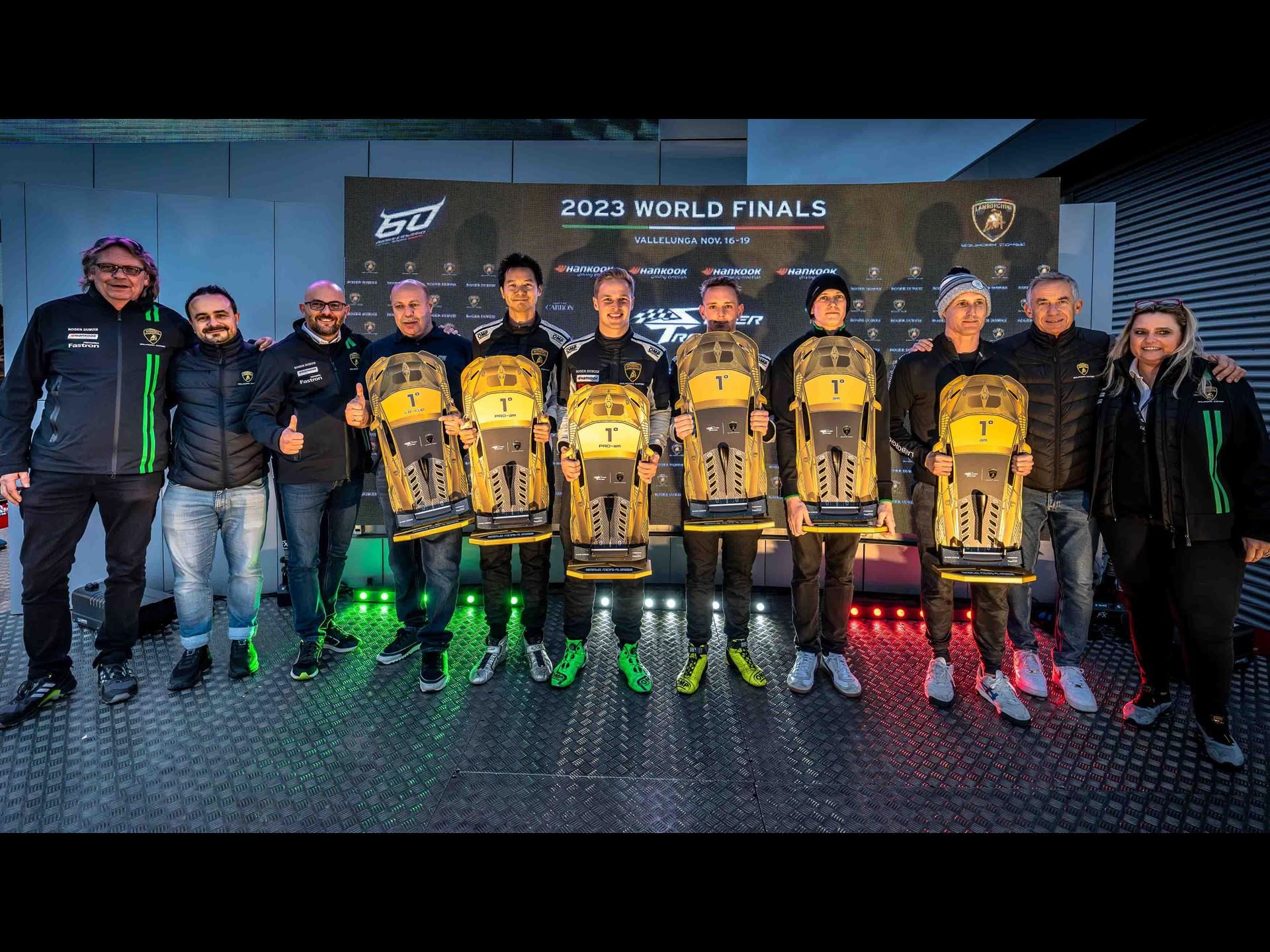
Lamborghini’s 10th Super Trofeo World Finals concluded at the Autodromo Vallelunga Piero Taruffi with a record 82 cars on the entry list, smashing the previous high of 65 set at Portimão the year before. Across two days of racing in front of over 10,000 spectators, champions were crowned in all four categories: Amaury Bonduel (BDR Competition) secured the Pro title, Alex Au and Frederik Schandorff (Target Racing) claimed Pro-Am honors, Anthony McIntosh and Glenn McGee (Precision Performance Motorsports) earned the Am championship, and Shota Abkhazava (ArtLine Racing) won the Lamborghini Cup by a single point.
During the Saturday evening prize ceremony, Lamborghini confirmed Jerez de la Frontera as the host for the 2024 World Finals, bringing the event back to the Spanish circuit that previously staged the finale in 2019.
The results alone would have made for a strong weekend. Yet the most compelling story from Vallelunga belonged to Am champion Glenn McGee, a former sim racing world champion who made his real-world Super Trofeo debut only at the start of the 2023 season and walked away with a global title. His presence on the top step says something specific about what the Super Trofeo series is becoming: a racing ladder open enough to reward talent regardless of where it was first proven.

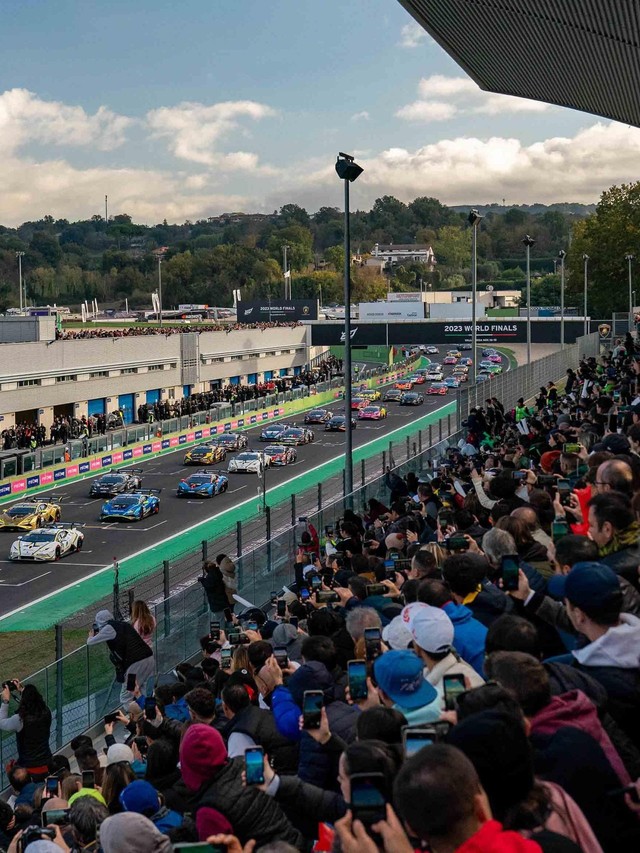
A massive crowd watches as Lamborghini Huracán Super Trofeo EVO2 cars line up on the starting grid.
From iRacing Alien to World Finals Champion
Glenn McGee’s path to Vallelunga reads like a screenplay that would get rejected for being too neat. He built his reputation on iRacing, where he earned the informal label of “Alien” for his speed, and won the iRacing/Mazda championship. According to one report, that virtual dominance led to his winning the Mazda Road to 24 Shootout in 2015, which came with a $100,000 scholarship and a seat in the Global Mazda MX-5 Cup series. From spec Miatas to Lamborghini Super Trofeo machinery is a significant leap, but the core skill set, racecraft under pressure and the ability to extract tenths from an unfamiliar car, clearly transferred.
McGee made his Super Trofeo North America debut at the start of 2023. By November, he and co-driver Anthony McIntosh were standing on the top step at the World Finals. In Race 1, McGee qualified on pole and, after losing the lead briefly to Julien Piguet at the start, fought his way back to the front with committed overtakes at turns four and eleven. The pair sealed the championship with a third-place finish in Race 2, where McGee started seventh and managed the chaos around him with the composure of someone who had already processed thousands of simulated race starts.
“I remember being a kid and sitting on my couch driving against the world’s best sim drivers and only ever dreamed of doing the real thing. And to come up against these guys and become not only a sim racing world title holder and a real-world title holder is an incredible feeling.”
Lamborghini says McGee is the first esports and iRacing champion to earn a real-world title at this level of manufacturer-backed competition. Whether or not that claim holds up to every possible interpretation, the broader point stands: the Super Trofeo series accepted a driver whose primary credential was virtual speed, and he proved competitive immediately. That accessibility is worth more to Lamborghini’s brand than another professional driver collecting another trophy.

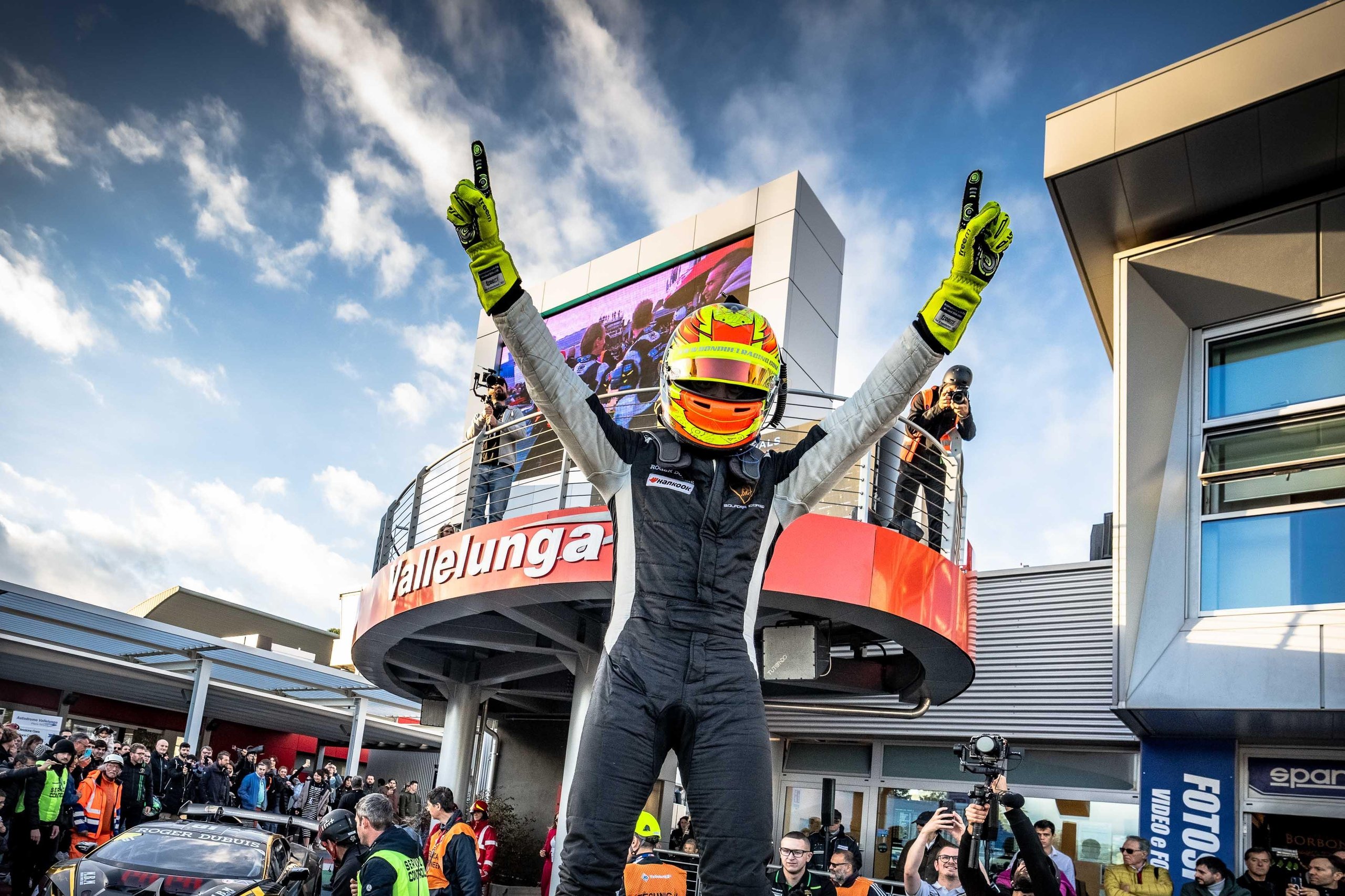
A Lamborghini Huracán Super Trofeo EVO2 car crosses the finish line under the waving checkered flag.
Record Entries and the Drama That Comes With Them
An 82-car field does not produce clean racing, and Vallelunga delivered accordingly. The Pro class saw Mattia Michelotto’s VSR entry tagged at the hairpin by Nico Jamin in Race 1, dropping the defending champion to the back of the field. Michelotto then compounded the damage by jumping the pit-lane red light, earning a drive-through penalty that ended any hope of a second consecutive World Finals crown. Bonduel, by contrast, kept his composure throughout both races, winning Race 1 by 1.1 seconds over Brendon Leitch and finishing third in Race 2 to wrap up the title.
The Pro-Am battle carried its own subplot. Jonathan Cecotto took pole for Race 1 and led for half a lap before a wild moment at turn four dropped him down the order. Schandorff and Au capitalized, navigating safety car restarts and pit-stop strategy to claim victory. In Race 2, Schandorff fended off Loris Spinelli through the opening stint, building just enough of a gap to protect Au during the second half. Schandorff, now a two-time World Finals winner, described the tactical calculus plainly: he knew Target Racing had the pace, and his job was to prevent any desperate late move from the opposition.
The Lamborghini Cup category came down to a single point. Abkhazava started Race 2 from pole and held on despite losing the lead to Doyle with two laps remaining. His championship rival, Jonathan Hirshberg, saw his hopes evaporate when a multi-car incident at turn 10 took out his RaceTronics entry. In a category designed for gentleman drivers, the margins were razor-thin. Every class, in its own way, reinforced the same lesson: the Super Trofeo grid is deep enough now that talent and composure matter as much as budget.

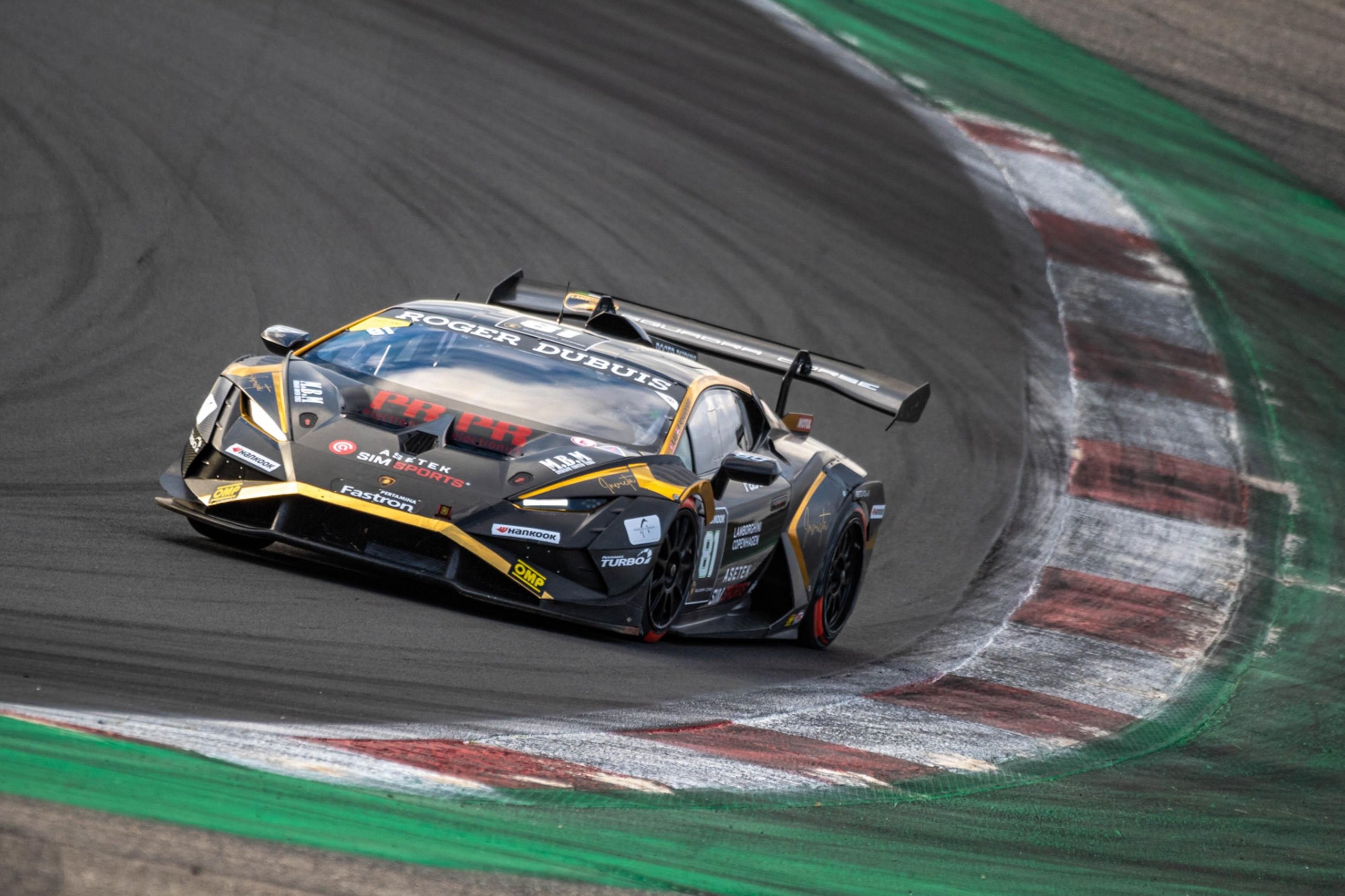
The blue Lamborghini Huracán Super Trofeo EVO2 car navigates a turn on the track with precision.
What Super Trofeo Actually Is: Lamborghini’s Talent Funnel
The World Finals bring together the three regional Super Trofeo championships from Europe, North America, and Asia into a single end-of-season event. The format works as both a spectacle and a scouting exercise. Drivers who prove themselves in the Am or Pro-Am ranks can, in theory, progress toward GT3 competition and beyond, making McGee’s story not just a feel-good narrative but a proof of concept for the entire ladder. The series runs exclusively on the Huracán Super Trofeo EVO2, which Car and Driver estimates produces 612 horsepower and weighs roughly 2,950 pounds.
For prospective entrants wondering about the financial commitment, one report indicates a base price of $360,000 for the car itself, before factoring in the season’s operational costs: tires, transport, crew, entry fees, and the inevitable repair bills that come with close-quarters single-make racing. The Super Trofeo occupies a specific niche in the customer racing landscape, sitting below the GT3 tier in outright performance but offering a structured, manufacturer-supported environment where the car is the constant and the driver is the variable.
Ferrari runs a comparable program with its Challenge series, and Porsche fields the Carrera Cup as its equivalent single-make ladder. The key differentiator for Lamborghini is scale relative to its production volume. Filling 82 grid slots for a World Finals event, drawn from a brand that builds far fewer cars annually than Porsche, suggests the Super Trofeo community punches above its weight in terms of engagement. Owners who buy Huracáns for the road see the racing series as validation that their car’s engineering carries genuine track credibility. When a sim racer can step into that same car and win a world title in his debut season, the validation runs both ways.
Jerez 2024 and the Bigger Motorsport Picture
The choice of Jerez de la Frontera for 2024 keeps the World Finals on European soil while rotating away from Italy. Jerez carries strong associations with MotoGP and Formula 1 testing, lending the event a motorsport gravitas that benefits Lamborghini’s positioning. The circuit previously hosted the 2019 World Finals, so logistics and local infrastructure are proven quantities.
The Super Trofeo series also feeds into Lamborghini’s expanding motorsport ambitions. The Temerario GT3, which Road & Track reported is ready for global racing from 2026, will eventually replace the long-serving Huracán GT3 in professional competition. A Temerario Super Trofeo variant will follow, meaning the entire customer racing ladder will transition to the new platform. For current competitors, this transition means adapting to a twin-turbo V8 with hybrid assistance after years of learning the naturally aspirated V10’s characteristics. The driving style required will change, and some of the skills honed on the EVO2 will need recalibration.
Lamborghini’s higher-tier LMDh effort with the SC63 faced well-documented struggles, and Jalopnik reported that the program was shelved after two seasons without a headline result. That reality makes the customer racing programs, Super Trofeo and GT3, even more important as the visible, results-producing face of Squadra Corse. Vallelunga’s record grid and its sim-racer-turned-champion narrative gave Lamborghini exactly the kind of story that keeps the racing community invested. Whether the Temerario era can sustain that momentum will depend on how smoothly the platform transition unfolds and whether the new car preserves the raw, accessible character that made the Huracán Super Trofeo a compelling entry point for drivers at every level, from gentleman racers to iRacing aliens.

The Lamborghini Huracán Super Trofeo EVO2 car accelerates down the track with the iconic logo in view.
Gallery