Paul Ricard Hosts the 15th Season of Lamborghini’s One-Make Series
Forty-eight identically specified Lamborghini Huracán Super Trofeo EVO2s lined up at Circuit Paul Ricard in the south of France to open the 2023 Lamborghini Super Trofeo Europe season, making this one of the largest grids in the championship’s fifteen-year history. The entry list alone tells a story. Spread across Pro, Pro-Am, Am, and Lamborghini Cup classes, it contains seasoned GT professionals, former DTM racers, LMP veterans, and teenagers making their first competitive laps in a 620-horsepower race car. It also contains a paraplegic driver racing a hand-controlled Huracán and the first Egyptian competitor the series has ever fielded.
Paul Ricard’s 5.842-kilometer, 15-turn layout rewards precision over outright bravery, a useful equalizer for a field this varied. Six double-header rounds fill the revised calendar after a longer-than-planned off-season pushed the opener back by a month: Spa-Francorchamps, the Nürburgring, Valencia, and two events at Vallelunga follow, with Vallelunga also hosting the annual Lamborghini Grand Finals in November.
Lamborghini first established the Super Trofeo in 2009. Fifteen editions later, the series has grown into something more than a gentleman-driver championship or a marketing exercise. The 2023 grid reads like a short anthology of ambition, adaptation, and barrier-breaking, and the stories embedded in it reveal as much about where Lamborghini’s customer racing operation is heading as any technical specification sheet.

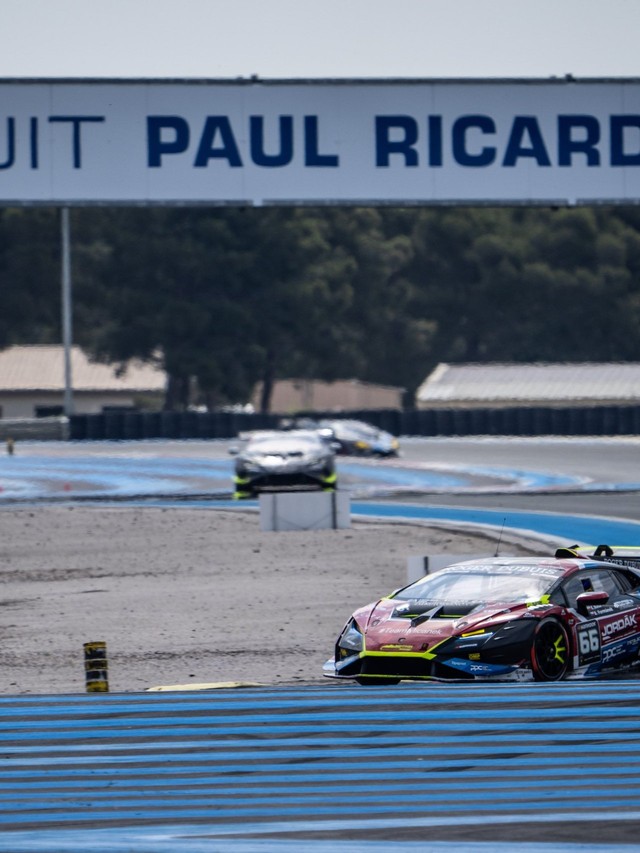
A Lamborghini Huracán Super Trofeo EVO2 takes a corner at the iconic Circuit Paul Ricard.
The Grid’s Most Compelling Stories: A Hand-Controlled Huracán and a 16-Year-Old Pioneer
Nigel Bailly’s Am-class entry alongside Wilfried Cazalbon at CMR represents a genuine engineering and human achievement. Paralyzed from the waist down after a motocross accident in his teenage years, Bailly will race the first hand-controlled Huracán Super Trofeo EVO2 in competition. The adaptation is not a token gesture. According to reports, the car’s FIA-homologated modifications include a mechanical handbrake on the right side, pushed to engage the brakes, and an electronic throttle behind the steering wheel, pulled to accelerate. Bailly steers with one hand while managing throttle with the other, retaining the standard sequential shift paddles.
His motorsport career began in 2017 at age 27 in a hand-controlled Renault Clio Cup car. He progressed through GT3 racing with Bentley before the manufacturer curtailed its program, and the transition to Lamborghini’s Super Trofeo was pragmatic. He debuted the hand-controlled Huracán at the 2022 Grand Finals in Portimão before committing to a full 2023 campaign. That trajectory underscores something important about the series: its structure accommodates competitors whose paths to the grid look nothing like the conventional feeder-series ladder.
At the opposite end of the experience spectrum, 16-year-old Ibrahim Badawy becomes the youngest driver and first Egyptian competitor in Super Trofeo history, racing with Lamborghini Roma by DL Racing. Lamborghini’s willingness to field a teenager on a grid alongside former DTM racers and LMP veterans says something about its ambitions for global reach.
Charlie Martin, competing with Brutal Fish Racing alongside team owner Jason Keats in the Lamborghini Cup, became the first transgender driver in the Super Trofeo’s North American championship last year. The move to the European series extends that presence on a larger stage. Former W Series driver Abbie Eaton, partnered with Daan Arrow in the newly formed Rebelleo Motorsport team, adds another dimension to a grid that, for a gentleman-driver series, looks increasingly professional and diverse. Together, these entries illustrate the kind of grid Lamborghini’s customer racing operation is actively building: one where the barriers to entry are financial and competitive, not biographical.
The Huracán Super Trofeo EVO2: Why the Machine Still Matters
Every car on this grid runs the same specification: a 5.2-liter naturally aspirated V10 producing 620 horsepower, sent to the rear wheels through a sequential six-speed Xtrac gearbox. That mechanical equality is the foundation on which every human story on the grid gains meaning. When Nigel Bailly races wheel-to-wheel with a former DTM driver, the car beneath them is identical. The results depend on preparation and talent, not machinery.
The EVO2 arrived for the 2022 season with enlarged 390-millimeter front steel brake discs (up from 380 mm) and what Lamborghini describes as radical aerodynamic refinements designed by Centro Stile, including hexagonal LED headlights referencing the Huracán STO and rear light clusters that pay tribute to the Countach. Carbon-fiber bodywork replaced plastic in the side panels and rear aerodynamic appendages, keeping weight down while the large rear wing and diffuser generate the downforce that makes these cars genuinely quick through Paul Ricard’s faster sections.
The car’s significance extends beyond its spec sheet. Lamborghini celebrated the 400th Huracán racing car in April 2021 and set a target of reaching 500 units with the EVO2 within a few years. That production volume is not trivial for a customer racing program; it represents a genuine industrial commitment to keeping grids full across three continental championships and the annual World Finals.
Maurizio Reggiani, Lamborghini’s Chief Technical Officer, once described Super Trofeo as the best testing ground for technical and aerodynamic solutions destined for both road and GT cars. The observation carries weight when you consider how much of the Huracán STO’s visual and aerodynamic language was refined through competition. With the Temerario GT3, which Autoblog reports will be Lamborghini’s first competition car fully designed, developed, and built in-house, the lessons learned from a decade of Super Trofeo operations become the foundation for Squadra Corse’s next chapter.

The number 92 Lamborghini Huracán Super Trofeo EVO2 races past the pit lane at Circuit Paul Ricard.
Super Trofeo as Lamborghini’s Strategic Proving Ground
One-make series occupy a peculiar position in motorsport: part marketing exercise, part genuine competition, part bridge between track-day enthusiasm and professional racing. Lamborghini’s version, split across Europe, Asia, and North America with a unifying World Finals, functions as all three simultaneously. Stephan Winkelmann, Lamborghini’s CEO, positioned the Huracán as one of the brand’s biggest commercial successes and credited the Super Trofeo series with amplifying that.
The commercial logic is straightforward. Every team running an EVO2 purchased it from Lamborghini. Every set of tires, every replacement part, every engine rebuild flows through the Squadra Corse supply chain. The series generates revenue and brand engagement that a conventional advertising campaign cannot replicate. For teams and drivers, it offers a structured, cost-controlled environment where equalized machinery means results hinge on preparation and talent.
Competitors like Ferrari (with its Challenge series) and Porsche (with the Carrera Cup) understand this equally well, but the difference for Lamborghini is the relative youth of its program. First established in 2009, Super Trofeo is younger than Porsche’s one-make infrastructure by decades. The pace at which Lamborghini has built grid sizes and global reach suggests the company views customer racing not as heritage maintenance but as active brand construction. A 48-car grid that includes a hand-controlled Huracán, a 16-year-old Egyptian, and multiple former champions is not an accident. It is the product of a program deliberately designed to welcome the widest possible range of competitors while maintaining genuine sporting credibility. The Temerario GT3 program, whenever it replaces the current Huracán GT3 EVO2 in top-tier competition, will inherit an operational knowledge base and a customer network that simply did not exist fifteen years ago.
Who to Watch Across the Four Classes
The Pro class features several credible title contenders. Oregon Team fields Marzio Moretti and Sebastian Balthasar, a pairing Lamborghini positions among the favorites. Last year’s runner-up, Amaury Bonduel of BDR Competition, returns with unfinished business, while Brendon Leitch of Leipert Motorsport competes as a solo entry in the European Pro field for the first time. Mattia Michelotto, the 2021 Grand Finals winner, joins VS Racing alongside Italian GT Cup race winner Gilles Stadsbader, forming a youthful combination with genuine pace. Experienced hands like former DTM racer Yelmer Buurman at Iron Lynx add depth to a field where the margins between the top five or six entries could be negligible.
Pro-Am may be the most competitive class on paper. Last year’s Pro co-champion, Loris Spinelli, drops into Pro-Am alongside Andrzej Lewandowski at VS Racing, a pairing that won the Pro-Am Grand Finals title together in 2019. Karol Basz, another Grand Finals winner, stays with Mičánek Motorsport. Frederik Schandorff, the 2019 Grand Finals winner, returns with Target Racing. The concentration of former champions in a single class means the Pro-Am battles could produce the weekend’s best racing.
In the Am class, Gabriel Rindone of Leipert Motorsport enters after two consecutive runner-up finishes, desperate for a breakthrough. Pierre Feligioni at Boutsen Racing, joined by experienced GT3 racer Renaud Kuppens, represents another strong combination. And then there is Bailly, whose presence in the same class as these seasoned competitors is perhaps the most telling measure of how seriously his campaign should be taken.
The Lamborghini Cup, designed primarily for newcomers, still features the formidable Gerard van der Horst, a four-time class champion aiming for a fifth title. The father-son combination of Luciano and Donovan Privitelio, who moved from FFF Racing to Iron Lynx, will target the title after guest appearances in GT2 European Series and Italian GT earlier in the year.

The number 78 Lamborghini Huracán Super Trofeo EVO2 demonstrates its agility on the track.
Schedule and How to Watch
The Paul Ricard weekend opens with two free practice sessions on Friday. Saturday brings a pair of 20-minute qualifying sessions, followed by Race 1 at 13:25 CET. Race 2 takes place on Sunday at 10:05 CET. Both races will be live-streamed on the Lamborghini Squadra Corse YouTube channel and Facebook page, which remains one of the more accessible ways to follow a factory-backed racing series without a paid subscription.
For anyone weighing whether the Super Trofeo is worth following, the practical answer is that it offers something increasingly rare in motorsport: identical machinery, a naturally aspirated V10 soundtrack that will not survive the transition to Lamborghini’s next-generation platform, and a grid where a paraplegic driver racing a hand-controlled car shares the same track as a 16-year-old making his first competitive start. The racing itself matters, but the texture of who shows up and why they are racing gives this series a character that pure performance metrics cannot capture.
Gallery


