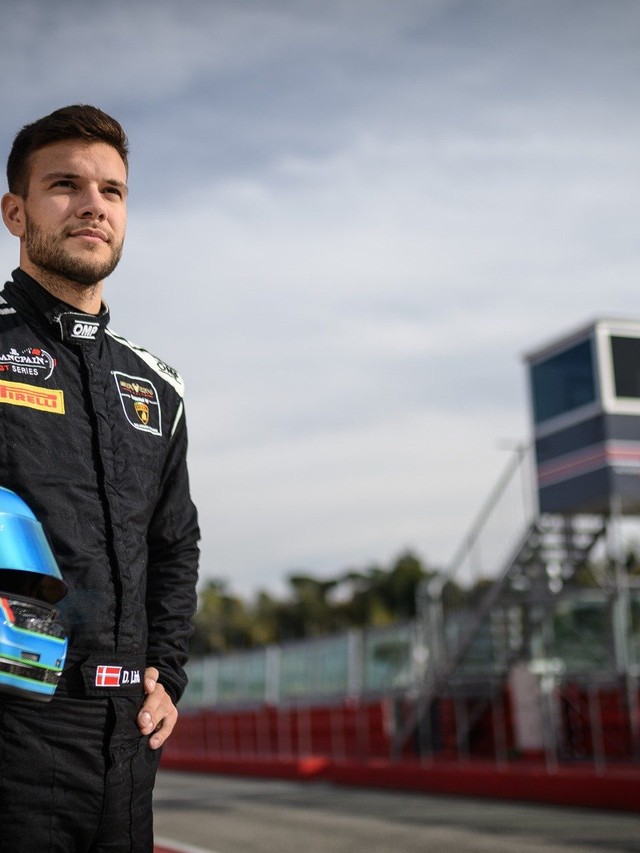
Lamborghini’s First Homegrown Factory Driver for 2019
When Lamborghini Squadra Corse announced its 2019 factory driver roster, one name stood apart from the rest. Danish racer Dennis Lind was not simply joining the lineup; he was arriving as the first driver ever to progress through the brand’s own young driver development programs all the way to full factory status. In a motorsport landscape where manufacturer backing can define careers, that distinction carries real weight. It validates a system Lamborghini built from scratch and signals to every aspiring GT racer in the Super Trofeo paddock that the pathway upward is genuine.
Lind takes his place alongside Mirko Bortolotti, Andrea Caldarelli, Marco Mapelli, and Giovanni Venturini, with Phil Keen and Franck Perera also joining as new additions. For 2019, Lamborghini confirmed Lind will compete in the Blancpain Endurance Series in Europe, placing him squarely in one of GT racing’s most demanding arenas.
Giorgio Sanna, Head of Lamborghini Motorsport, framed the promotion in terms that went beyond individual achievement:
“The arrival of Dennis in our factory squad is not only a demonstration of his qualities as a driver and a young man, but is also proof that our dedicated young driver programs contribute to their professional growth.”
That last phrase is the one worth pausing on. Sanna is not simply praising Lind. He is publicly staking the credibility of Squadra Corse’s entire junior infrastructure on one driver’s trajectory.
The Squadra Corse Pathway: How Lamborghini Nurtures Racing Talent
Most supercar manufacturers run some form of junior racing initiative. What makes Lamborghini’s approach distinctive is its structured, tiered architecture, designed to filter talent through increasing levels of competition before a driver ever earns factory consideration.
According to Lamborghini’s own program documentation, the system operates across three tiers. The Super Trofeo Junior Driver Program targets drivers aged 25 or under competing in one of the three regional Super Trofeo championships (Europe, North America, and Asia). Standout performers advance to the GT3 Junior Driver Program, where they race the Huracán GT3 in international competition. The highest rung, the Young Professional Driver roster, provides continued Squadra Corse support as drivers compete at the professional level.
The selection process reveals how seriously Lamborghini treats this pipeline. Rather than relying solely on age cutoffs, the program evaluates drivers through a coefficient ranking across continental championships, with assessments conducted by the Scuola Federale ACI Sport’s chief instructor alongside existing factory drivers. Candidates are judged by the very people they hope to join, adding a layer of competitive rigor that pure data analysis cannot replicate.
For Lind, the path started in 2016 at the Super Trofeo level. Winning both European and world titles in his debut season earned him a spot in the GT3 Junior Program. Strong results in dedicated GT3 shoot-out tests, including a top performance at the evaluation held after the Super Trofeo world final at Vallelunga, cemented his candidacy. The entire progression took roughly two and a half years, remarkably fast for a pipeline designed to be methodical. Yet speed was never the point. The point was that every rung of the ladder existed, and Lind climbed each one on merit.
Lind’s Triumphs: From Super Trofeo Champion to Blancpain GT Series Asia Victor
Lind began racing with Lamborghini in 2016 and immediately demonstrated the consistency that development programs are designed to identify. Winning both the European and world titles in the Super Trofeo in his debut season answered the fundamental question any factory team asks of a junior driver: can this person win when it matters?
The GT3 Junior Program represented a significant step up in complexity. GT3 racing demands a broader skill set than one-make series competition: tire management across longer stints, the ability to share a car effectively with a co-driver, racecraft in mixed-class traffic, and the discipline to extract consistent pace without destroying equipment. Lind’s 2018 campaign in the Blancpain GT Series Asia, sharing the FFF Racing Huracán GT3 with Martin Codric, provided the proving ground. Securing that championship demonstrated he could perform at the international level with a professional team, not just within Lamborghini’s controlled junior environment.
What often gets overlooked in driver announcements is the shoot-out element. After the Super Trofeo world final at Vallelunga, Squadra Corse held dedicated evaluation tests on the Monday following the race weekend. Lind posted the fastest times. In a sport where tenths of a second separate careers, topping a direct back-to-back comparison against your peers removes ambiguity from promotion decisions. Each result reinforced the same conclusion: the pipeline had identified genuine talent, and that talent had repaid the investment at every stage.
What Factory Driver Status Means for Lamborghini’s Motorsport Future
Factory driver status in GT racing carries implications that extend far beyond a name on a car door. A factory driver represents the manufacturer at the highest level of customer-facing competition, tests development parts, provides engineering feedback that shapes future race cars, and serves as the benchmark against which customer teams measure their own drivers. In Lamborghini’s case, the factory squad also functions as the brand’s most visible motorsport ambassadors, appearing at client events, Super Trofeo rounds, and manufacturer showcases.
Promoting Lind from within rather than signing an established name from outside the organization sends a specific message to the broader GT racing ecosystem. It tells prospective Super Trofeo entrants and their sponsors that the junior programs offer a real career outcome, not just a marketing exercise. For a one-make series that depends on grid numbers and team participation fees for its financial model, that credibility is worth more than any single race result.
Lamborghini’s motorsport division was building momentum during this period. The Huracán GT3 platform had already proven competitive in global GT3 racing, and the brand’s investment in customer racing infrastructure was growing. Lind’s promotion coincided with a broader strategic push that would eventually lead to the development of the Temerario GT3, which multiple sources confirm will replace the Huracán GT3 Evo 2 as Lamborghini’s factory-backed GT3 contender. According to Road & Track, the Temerario GT3 represents a milestone as the first race car entirely designed and developed in-house at Sant’Agata Bolognese. The pipeline that produced Lind was, in effect, maturing alongside the machinery itself.
How Lamborghini’s Driver Development Compares to Its Supercar Rivals
Ferrari’s Driver Academy benefits from the gravitational pull of Maranello’s single-seater heritage, feeding talent into both GT programs and its Formula 1 operation. The possibility of an F1 seat, however remote, attracts a deep talent pool and significant sponsor investment. Porsche’s Junior Programme operates with characteristic systematization through the Carrera Cup one-make series, channeling talent into factory GT efforts. Porsche’s advantage is scale: the sheer number of 911 GT3 Cup cars racing globally means the program can evaluate hundreds of drivers across dozens of national and regional championships every season.
Lamborghini’s approach differs in a meaningful way. Without an F1 program to serve as a talent magnet, Squadra Corse built its pipeline around the Super Trofeo series and GT3 racing exclusively. The result is a system that is narrower but arguably more focused. Every driver in the program is being evaluated for GT racing specifically, not as a potential open-wheel candidate who might pivot to sportscars if the single-seater path closes.
Lind’s promotion demonstrated that this focused approach could produce a factory-caliber driver without the broader infrastructure that Ferrari and Porsche enjoy. A new race car demands drivers who understand the manufacturer’s engineering philosophy from the inside. Homegrown talent, shaped by the same organization that builds the cars, offers a continuity that hired guns from rival programs cannot. Lind’s ascent was not just a personal milestone; it was the proof of concept Squadra Corse needed to justify the entire structure.
Lind’s 2019 Season: The Blancpain Endurance Series Challenge
Lamborghini confirmed Lind would compete in the Blancpain Endurance Series in Europe for 2019, a championship that includes some of the most grueling events on the GT racing calendar. The series features races of three, six, and twenty-four hours, demanding not only raw speed but physical endurance, precise car management, and the ability to maintain concentration across multiple stints in traffic.
For a newly promoted factory driver, this represents the ideal proving ground. Sprint races reward outright pace; endurance events reward judgment. Squadra Corse’s decision to place Lind in endurance competition rather than sprint events suggests confidence in his maturity as much as his speed. Endurance racing also exposes a driver to the collaborative dynamics of multi-driver lineups, a skill set that becomes essential at the factory level where manufacturer results depend on the collective performance of an entire crew.
Joining a factory roster that already included proven performers like Bortolotti and Caldarelli meant Lind would be measured against an internal standard as much as an external one. In GT racing’s tightly contested professional ranks, the competition within your own garage can be just as fierce as the battle on track.
That internal pressure underscored the calculated risk Lamborghini was taking. If Lind delivered, the entire junior program gained legitimacy. If he struggled, questions about the pipeline’s effectiveness would follow. For a brand still building its motorsport reputation relative to longer-established rivals, that bet on a young Dane from their own academy said something about organizational conviction that no corporate statement could match. The pipeline had produced its first graduate. Now the graduate had to prove the pipeline right.
Gallery


