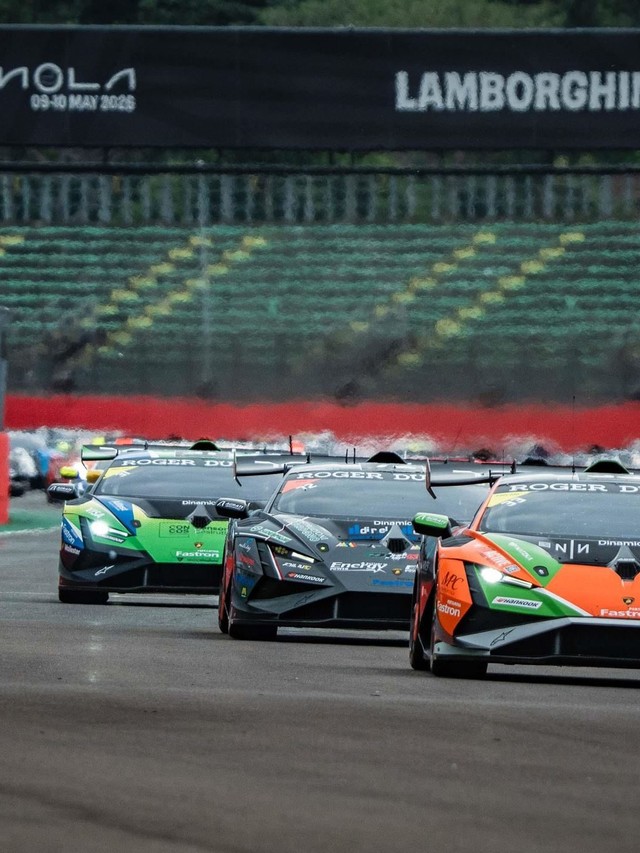
GDL Racing’s Young Guns Take Yas Marina
Rik Breukers, eighteen years old and racing under the Lamborghini Young Drivers Program banner, lined up on pole for Race 2 of the Lamborghini Super Trofeo Middle East at Abu Dhabi’s Yas Marina Circuit on February 11, 2017. Beside him in GDL Racing’s Huracán Super Trofeo #7 sat twenty-two-year-old Axcil Jefferies, a former GP2 Series competitor from Zimbabwe. Together they had posted the fastest times across qualifying and race sessions all weekend, yet had nothing to show for it after contact at the opening corner knocked them out of Race 1.
Race 2 gave them a second chance, and they seized it through pace rather than caution. Breukers lost the lead to Marco Antonelli, the Race 1 winner, at the first turn, then spent six laps pressing at qualifying speed before finding a way back past. When the pit window opened for the mandatory driver change, the GDL crew pitted immediately, handing the car to Jefferies. Antonelli’s team gambled the other way, using the full pit window to try to leapfrog on strategy. It did not work. Jefferies controlled the second stint with consistent, rapid laps that kept Antonelli’s co-driver David Roda pinned in second until the flag.
Behind them, Costantino Bertuzzi and Nigel Farmer completed a clean sweep of the PRO-AM class for GDL Racing, their second podium of the weekend. Antonelli and Roda took the AM class win and finished second overall, while Jack Bartholomew, partnered with Indian driver Parth Ghorpade for FFF Racing Team by ACM, recorded the fastest lap of the race.
Why the Young Drivers Program Changes the Equation
Strip away the weekend’s tactical drama and one detail stands out: Breukers was not simply a quick teenager who happened to be racing Lamborghinis. He competed as a member of the Lamborghini Young Drivers Program, a development ladder embedded within the Super Trofeo ecosystem. At eighteen, racing against experienced gentleman drivers and semi-professional entrants, he qualified on pole and recovered a lost lead through outright pace.
The Super Trofeo series, organized by Lamborghini Squadra Corse since its inaugural season in 2009, provides the structured environment that makes this kind of development possible: identical cars, controlled regulations, and grids that mix professional, semi-professional, and amateur talent across PRO, PRO-AM, AM, and Lamborghini Cup classes. Young drivers get seat time against varied competition on world-class circuits, and Lamborghini gets a talent pipeline. Ferrari Challenge and Porsche Carrera Cup run analogous one-make series that feed drivers upward into GT3 and GT4 programs. Lamborghini’s version works along similar lines, but the Super Trofeo’s three-continent structure, spanning Europe, Asia, and North America with regional rounds like this Middle East event, gives young entrants exposure to a wider range of circuits and competitive environments than most single-region ladder programs offer.
That breadth is the quiet advantage. A result like Breukers and Jefferies’ Yas Marina victory is not just a trophy for GDL Racing. It is a data point in a longer developmental arc, proof that the program can take raw talent and give it the competitive reps needed to progress.
The Huracán Super Trofeo: Purpose-Built for This Fight
The machine underneath the result matters as much as the drivers who delivered it. The Huracán Super Trofeo is a hardcore, race-ready version of the Huracán road car, stripped of its all-wheel-drive system and configured as a rear-wheel-drive racer. The later EVO2 specification produces 620 horsepower from a 5.2-liter naturally aspirated V10, sits on a hybrid carbon and aluminum frame, and weighs just 1,270 kg dry, yielding a weight-to-power ratio of 2.05 kg per horsepower.
The car is emphatically not street-legal. One unusual exception surfaced when Autoblog reported a Michigan dealer selling a titled-for-road-use example, but that remains a curiosity rather than a precedent. What matters for the talent pipeline is that Lamborghini built a dedicated race car around the naturally aspirated V10 rather than simply bolting a roll cage into a road car. That commitment to purpose-built hardware is part of what made the Huracán generation so effective as a customer racing platform. It replaced the Gallardo Super Trofeo and ran for nearly a decade, becoming the backbone of Lamborghini’s global customer motorsport operation.
For prospective buyers or aspiring competitors, Lamborghini does not publish a standard entry price for Super Trofeo competition, and the total outlay, covering car purchase, spares, transport, entry fees, and engineering support, varies significantly by region and team. What the series does offer is a controlled, manufacturer-backed environment where mechanical parity keeps the racing close and the focus squarely on driver skill.
From One-Make Grid to GT3 Launchpad
One-make series are sometimes dismissed as glorified track days for wealthy amateurs. The Super Trofeo is partly that, by design: the AM and PRO-AM classes exist specifically to give gentleman drivers competitive racing in a safe, well-organized framework. The PRO class, where Breukers and Jefferies competed, serves a different function entirely. It is the bottom rung of a racing ladder that leads toward GT3 and, eventually, factory-supported endurance programs.
Lamborghini’s motorsport ecosystem now includes a significant new chapter that illustrates where that ladder can lead. According to Autoblog, the Temerario GT3 debuted at the 2025 Goodwood Festival of Speed as Lamborghini’s first competition car fully designed, developed, and built in-house. The Super Trofeo series created the institutional knowledge and the driver network that make a program like that viable. Without years of running customer racing operations across three continents, Squadra Corse would lack both the engineering feedback loops and the pool of proven drivers needed to field a credible GT3 effort.
A race like the 2017 Yas Marina round looks modest in isolation: one weekend, one result, one young Dutchman and one Zimbabwean finding their rhythm in a V10 race car. Viewed through the lens of what Lamborghini built afterward, it represents exactly the kind of incremental investment that compounds over time. The Super Trofeo series began in 2009. By 2017, it was producing results like this one. By 2025, the infrastructure and talent it cultivated supported a fully in-house GT3 program.
What Enthusiasts Should Take Away
Race results from regional Super Trofeo rounds rarely generate headlines outside the Lamborghini community, and that is precisely why they matter. The series operates as quiet infrastructure, developing drivers, proving hardware, and building the operational muscle that Squadra Corse needs to compete at higher levels. Breukers and Jefferies’ victory at Yas Marina is a snapshot of that process working as intended.
For anyone considering Super Trofeo as a competitive entry point, the takeaway is straightforward. The series provides real racing with manufacturer support, a clear class structure that accommodates different skill levels, and a potential pathway into GT3 competition. The Huracán Super Trofeo platform proved itself across nearly a decade of global racing. Whatever replaces it will inherit that credibility, and the young drivers who cut their teeth in rounds like this one are the people Lamborghini will call when it needs proven talent for its next chapter.
Gallery


