Fifty Minutes, Fifteen Turns, Zero Cautions
Eighteen Huracán Super Trofeo EVOs launched into Barber Motorsports Park’s 2.38-mile ribbon of tarmac on April 6, 2019, and not a single full-course caution interrupted the next fifty minutes. Sprint formats with mixed-experience grids tend to produce at least one safety car intervention, especially on an opening weekend when drivers are still calibrating their aggression. Barber’s fifteen turns, several of them fast, sweeping compressions where a missed apex costs real time, kept the field honest without breaking it.
Every car on the grid ran the updated EVO specification with its prominent roof scoop and enlarged rear wing. The result was a race defined by lead changes rather than attrition in the gravel. Passing happened through Barber’s wide, flowing corners, not through mechanical failure or contact-induced retirements. For the series that Squadra Corse positions as the fastest single-make championship in the world, the opener delivered something more interesting than raw speed: proof that the car lets drivers race each other rather than wrestle the machinery. That distinction would echo through every class result before the afternoon was over.
The Conor Daly Factor: An IndyCar Pro on Five Laps of Homework
Conor Daly, a name more commonly associated with IndyCar ovals and street circuits, climbed into the No. 46 Precision Performance Motorsports entry with a total of five laps of prior seat time in the Huracán Super Trofeo EVO. Five laps. In a car he openly admitted he did not know.
“It was fun because I think my longest stint in the car before the race was only five laps. It was cool because you had to make some adjustments in the car and I got used to that.”
His teammate Brandon Gdovic handled the opening stint, building a lead after the No. 29 Change Racing entry driven by Richy Antinucci received a drive-through penalty for an early incident. Gdovic, who knew the car but not the track, played the role of tire conservator, keeping the rubber alive for Daly’s closing stint.
With roughly seventeen minutes remaining, Daly inherited the car behind PRO-AM leader Damon Ockey, who was leading overall at that point. Daly and Corey Lewis, who had taken over for Antinucci, both cleared Ockey within moments. From there it became a two-car fight. Daly stretched his advantage to just under two seconds at the flag, holding off Lewis, a driver with far more laps in the Huracán than Daly could claim.
Plenty of crossover drivers struggle in their first outing with enclosed-cockpit machinery: different braking points, different weight transfer characteristics, the unfamiliar sensation of racing with fenders. Daly himself acknowledged the challenge: “It was tough today because I know this track but not really the car.” That five laps of acclimatization proved sufficient says less about Daly’s adaptability, considerable though it is, and more about the EVO’s transparency. A car that communicates its limits clearly allows a skilled driver to find the edge quickly. It hides its limits forces even the best to spend sessions building trust. The Barber result suggested the EVO belongs firmly in the first category.
Every Class, Every Winner: All First-Timers
Daly’s headline victory obscured a more telling statistical anomaly: every class winner at Barber was taking a Super Trofeo victory for the first time.
In PRO-AM, Damon Ockey and Jacob Eidson (No. 09 USRaceTronics, Lamborghini Vancouver) converted qualifying pace into a class win. Eidson admitted to a shaky start but recovered to hand Ockey the car in a strong position. Ockey could not hold off the outright PRO leaders, but he kept his class rivals behind for the duration.
McKay Snow dominated the AM class from start to finish in the No. 63 Change Racing entry, winning by nearly thirty seconds. That margin in a fifty-minute sprint, where the entire field runs identical machinery, reflects a driver who found his rhythm immediately and never lost it.
The LB Cup produced the most dramatic storyline. Ashton Harrison and Stephanie Cemo (No. 43, Prestige Performance/Wayne Taylor Racing) led the class at the pit stop, but Cemo received a drive-through penalty after taking over. She served it and still held the lead, only for contact with the No. 88 of Jeremy Cheng to knock the car out of contention with twelve minutes remaining. That handed the win to Mel Johnson (No. 08 GMG Racing, Lamborghini Newport Beach), who described it as his first Super Trofeo victory.
Four classes. Four first-time winners. In a series that began in 2009 and expanded to North America in 2013, that kind of clean sweep does not happen because of luck. It happens because the platform rewards talent acquisition over institutional knowledge, and the Barber opener was the clearest demonstration yet of that principle at work.

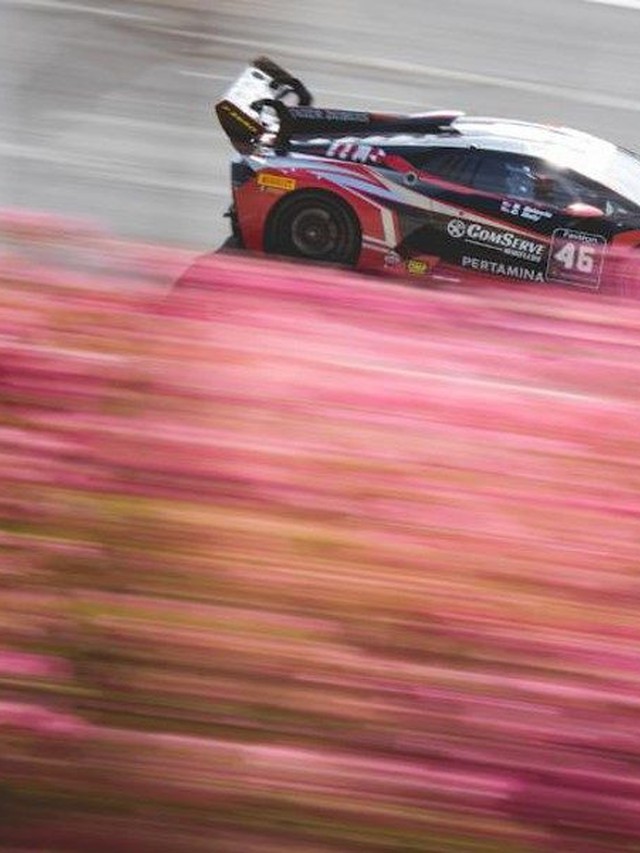
The Lamborghini Huracán Super Trofeo EVO speeds through a vibrant landscape during a competitive race session.
Engineering Parity: What the 2019 EVO Aero Actually Changed
The original Huracán Super Trofeo was already a purpose-built race car, stripped of road niceties and fitted with a sequential gearbox, rear-wheel drive, and a full carbon fiber aero package. The EVO update refined the aerodynamic philosophy in ways that matter more for accessibility than outright lap time.
The roof scoop, the most visually distinctive addition, improved airflow to the engine bay while also contributing to high-speed stability. The enlarged rear wing generated more consistent downforce across a wider speed range. Together, these changes made the car more predictable at the limit, which is exactly where the difference between a veteran and a newcomer narrows or widens.
Consider the mechanism. A car that behaves consistently rewards a driver who can read its feedback. A car with a narrow operating window, where downforce falls off sharply at certain speeds or the rear becomes unpredictable under trail braking, punishes anyone who has not memorized its quirks through hundreds of laps. The EVO’s aero refinements widened that operating window. Gentleman drivers in the AM and LB Cup classes benefited most directly, but even PRO entries like Daly’s gained from the improved predictability. When the car does what you expect, you spend less time managing it and more time racing.
This is the engineering argument beneath the first-time-winner sweep. Squadra Corse did not make the car slower or easier. They made it more honest. The 5.2-liter naturally aspirated V10 still produced its full output through a six-speed sequential gearbox to the rear wheels only. The challenge remained substantial. But the aerodynamic envelope became wider, and within that wider envelope, talent could express itself more quickly. Barber’s results were not an accident of circumstance; they were a consequence of design.
The Super Trofeo Ladder vs. Ferrari Challenge: A Different Philosophy
Lamborghini’s customer racing structure and Ferrari’s Challenge series occupy similar market positions: single-make championships designed to bring wealthy enthusiasts and aspiring professionals into competitive motorsport. The execution diverges in ways that the Barber results illustrate.
The Ferrari Challenge historically rewards series tenure. Drivers who accumulate seasons of experience within the ecosystem tend to dominate, and the learning curve for newcomers can be steep. The Super Trofeo, particularly after the 2019 EVO update, demonstrated the opposite tendency. A driver with five laps of practice won the overall. A first-time AM entrant won by thirty seconds. The series structure, combined with the car’s engineering parity, compressed the learning curve dramatically.
For prospective customer racers evaluating where to spend their budget, this distinction matters. Some reports suggest entry fees for the Super Trofeo series start around €36,000, though a full season campaign including car lease, transport, engineering support, and consumables costs considerably more. The real question is not just the entry fee but the competitive timeline: how many seasons before you can fight for wins? At Barber in 2019, the answer for the Super Trofeo was zero.
The series also functions as a deliberate ladder toward GT3 competition. Squadra Corse designed it as a stepping stone, and the Huracán’s racing lineage now extends from the Super Trofeo through the GT3 and into the forthcoming Temerario GT3, which Autoblog reports will be Lamborghini’s first competition car fully designed, developed, and built in-house. For drivers entering the Super Trofeo today, that pathway from customer series to factory-supported GT3 program represents a coherent career trajectory that few rival manufacturers can match with a single chassis family.
What Barber 2019 Still Means for the Huracán’s Legacy
The Huracán Super Trofeo EVO occupies a specific place in Lamborghini’s racing genealogy: the moment Squadra Corse proved that engineering parity could coexist with genuine competitive drama. The car was not dumbed down. It was clarified. And the results at Barber, where every class winner was a first-timer, validated that approach more convincingly than any technical white paper could.
For enthusiasts watching the Huracán’s final chapters play out (the EVO2 specification continues to race as the platform transitions toward the Temerario), the 2019 Barber opener stands as a useful reference point. It demonstrated that Lamborghini’s customer racing philosophy prioritizes the driver over the dynasty, the talent over the tenure. Conor Daly put it simply enough: he knew the track but not the car, and the car met him halfway.
Anyone considering a used Super Trofeo EVO for track day use should note that these cars are not street-legal. Autoblog recently covered one Michigan dealer attempting to sell a road-titled example, but that remains an extreme outlier. The EVO’s value proposition is its purity: a naturally aspirated V10, rear-wheel drive, sequential gearbox, and an aero package designed for one purpose. Low-mileage examples have appeared at auction, and the collector market recognizes them as the last generation of pure V10 customer race cars Lamborghini will build. Whether you buy one to race or to preserve, the Barber results confirm what the car was engineered to do: let the driver be the variable, not the machinery.


