The Season Opener Nobody Expected
When the 2019 Lamborghini Super Trofeo North America season kicked off at Barber Motorsports Park on a cool Friday morning, the timing sheets produced a result that should have been impossible on paper. The No. 9 USRaceTronics entry of Damon Ockey and Jake Eidson, classified in the Pro-Am class, posted a 1:23.840 around the technical 2.3-mile, 17-turn Alabama circuit. That was the fastest lap of the entire day, across every class, including the full Pro field stacked with defending champions and factory-supported talent.
A Pro-Am car topping the overall time sheets is roughly the equivalent of a club-level tennis player walking onto Centre Court and returning Djokovic’s serve. The class designation exists specifically because one driver in the pairing is considered a gentleman racer rather than a professional. For that car to beat every Pro entry in the opening session tells you something important about the platform underneath it: the Huracán Super Trofeo EVO is so aerodynamically stable and electronically well-sorted that it compresses the gap between professional and amateur driving talent to almost nothing.
How Ockey and Eidson Outpaced the Pro Champions
The numbers sharpen the story. Ockey’s 1:23.840 beat the Pro class leader, series newcomer Sandy Mitchell in the No. 1 Prestige Performance/Wayne Taylor Racing entry, by over four tenths of a second. Mitchell, according to Lamborghini, was making his Super Trofeo North America debut and still managed to slot into second overall at 1:24.258. Defending Pro class champion Corey Lewis, a driver with a full season of title-winning experience, could only manage third overall at 1:25.066.
The afternoon session reshuffled the order slightly. Lewis’s teammate Richy Antinucci topped the field with a 1:24.455 after his Change Racing team chose to bolt on fresh tires early in the session, a calculated gambit to establish peak-grip baseline data for qualifying. Eidson, continuing the No. 9 car’s pace, posted the Pro-Am class best of 1:25.711. McKay Snow led the Am class at 1:25.992, and Ashton Harrison topped LB Cup at 1:28.830.
What matters is the spread. The fastest Pro-Am time and the fastest Pro time were separated by fractions, while the Am and LB Cup classes remained within roughly five seconds of the outright pace. On a circuit where mechanical grip matters more than raw horsepower, that kind of consistency across wildly different driver experience levels points directly to the car’s engineering.

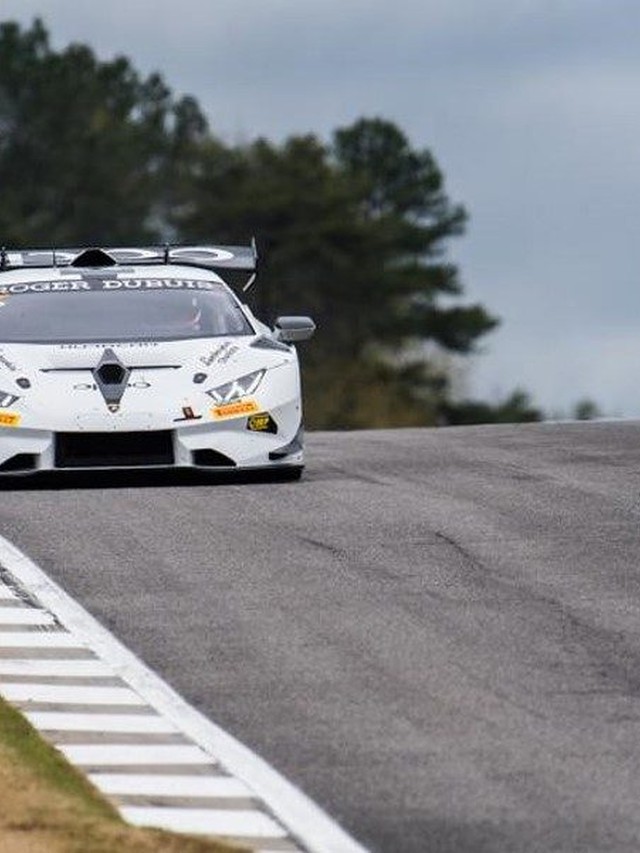
The Lamborghini Huracán Super Trofeo EVO showcases its aerodynamic prowess during a high-speed run at Barber Motorsports Park.
Why Barber Exposes the EVO’s Real Talent
Barber Motorsports Park is not a power circuit. Its 17 turns through rolling Alabama terrain reward cars and drivers who can maintain composure through blind crests, elevation changes, and tightening radii. You can see this in the sole available image from the weekend: a white Huracán Super Trofeo EVO cresting a hill under overcast skies, its aggressive rear wing and roof scoop silhouetted against the grey. That crest is the kind of feature that unsettles an aerodynamic platform, momentarily unloading the car before it plunges back into a compression zone.
The EVO’s revised aero package was designed specifically to handle these transitions. Compared to the original Huracán Super Trofeo, the EVO introduced a redesigned front splitter, a central rear fin for yaw stability, and that distinctive roof-mounted air intake. The combined effect is a car that generates high downforce without punishing a less experienced driver with sudden snap oversteer when the load changes. For a gentleman driver cresting a blind hill at over 100 mph, that kind of predictability is the difference between a fast lap and a trip through the gravel.
Antinucci’s tire strategy in the afternoon session reveals another layer. By running fresh rubber early, Change Racing was essentially calibrating the car’s peak mechanical grip against its aero balance, a setup philosophy that only works when the underlying platform is stable enough to give clean data. When the car itself introduces variables, the data gets noisy and the engineers start chasing ghosts.
Lamborghini’s Electronics vs. Porsche’s Analog Philosophy
The same weekend at Barber also hosted the Porsche GT3 Cup Challenge USA, and the contrast between the two series is instructive for anyone considering customer racing. Lamborghini says the Porsche GT3 Cup cars lack both ABS and traction control, placing the entire burden of threshold braking and corner-exit management on the driver’s right foot and left hand. Max Root, who topped the Porsche afternoon session at 1:27.648, described the Cup car as a place where “it’s all driver.”
That is a perfectly valid racing philosophy. But it also means the floor for driver performance is much lower. A gentleman racer in a Porsche Cup car who gets the braking zone wrong by three meters is going to lock wheels and lose seconds, or worse. The same driver in the Huracán EVO has electronic safety nets that keep the car composed while still demanding real skill for outright pace.
The lap time gap tells part of the story. Root’s best Porsche time of 1:27.648 was nearly four seconds slower than Ockey’s best Lamborghini lap. Comparing one-make series lap times is never perfectly apples-to-apples because the cars differ in power, weight, and tire specification. Still, the broader point holds: Lamborghini’s approach to customer racing is to build a car that flatters a wide range of talent, and the results at Barber validate that strategy convincingly. For prospective customer racers weighing their options, the philosophical question is straightforward. Do you want a car that teaches you the hard way, or one that lets you develop speed progressively while still competing at the sharp end? The Super Trofeo series was built around the second answer.
New Blood and the Pressure on Defending Champions
Sandy Mitchell’s debut performance adds another dimension to the 2019 season. Lamborghini says Mitchell is a newcomer to the North American series, yet he slotted into second overall in the morning session on his first official outing. That kind of immediate competitiveness from a fresh entry puts enormous pressure on established teams. Lewis and Antinucci won the 2018 Pro title, and suddenly they are looking at a field where both a Pro-Am car and a debutant are matching or beating their pace on day one.
The Super Trofeo series has always served as Squadra Corse’s primary pipeline for developing both drivers and customer racing infrastructure. Teams like USRaceTronics and Change Racing invest significant resources in engineering support, and the quality of that support is now high enough that class boundaries feel increasingly artificial. When the Am class leader is within two seconds of the overall fastest time, the entire grid is operating in a compressed performance window that makes for genuinely unpredictable racing.
“The car is doing great. We were P1 in practice and for starting off the season, you can’t really ask for much more. The USRaceTronics team is doing a great job.” – Jake Eidson
Eidson’s quote is telling in its simplicity. No excuses, no caveats about class distinctions. The car was fastest, full stop.
How to Watch the 2019 Season Opener Races
Both opening rounds of the 2019 Lamborghini Super Trofeo North America season were available to stream live on IMSA.TV within the United States and on squadracorse.lamborghini.com/live-streaming internationally. Race 1 was scheduled for Saturday at 2:50 pm EDT, with Race 2 following on Sunday at 1:55 pm EDT. An NBCSN tape-delayed broadcast was set for Friday, April 19 at 1:00 pm EDT.
For anyone tracking the series going forward, the practice results at Barber set up a genuinely interesting season. If Pro-Am cars can challenge for outright pace from the very first session, the class battles throughout the year could produce some of the most competitive one-make racing on the North American calendar. The Huracán EVO platform, it turns out, might be good enough to make the driver classifications almost irrelevant.


