A Virtual Debut for a Visceral Machine
Lamborghini chose to reveal the Huracán EVO Rear-Wheel Drive Spyder not at a motor show or a coastal press launch, but through an augmented reality experience on lamborghini.com. Visitors could place the car in their own driveway, living room, or wherever else their phone camera pointed. As a first for the brand, the AR format was a practical response to a world that had temporarily stopped gathering in large groups, yet it also carried a quiet message: this car is meant to exist in your personal space, not behind a velvet rope.
The substance behind the digital showmanship is straightforward. Lamborghini confirmed the RWD Spyder produces 610 hp and 560 Nm of torque from its 5.2-liter naturally aspirated V10, reaches 100 km/h in 3.5 seconds, and tops out at 324 km/h. Those numbers match the RWD coupe exactly. The real argument for this car was never about adding power. It was about subtracting everything between the driver’s ears and the engine’s intake trumpets, and then removing the roof for good measure.
Why the V10 Sounds Different With the Sky Above
Every naturally aspirated V10 sounds good. A naturally aspirated V10 with no roof, a rear-mounted engine bay acting as a resonating chamber, and an electronically lowerable rear window serving as a volume knob sounds extraordinary. Lamborghini says the rear window functions as a windshield when raised and amplifies the engine’s unique character when lowered, and that description undersells the effect.
The soft-top roof stows in 17 seconds and can be operated at speeds up to 50 km/h, a practical detail that matters more than it might seem. Caught on a canyon road when the sun breaks through? Drop it without pulling over. Two removable lateral wind shields handle cabin turbulence, keeping conversation possible even at speed. These are small engineering courtesies, but they separate a car you actually use from one you trailer to weekend events.
As the supercar world moves toward forced induction and hybrid assistance, the RWD Spyder represents one of the last opportunities to experience a large-displacement, naturally aspirated Lamborghini engine in its most exposed, unfiltered form. That context sharpens the car’s appeal for any buyer weighing it today.
Driver Engagement Over Digital Intervention
Lamborghini positioned the RWD Spyder as a car that delivers its experience through hardware rather than software. Strip away the marketing language and the engineering supports that claim. Removing the front driveshafts and differential saves weight, shifts the dynamic balance, and forces the P-TCS traction control system to manage all 610 hp through just two contact patches. The result, according to Lamborghini, is a car built around unfiltered physical feedback and maximum engagement.
The ANIMA selector on the steering wheel calibrates the P-TCS across three modes. STRADA minimizes rear-wheel slippage and manages torque on low-grip surfaces. SPORT allows the rear to slide during acceleration, limiting torque only when oversteer angles increase too quickly, giving the driver room to play while keeping a safety net in place. CORSA optimizes traction for high-performance corner exits. Where the AWD Huracán EVO uses its front axle and more complex electronics to mask the limits of grip, the RWD variant lets the driver find those limits, feel them through the seat and steering column, and manage them personally.
Passive shock absorbers (with optional MagneRide electromagnetic dampers) reinforce the analog character. Double wishbone suspension with overlapped quadrilaterals sits at each corner, paired with standard 19-inch Kari rims wearing specially developed Pirelli P Zero tires. Carbon ceramic brakes are available as an option for buyers who plan to use the car hard, and for a rear-drive convertible with this much power, that box is worth ticking.
The RWD vs. AWD Decision: What Actually Changes
Choosing between the RWD and AWD Huracán EVO Spyder is less about raw capability and more about what kind of driver you want to be on any given Sunday. The AWD version produces 631 hp and reaches 100 km/h roughly four tenths quicker, according to available reporting. Its additional grip makes it more forgiving in wet conditions and more explosive off the line. For buyers who want the fastest possible point-to-point weapon with the roof down, the AWD remains the rational choice.
The RWD Spyder trades that margin of safety for something harder to quantify. With 60 percent of its 1,509 kg dry weight over the rear axle, the car communicates its intentions clearly. Experienced drivers will feel the rear tires loading and unloading through corners in a way the AWD variant deliberately smooths over. In SPORT mode, the P-TCS allows enough slip to hold gentle drifts, a quality that the more buttoned-down AWD system discourages. That willingness to let the driver explore the edge of grip, rather than electronically papering over it, is the philosophical core of the entire RWD proposition, and the open roof only intensifies the sensation.
Design for Freedom: Aerodynamics and Open-Top Purity
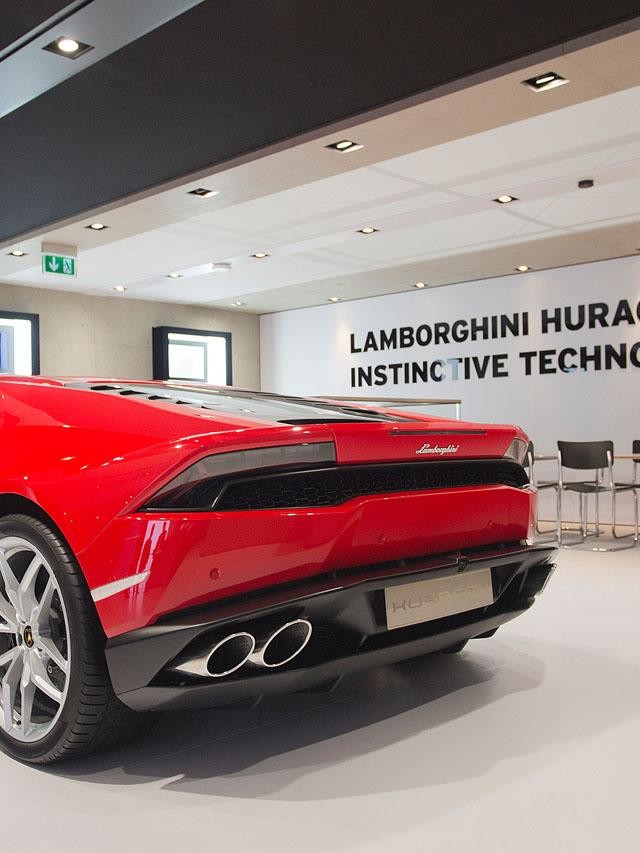
Lamborghini says the Spyder’s exterior lines deliver drag reduction and downforce matching the coupe without additional aerodynamic appendages, a meaningful engineering claim for a convertible, where the disrupted roofline typically compromises airflow management. A new front splitter and vertical fins within larger, framed front air intakes distinguish the RWD variant visually from its AWD sibling, while a unique rear diffuser integrated into a high-gloss black rear bumper completes the separation.
The soft-top itself deserves credit for maintaining clean lines whether raised or lowered. Unlike a folding hardtop, the fabric roof avoids the weight penalty and packaging complexity that would compromise the engine bay or luggage space (such as it is, at 100 liters). The aluminum and thermoplastic resin body sits on a hybrid chassis of aluminum and carbon fiber, a construction philosophy Lamborghini refined across the entire Huracán generation. At 1,509 kg dry, the RWD Spyder carries the inevitable weight penalty of convertible reinforcement, but the 2.47 kg/hp weight-to-power ratio keeps it firmly in supercar territory and, more importantly, preserves the lightness that makes the rear-drive character so communicative.
Personalization, Pricing, and the Buyer’s Calculus
Lamborghini confirmed a suggested retail price of USD 229,428 (before taxes) in the United States, with European pricing starting at EUR 175,838 and UK pricing at GBP 151,100. First deliveries were scheduled for summer 2020. The Ad Personam program opens virtually limitless color and trim combinations, a feature that Lamborghini buyers exercise enthusiastically. Interior connectivity comes through an 8.4-inch HMI touchscreen with Apple CarPlay.
The RWD Spyder occupies a specific niche in the Lamborghini lineup. It costs less than the AWD variant, weighs less, and deliberately offers less electronic sophistication. For a driver who values sensory connection over outright grip, and who wants the V10 soundtrack delivered with nothing between it and open sky, the proposition is compelling. As Lamborghini’s lineup transitions toward hybrid power, the naturally aspirated, rear-wheel-drive Spyder looks increasingly like a car that will be remembered for what it refused to add.
| Market | Suggested Retail Price (taxes excl. unless noted) |
|---|---|
| USA | USD 229,428 |
| Europe | EUR 175,838 |
| UK | GBP 151,100 |
| China | RMB 2,794,000 (taxes included) |
| Japan | YEN 26,539,635 |
Key Specifications: Huracán EVO RWD Spyder at a Glance
| Specification | Detail |
|---|---|
| Engine | 5,204 cc V10, 90°, naturally aspirated, IDS+MPI dual injection |
| Power | 610 hp (449 kW) at 8,000 rpm |
| Torque | 560 Nm (413 lb-ft) at 6,500 rpm |
| Transmission | 7-speed LDF dual-clutch |
| Drivetrain | Rear-wheel drive with P-TCS |
| 0 to 100 km/h | 3.5 seconds |
| 0 to 200 km/h | 9.6 seconds |
| Top Speed | 324 km/h (201 mph) |
| Braking 100 to 0 km/h | 32.2 m |
| Dry Weight | 1,509 kg (3,326 lbs) |
| Weight Distribution | 40% front, 60% rear |
| Chassis | Aluminum and carbon fiber hybrid |
| Roof Operation | 17 seconds, operable up to 50 km/h |
| Fuel Capacity | 83 liters |
| WLTP Combined Consumption | 13.9 l/100 km |
| CO2 Emissions | 335 g/km |


