Two DTM Wins, One Round Number That Actually Means Something
Mirko Bortolotti’s first DTM victory at Nürburgring on Saturday also happened to be the Lamborghini Huracán GT3’s 150th overall GT3 win, a milestone Lamborghini says arrived in the tenth year of its Squadra Corse racing program. The following day, Maximilian Paul drove the GRT Grasser Racing Team‘s Huracán GT3 EVO2 to a second consecutive victory in soaking conditions. Two wins in a single weekend, against Mercedes-AMG and Porsche factory-backed opposition, on a circuit notorious for punishing mechanical fragility.
Round numbers can be hollow. This one carries weight because of what it took to accumulate. The first GT3 victory came at Monza in 2015, when Lamborghini’s customer racing operation was still proving it belonged on the same grid as Porsche and Ferrari. The 150th arrived eight years later with a car that remains competitive in conditions ranging from bone-dry qualifying to a full downpour mid-race. That kind of range, across multiple generations of the same platform, tells you more about the Huracán GT3 program’s engineering depth than any single result could.
Saturday: Bortolotti’s Masterclass in Tire Gambling
Bortolotti, driving the #92 Huracán GT3 EVO2 for SSR Performance, set pole with a 1m25.118 lap, more than a tenth and a half clear of the field. He held position at the start against Thomas Preining’s Porsche and controlled the race through a full course yellow triggered by a heavy crash at turn one.
The decisive moment came during that caution period. Rain arrived, and teams further down the order pitted for wet tires. SSR Performance kept Bortolotti on slicks. The track dried rapidly after the restart, vindicating the call and stranding wet-shod rivals on the wrong rubber. Bortolotti’s closing laps told the story: Lucas Auer’s Mercedes closed the gap steadily, only for Bortolotti to post the fastest first sector of the race and pull back out to a margin of just over one second at the flag.
Bortolotti acknowledged the difficulty of the tire decision at Nürburgring, where microclimates around the Eifel circuit can make one sector damp while another stays dry. That SSR Performance read the conditions correctly under pressure speaks to the maturity of the team-and-driver relationship within the Squadra Corse ecosystem.

A jubilant race car driver celebrates a victory, showing his excitement with a wide smile and clenched fists.
Sunday: Paul Makes the EVO2 Look Alive in the Rain
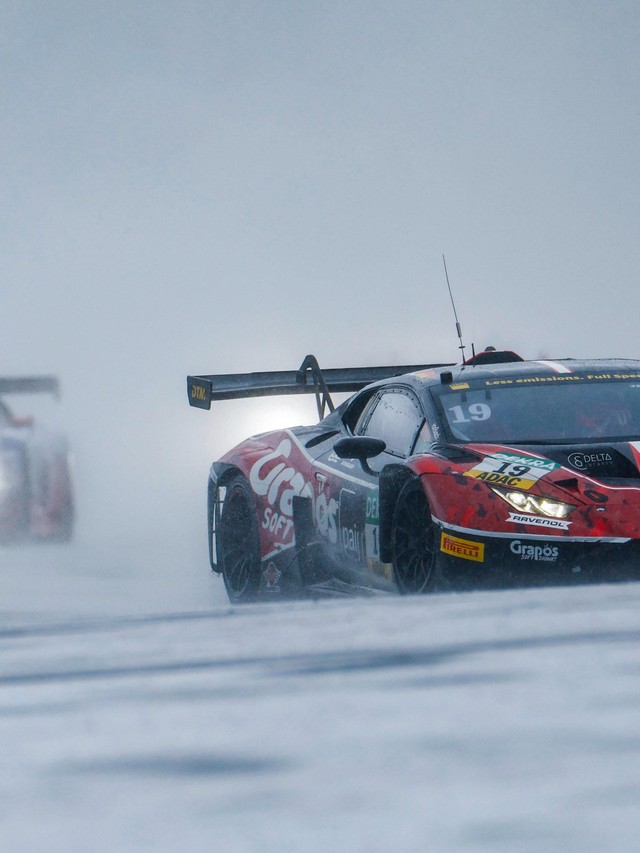
Sunday’s race reversed the weather script entirely. Rain set in for the duration, and Maximilian Paul started on wet tires, a choice that elevated him into contention early. Lamborghini says Paul was among the fastest drivers on track before the mandatory pit window even opened, and he used a full course yellow to pit without losing position.
The defining moment came inside the final ten minutes. Paul closed on race leader Auer and executed an overtake on the inside of the hairpin, then pulled out a gap of more than seven seconds over Laurin Heinrich’s Porsche before a late safety car neutralized the final two laps. Where Saturday rewarded a bold dry-tire gamble, Sunday rewarded outright wet-weather pace, and the same car delivered both results. That versatility, more than any single lap time, is what separates a competitive GT3 platform from a truly dominant one.

The Lamborghini Huracan GT3 EVO2, number 19, navigates a challenging wet track during a race.
A Decade of Squadra Corse: From Outsider to Endurance Winner
For most of the brand’s history, Lamborghini’s motorsport credibility at the factory level was essentially nonexistent. Customer teams ran Diablos and Murcielagos in various GT categories, but the company itself treated racing as someone else’s problem. Squadra Corse changed that calculus when it launched in 2015 with the Huracán GT3, built in collaboration with Dallara and designed to meet FIA GT3 specifications.
The program’s trajectory since then covers every race a GT manufacturer wants on its resume. Lamborghini says the Huracán GT3 won the Rolex 24 at Daytona in 2018, repeated that result in 2019, then added the Sebring 12 Hours the same year for what the company calls the “unofficial 36 hours of Florida.” A third Daytona class win followed in 2020, alongside a trio of GT World Challenge Europe titles. Bortolotti, who drove a GRT Grasser Racing Team Huracán GT3 EVO2 to victory at the CrowdStrike 24 Hours of Spa, recently completed what Sportscar365 described as a decade-long pursuit of victory for Lamborghini at that event. Bortolotti described the Spa win as completing a “circle” for the Huracán in its final competitive years.
Bortolotti’s personal arc mirrors the program’s maturation. He joined the Huracán GT3 effort near its inception and stayed through every evolution, with only a single year at Audi in 2020 interrupting the partnership. That continuity between driver and platform is rare in modern GT racing, where factory contracts shuffle annually, and it partly explains why the car’s performance envelope kept expanding even as the basic architecture aged.
What 150 Wins Mean for the Brand and for Buyers
GT3 racing functions as the most direct engineering feedback loop between track and showroom in the supercar world. The regulations require a production-based engine, a chassis derived from the road car, and aerodynamics that relate to the street version’s shape. When a GT3 car wins at Daytona, Spa, and Nürburgring across variable weather and tire strategies, it validates the underlying platform in ways that a press launch on a sunny test track never can.
The naturally aspirated V10 architecture that powered the Huracán through its entire production life proved adaptable enough to win against turbocharged rivals from Porsche, Mercedes-AMG, and Ferrari across multiple regulatory cycles. Few GT3 platforms in the modern era have remained competitive for a full decade without a complete replacement. Porsche, by comparison, cycled through three entirely new 911 GT3 race cars during the same period, according to Road & Track. Lamborghini extracted ten years of front-line competitiveness from iterative EVO and EVO2 updates to the same fundamental car.
That longevity is the real story behind the number 150. It speaks to development efficiency, to the depth of the original Dallara-developed chassis, and to Squadra Corse’s ability to keep finding performance within a tightly regulated rulebook.

Two powerful GT3 cars battle for position on a rain-soaked racetrack, their headlights cutting through the spray.
The Temerario GT3: Inheriting a Legacy, Abandoning the V10
The Temerario GT3, slated to replace the Huracán GT3 EVO2 as Lamborghini’s factory-backed GT3 entry, represents the most significant reset in the program’s history. The new car will use a modified version of the road-going Temerario’s twin-turbocharged V8, ditching the naturally aspirated V10 that defined the Huracán’s character on track and in the grandstands. GT3 regulations prohibit hybrid systems, so the Temerario GT3 also drops the road car’s electric motors.
Notably, the Temerario GT3 is the first race car entirely designed and developed by Lamborghini at its Sant’Agata Bolognese facility, a shift from the Dallara partnership that produced the original Huracán GT3. That decision signals confidence in Squadra Corse’s in-house engineering capability, built through exactly the kind of decade-long learning curve that 150 victories represent.
Whether the Temerario GT3 can match its predecessor’s record remains an open question. Customer teams that built their programs around the Huracán’s characteristics will need to adapt to a fundamentally different powerband, different weight distribution, and the complexities of turbo management in wheel-to-wheel racing. The transition will test Lamborghini’s ability to transfer institutional knowledge from one platform to the next rather than starting from scratch. For buyers watching from the road-car side, the Temerario GT3’s competitiveness will be the clearest signal of whether Lamborghini’s move to forced induction preserves the performance credibility that the Huracán spent a decade building.
Gallery


