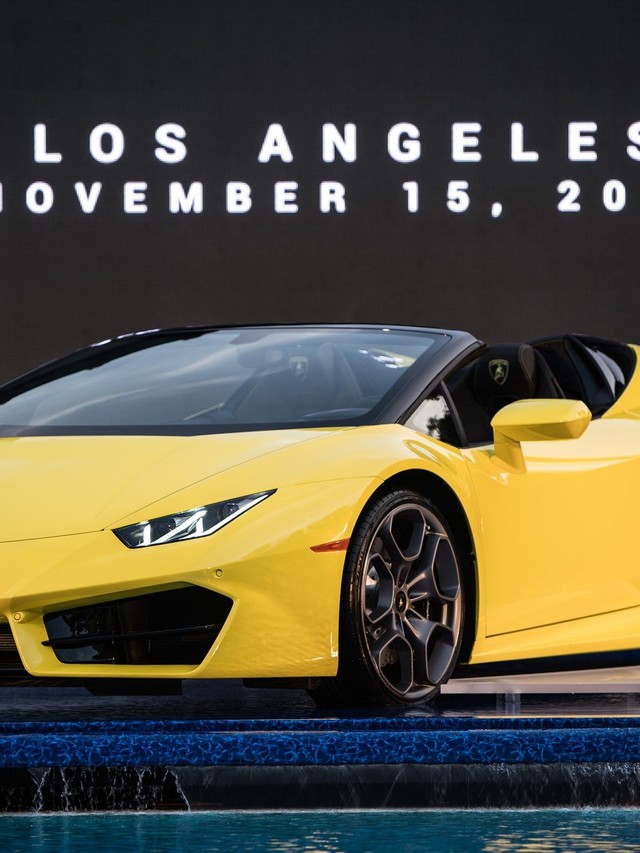
A Rear-Drive Convertible Arrives in Los Angeles
Lamborghini pulled the cover off the Huracán Rear-Wheel Drive Spyder at the Los Angeles Auto Show on November 15, 2016, completing a lineup expansion that gave buyers something genuinely unusual: a naturally aspirated V10 convertible sending all of its power exclusively to the rear axle. The car debuted in vivid yellow, roof stowed, with two distinctive fins rising from the folded top housing to extend the bodywork’s profile rearward.
Then-CEO Stefano Domenicali framed the RWD Spyder as a gateway into the Huracán family, priced between the rear-wheel-drive coupé and the all-wheel-drive coupé. Lamborghini positioned it squarely at buyers who wanted the sensory drama of open-air V10 motoring without the electronic safety net of a front axle pulling them through corners. Worldwide availability followed in January 2017. Everything about the car, from its chassis tuning to its electronically lowerable rear window, pointed toward a single promise: raw, unmediated driving emotion with the sky overhead.
Why Rear-Wheel Drive Changes the Conversation
For decades, all-wheel drive defined the Lamborghini ownership experience. The Diablo VT, the Murciélago, and the Gallardo LP 560-4 all used front-axle traction as a core part of their identity. When Lamborghini began offering rear-wheel-drive Huracáns, starting with the LP 580-2 coupé, it represented a philosophical pivot worth understanding, and the Spyder sharpened that pivot by stripping away the roof along with the front driveshaft.
Removing the front differential accomplishes more than saving weight. It fundamentally alters the car’s vocabulary. With a 40/60 front-to-rear weight distribution, compared to a more nose-heavy split in AWD form, the RWD Spyder reduces rotational inertia on the front axle. Steering becomes more communicative because the front tires handle only one job: turning. In the AWD car, they also manage torque delivery, which dilutes the feedback loop between road surface and steering wheel.
The practical translation is a car that rotates more willingly on corner entry and demands more respect on corner exit. Lamborghini calibrated the ESC to emphasize oversteer characteristics in every ANIMA driving mode, from STRADA through SPORT to CORSA, actively encouraging the rear end to participate in direction changes rather than suppressing it. For drivers who find the AWD Huracán too composed, too willing to flatten out their mistakes, the RWD Spyder is the antidote, and the open top ensures they hear every nuance of the chassis working beneath them.
The V10 and the Missing Roof: A Sensory Argument
Power comes from the same 5.2-liter naturally aspirated V10 found in the RWD coupé, producing 580 horsepower at 8,000 rpm and 540 Nm of torque at 6,500 rpm, with 75 percent of that torque accessible from just 1,000 rpm. One report from MotorAuthority listed the output as 572 horsepower, a minor discrepancy likely rooted in regional measurement standards, but the official Lamborghini figure stands at 580 hp.
The soft top opens or closes in 17 seconds at speeds up to 50 km/h (31 mph), and this is where the RWD Spyder makes its most compelling case against the coupé. Lamborghini designed the rear window to open electronically: raised, it functions as a wind deflector, but lowered, it channels the V10’s intake howl directly into the cabin. Removable lateral windguards reduce buffeting enough to hold a conversation at speed, but the real point is choosing how much engine sound you want. At 7,000 rpm with that rear glass down, the naturally aspirated V10 delivers the kind of mechanical drama that turbocharged competitors simply cannot replicate.
An integrated duct behind the headrests manages airflow turbulence during open-top driving. Combined with the twin fins that emerge from the roof casing, the Spyder’s aerodynamic package keeps the cabin livable without resorting to the sealed-greenhouse approach of a retractable hardtop. Every element of the roof system reinforces the car’s central thesis: this is a Lamborghini built to let the driver feel everything.
Engineering Tuned for a Different Kind of Driver
Lamborghini did not simply remove the front driveshaft and call it finished. The RWD Spyder’s double wishbone suspension uses springs and anti-roll bars optimized specifically for two-wheel drive. Electronic power steering and the optional Lamborghini Dynamic Steering (LDS) received their own calibration profiles, tuned to complement the lighter front end and the car’s willingness to rotate.
At the center of the chassis sits the Lamborghini Piattaforma Inerziale (LPI), a sensor suite that tracks the car’s movement in three dimensions. LPI feeds real-time data to the optional Magneto Rheological Suspension (MRS), the steering system, and the stability controls. The result is a car that knows exactly what it is doing at every moment, even when the driver is exploring the limits of rear-axle traction. Pirelli developed PZero tires exclusively for the rear-wheel-drive Huracán, mounted on 19-inch Kari rims, and the braking system uses specially contoured steel discs with aluminum brake disc pots to reduce unsprung mass.
The seven-speed Lamborghini Doppia Frizione (LDF) dual-clutch transmission handles gear changes and includes launch control. At a dry weight of 1,509 kg (3,326 pounds), the RWD Spyder achieves a weight-to-power ratio of 2.6 kg/hp. Lamborghini says the car reaches 100 km/h from rest in 3.6 seconds on its way to a 319 km/h (198 mph) top speed. When full power is unnecessary, cylinder deactivation shuts down five of the ten cylinders, a feature that works so seamlessly most drivers will never notice the transition. All of this engineering exists in service of a single goal: keeping the driver connected to the road rather than insulated from it.
Where It Fits and Who Should Care
MotorAuthority observed that Lamborghini dropped its traditional alphanumeric naming convention for this model, a small but telling signal. The old LP 580-2 designation communicated power and driven wheels in a format only enthusiasts decoded. The simpler “Rear-Wheel Drive Spyder” label suggests Lamborghini wanted this car to read as approachable, not arcane.
Lamborghini did not disclose exact pricing at the LA debut, stating only that the RWD Spyder would slot between the two-wheel-drive coupé and the four-wheel-drive coupé. For prospective buyers, the meaningful question was never the sticker price but the driving philosophy they preferred. The AWD Spyder is faster in most measurable scenarios: better launch traction, more composure in wet conditions, and a higher margin for error at the limit. The RWD Spyder trades all of that for something harder to quantify on a spec sheet. It rewards precision, punishes laziness, and communicates through the seat and steering rim in a way the AWD version smooths over.
In the broader competitive landscape, the RWD Spyder occupied interesting territory. Its naturally aspirated V10 stood apart from turbocharged mid-engine convertibles offered by rival manufacturers, delivering linear throttle response and a top-end scream that forced-induction engines filter out. For buyers cross-shopping open-top supercars in this segment, the Huracán RWD Spyder’s defining trait was not its power figure or its sprint time but the unmediated connection between driver input and vehicle response, amplified by the absence of a roof and the presence of ten cylinders breathing without restriction.
Among Huracán buyers who spec RWD models, the common thread tends to be experience. These are often second or third Lamborghini owners who already know what the AWD system does and want something that asks more of them. The RWD Spyder was built for exactly that buyer: someone who considers a little oversteer not a problem to be solved, but the whole point.
Gallery


