A Full-Scale Fantasy Lands in Monte Carlo
Lamborghini could have dropped the Lambo V12 Vision Gran Turismo as a quiet digital download. Instead, the company built a full-scale physical model of a car that will never touch asphalt and rolled it onto a stage at the 2019 FIA Certified Gran Turismo Championships World Finals in Monte Carlo. The single-seater virtual concept, designed exclusively for Sony’s Gran Turismo Sport on PlayStation 4, was scheduled to become available in-game from spring 2020. That Sant’Agata chose an esports championship final over a traditional auto show tells you everything about who this car was really for.
Stefano Domenicali, then Chairman and CEO of Automobili Lamborghini, described the concept as a “virtual vision in the form of a real model” aimed squarely at “the young generation of racing game and super sports car enthusiasts.” The phrasing is deliberate. Lamborghini’s future customer base is forming opinions right now, thumbs on controllers, not yet old enough for a configurator appointment. Building a physical showpiece and debuting it in front of that audience is a calculated move to make sure those future buyers grow up thinking in terms of hexagons and Y-signatures.

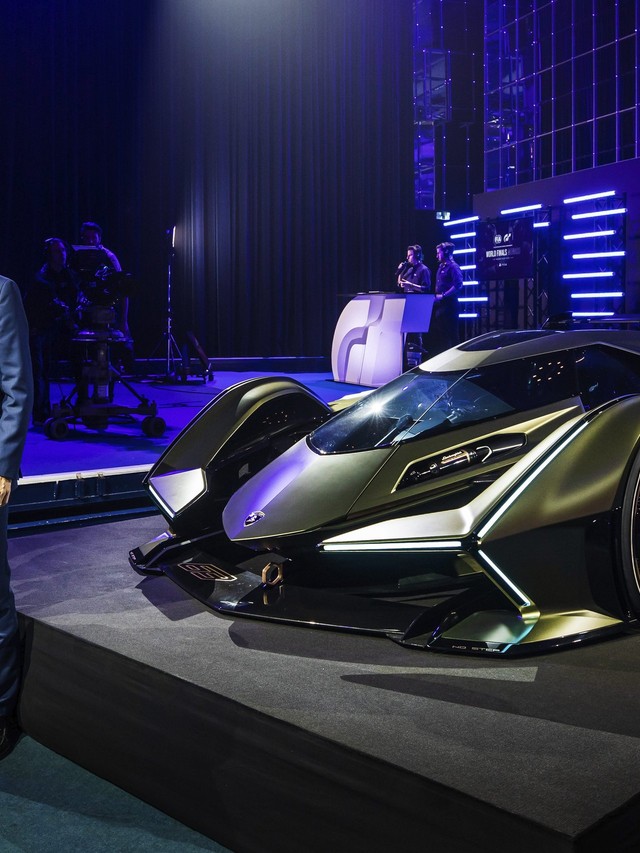
Two key figures pose with the striking Lamborghini Lambo V12 Vision Gran Turismo concept car at its official unveiling.
Why a Virtual Lamborghini Matters More Than You Think
Concept cars built for video games can feel like marketing exercises with a shelf life measured in news cycles. The V12 Vision GT is marketing, certainly, but the strategy behind it deserves a closer look. Lamborghini is not the first luxury automaker to participate in the Vision Gran Turismo program; Mercedes-AMG debuted its own Vision GT concept back in 2013 for Gran Turismo 6, and according to Autoblog, that car was also presented as a full 1:1-scale model with no powertrain. BMW, Mazda, and others followed. What separates Lamborghini’s approach is timing and audience alignment.
By 2019, the Gran Turismo franchise commanded a massive global community, and the FIA-certified championship structure gave the game a veneer of motorsport legitimacy. The audience in that Monte Carlo room, and watching online, skewed younger and more digitally engaged than any Geneva or Frankfurt crowd. For a brand that sells roughly 10,000 cars a year and depends on aspiration far more than volume, seeding desire among 18-year-olds who might become buyers at 35 is a long game worth playing.
Reddit reactions at the time reflected exactly the split Lamborghini probably hoped for. Some users called the design “peak Lamborghini” and “the most batshit insane vehicle that pushes the boundaries of what’s possible,” while others compared it to a Hot Wheels car. Both reactions serve the brand. Indifference would be the only failure.
Design Without Guardrails: Centro Stile Unplugged
Freed from crash regulations, pedestrian impact standards, and the need to accommodate a second occupant, Lamborghini Centro Stile treated this concept as a pure design experiment. The result is aggressive even by Lamborghini standards. The main body sits disconnected from the fenders, creating deep channels that serve as visual aerodynamic passages. A dominant rear wing houses an enormous Y-shaped taillight, and some commentators noted the rear lighting’s resemblance to the earlier Terzo Millennio EV Concept. The characteristic Y-signature appears at both front and rear, anchoring the design in recognizable Lamborghini language despite the extreme proportions.
The most theatrical detail is the cockpit entry: the driver climbs in from the front of the car, fighter-jet style, settling into a single seat where all controls live in the steering wheel and every instrument readout is projected virtually. Lamborghini says the hexagon-patterned side windows draw direct inspiration from the 1968 Marzal, a concept designed by Marcello Gandini that remains one of the strangest and most beautiful objects ever to wear the bull badge. That reference is a knowing wink to enthusiasts who understand the depth of Lamborghini’s design archive, even as the overall shape screams 2040.
Mitja Borkert, Head of Lamborghini Centro Stile, framed the project as an opportunity for his team to explore ideas that production constraints would normally forbid, while also reflecting the company’s direction on lightweight materials and hybridization. In 2019, with the Sián FKP 37 still fresh news, the word “hybridization” carried particular weight. Stripped of every real-world compromise, the V12 Vision GT became a canvas for telegraphing where Lamborghini’s design thinking was headed.

Three enthusiastic individuals celebrate the launch of the Lamborghini Lambo V12 Vision Gran Turismo concept car.
A Virtual V12 With Real Implications
In its digital form, the V12 Vision GT borrows the hybrid powertrain from the Sián FKP 37, which pairs a 6.5-liter naturally aspirated V12 with supercapacitor-based mild-hybrid assistance. The choice was not arbitrary. In 2019, the Sián represented Lamborghini’s first step toward electrification, and embedding that powertrain in a gaming concept served as a quiet signal: the V12 would survive, but it would carry electrical assistance going forward.
Looking back from 2025, the trajectory is clear. The Revuelto now pairs a V12 with a more substantial plug-in hybrid system, and the Temerario brings a twin-turbo V8 hybrid to the “entry” supercar segment. The V12 Vision GT did not predict those cars in any literal sense, but the underlying message, that Lamborghini would hybridize while preserving combustion character, proved accurate. Borkert’s 2019 reference to “lightweight materials and hybridization” reads less like marketing language in hindsight and more like a genuine roadmap tease.
For enthusiasts watching Lamborghini’s evolution, this is the practical takeaway: concept cars like the V12 Vision GT are worth paying attention to not for their specs, which are virtual and somewhat arbitrary, but for the technological priorities they telegraph. When Lamborghini’s design chief publicly names hybridization and lightweight construction as the company’s future direction, the production cars that follow tend to confirm it.
Playing the Long Game Against Rivals
Lamborghini was relatively late to the Vision Gran Turismo program compared to Mercedes-AMG, which entered six years earlier. Lateness, though, can be an advantage when the execution is memorable. The V12 Vision GT’s design is extreme enough to function as a poster car for a generation of gamers, which is precisely the point. Ferrari, notably, sat out the Vision GT program entirely, choosing to guard its brand through more traditional channels. Whether that restraint or Lamborghini’s embrace of gaming culture proves more effective at building long-term loyalty is a question that will take a decade to answer.
One detail worth noting: although the concept was originally announced for Gran Turismo Sport availability in spring 2020, one report indicates it ultimately debuted in Gran Turismo 7 instead. The platform shift matters less than the longevity. The car remains a fixture in the game’s roster, which means every new player who picks up a controller encounters Lamborghini’s most extreme design statement. That kind of persistent brand exposure, embedded inside entertainment rather than interrupting it, is something no 30-second television spot can replicate.
The V12 Vision GT will never idle at a stoplight or collect parking lot door dings. Its value to Lamborghini is measured in impressions, not invoices. For a brand that thrives on aspiration, the distinction between a car you can buy and a car you desperately wish existed may not matter as much as traditionalists assume.
Gallery


