5,750 Cars, One Clear Catalyst
Lamborghini delivered 5,750 cars worldwide in 2018, a 51% increase over 2017’s total of 3,815 units. The number that matters most within that figure: 1,761 Urus Super SUVs found customers in roughly six months of actual market availability, starting from the model’s July introduction. Strip the Urus out, and the remaining 3,989 deliveries still represent year-over-year growth for the supercar lines alone. Leave it in, and Lamborghini crossed a threshold the brand had never approached.
The result extended a global sales growth streak to eight consecutive years, but the scale of the jump was unlike anything before it. From 1,302 units in 2010 to nearly six times that volume eight years later, Sant’Agata Bolognese had transformed itself from a low-volume exotic house into something closer to a luxury powerhouse, without abandoning the V10 and V12 cars that built its identity. That is the real story of 2018: the Urus did not replace Lamborghini’s supercar soul, it bankrolled its expansion.
The Urus Gamble: From Internal Skepticism to Bestseller
According to Robb Report, Lamborghini executives initially harbored skepticism about the Urus. The concern was predictable and, frankly, reasonable: would bolting a Lamborghini badge onto a twin-turbo V8 SUV cheapen the brand that built its mythology on mid-engine exotics with naturally aspirated screamers? The LM002 proved Lamborghini could build something with ground clearance, but that was a military curiosity, not a volume play.
The market answered emphatically. The Urus became Lamborghini’s top-selling model in the United States, according to GoodCarBadCar.net, which reported a 27% increase in U.S. sales for 2018, reaching 2,489 vehicles. Eighty percent of Urus buyers were new to the Lamborghini brand, a conquer rate that meant the SUV functioned as a gateway rather than a cannibalization risk. Some of those new customers went on to purchase supercars from the same dealer. The fear of brand dilution turned out to be exactly backward: the Urus expanded the customer base while feeding the traditional business.
Ferrari, by contrast, would not deliver its own high-riding model, the Purosangue, until five years later. Aston Martin’s DBX arrived two years after the Urus. Lamborghini’s willingness to move first gave it a head start in a segment that every competitor eventually validated by entering.
Supercars Kept Climbing, Too
The real proof that the Urus did not hollow out Lamborghini’s core business sits in the V10 and V12 columns. Aventador sales grew 3%, from 1,173 to 1,209 units, while the Huracan climbed 5%, from 2,642 to 2,780 units. Both lines set records. For a model born in 2011, the Aventador’s continued strength seven years into its lifecycle spoke to the enduring pull of a naturally aspirated V12 in a market increasingly crowded with turbocharged alternatives.
The Aventador SVJ, unveiled at Monterey Car Week, reinforced that pull with a Nurburgring Nordschleife production car record of 6:44.97 over the 20.6 km layout. All 900 units sold out before the announcement. Lamborghini also presented the SC18 Alston, a one-off V12 track car developed by Squadra Corse in collaboration with a single customer, signaling an appetite for bespoke commissions beyond the Ad Personam paint-and-trim program.
Lamborghini stated that more than 50% of all super sports cars delivered carried some level of personalization through Ad Personam. For buyers weighing a Lamborghini purchase, that statistic carries a practical implication: when half the production run is individually specified, a car’s resale identity becomes tied to how tastefully, or boldly, it was configured.
Global Reach and Regional Records
All three major sales regions set new benchmarks, and the breadth of that growth underscores how thoroughly the Urus reshaped demand. EMEA led with 2,497 units, a 69% surge. The Americas followed at 1,952 (up 46%), and Asia Pacific delivered 1,301 (up 30%). The USA remained the largest single market at 1,595 units, with the UK, Japan, Germany, Greater China, Canada, and Italy all posting national records.
The regional balance matters strategically. Lamborghini was not dependent on a single market propping up the numbers. Growth was broad, which insulates the brand against localized economic wobbles, a point worth remembering given the political uncertainties the company itself acknowledged in its 2019 outlook.
Motorsport, Heritage, and the Seeds of What Came Next
Squadra Corse introduced the Huracan GT3 EVO at the Nurburgring round of the Super Trofeo Europe in September 2018, the evolution of a platform that had already won 12 international titles, the Rolex 24 at Daytona, and the 12 Hours of Sebring. By that point, Lamborghini reported over 200 racing Huracans produced, all built on the same Sant’Agata production line as the road cars. The Urus ST-X Concept, revealed at the 2018 World Finals, proposed a racing Super SUV for a mixed-surface single-marque championship. It was wild, probably impractical, and exactly the kind of idea that keeps a brand’s image sharp while the accountants count Urus deposits.
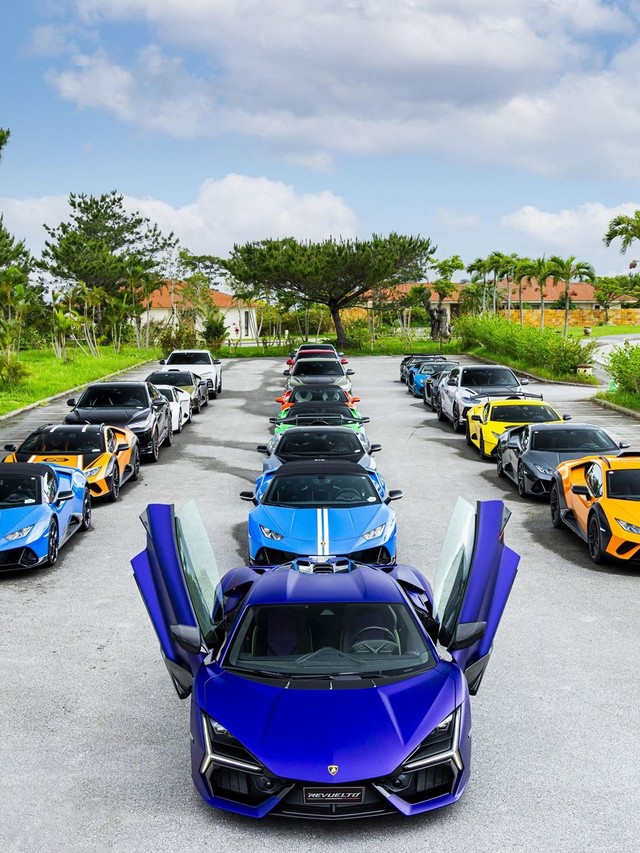
Looking back from the vantage point of 2025, the 2018 results read like the foundation for everything Lamborghini built afterward. The financial confidence generated by the Urus funded the transition to the Revuelto’s hybrid V12 architecture, the Temerario’s twin-turbo V8 program, and the GT3 racing pipeline that connects road car revenue to track credibility. Lamborghini delivered 10,747 cars in 2025, nearly doubling the 2018 record. The trajectory started here, with a Super SUV that skeptics inside the company once questioned and a supercar lineup that refused to slow down while the new arrival commanded the spotlight.
Gallery


