Supercars in Via Tortona: Lamborghini’s Milan Fashion Week Debut
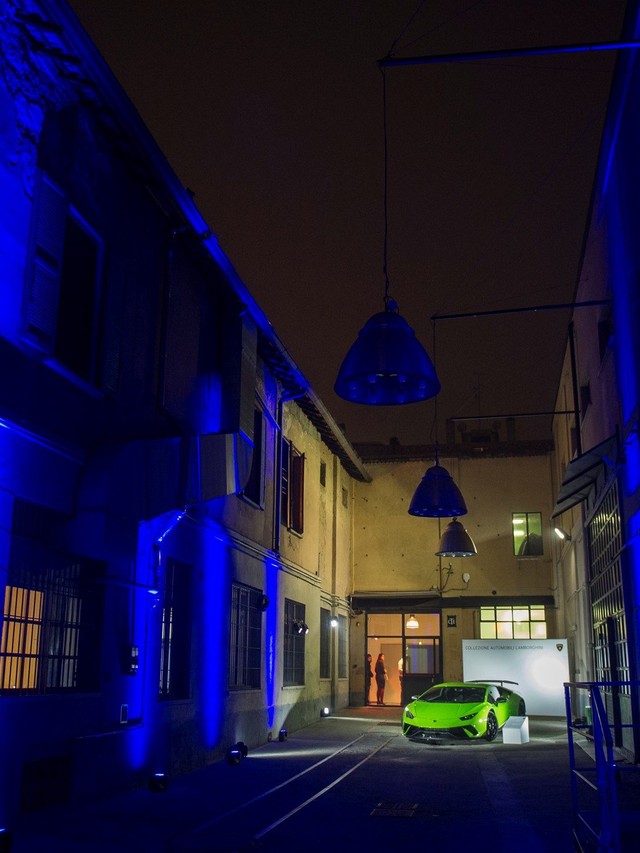
When Lamborghini staged a reception during Milan Men’s Fashion Week in January 2018 to present the Collezione Automobili Lamborghini fall-winter 2018-19, the company made sure nobody confused it with a pop-up merch table. The venue, set in the exposition spaces of Via Tortona, a reliable magnet for fashion and luxury press during the Milanese schedule, featured four cars arranged alongside the clothing: the then-new Urus Super SUV, the Countach 25° Anniversario, the Aventador S, and the Huracán Performante. An Authentic Living Riva 1920 display completed the staging.
That car selection told the story before a single garment came off the rack. Placing the Urus next to three icons of Lamborghini’s supercar lineage framed the SUV as part of the same bloodline, not a commercial outlier. The Countach reminded everyone that Lamborghini’s visual language predates most of the luxury fashion houses in attendance. And the Riva 1920 installation reinforced the idea that Lamborghini sees itself competing for the broader luxury wallet, not just the garage. Everything in the room pointed toward a single proposition: that the angular, aggressive design identity born in Sant’Agata Bolognese can extend convincingly beyond sheet metal.
Defining the ‘Lamborghini Man’: More Than a Logo on a Polo Shirt
The collection is structured around three lines, Informal Luxury, Casual, and Pilota Ufficiale, all built on what Lamborghini calls “Tailor Tech” items. The company promises high-quality construction, performance-oriented materials, and what it describes as 24/7 functionality. Key pieces include a parka, an event parka, a supercar jacket, a wool-tech blazer, a field jacket, a soft shell jacket, techno sweatshirts, and leather touchscreen gloves.
The underlying pitch is a “total look” for what Lamborghini envisions as its ideal customer: someone who wants to carry the brand’s aesthetic from a Monday business meeting through a weekend trip without looking like a walking billboard. According to FashionNetwork, Boris Puddu, who oversees the Collection and Licences division, put it bluntly: “We are not a derivative product, but a real fashion brand.”
Whether that ambition fully lands depends on execution and pricing, neither of which Lamborghini disclosed in detail. The intent, though, is unmistakable: the Collezione is designed to function as a standalone wardrobe, not a souvenir shop for people who just bought a Huracán.
Tailor Tech: Translating Engineering Language into Fabric
The term “Tailor Tech” borrows directly from Lamborghini’s automotive vocabulary, where every material choice serves a performance rationale. In the car world, that means forged carbon fiber, lightweight aluminum, and active aerodynamics. In apparel, it translates to technical fabrics, functional design details like touchscreen-compatible leather, and construction that Lamborghini positions as engineered rather than merely tailored.
The approach mirrors the company’s Ad Personam program for vehicle customization: offer a curated set of high-quality options that feel bespoke without requiring a buyer to navigate an entirely open-ended process. For enthusiasts, the interesting question is whether these garments genuinely reflect the R&D ethos Lamborghini claims, or whether “Tailor Tech” is marketing language applied to competent but unremarkable Italian sportswear. Without independent reviews of the fabric technology and construction quality, that remains an open question, one that cuts to the heart of whether the “total look” philosophy carries real substance or simply borrows the brand’s credibility.

A bright green Lamborghini Huracan is showcased under dramatic blue lighting in a narrow urban alley at night.
Cosmetics, Fragrances, and Urus-Branded Accessories
Perhaps the most eyebrow-raising announcement from the event was a new partnership with Swiss Prestige Cosmetics, resulting in a male cosmetics range called Men’s Code. For a company whose core product involves naturally aspirated V12 engines and carbon fiber monocoques, launching skincare is a significant brand stretch. Lamborghini says the partnership reflects a shared commitment to research and quality, though the company offered no specifics about the product line’s formulation or pricing.
Alongside Men’s Code, Lamborghini confirmed that its existing partnerships with Intertrade Group for L fragrances and Mizuno for running shoes would continue. New co-branded Special Editions, created with Italian luxury artisans Enzo Bonafè (shoes), Hettabretz (leather goods), and Tecknomonster (luggage), are dedicated specifically to the Urus. Tying premium accessories to the SUV rather than the Aventador or Huracán is a telling choice, and it reveals exactly where Lamborghini believes the lifestyle customer lives. The Urus buyer is more likely to travel with matching luggage than to show up at a track day, and the accessory strategy follows that logic precisely.
The Urus Effect: Why the SUV Unlocked a Lifestyle Strategy
Lamborghini’s decision to build an entire fashion and lifestyle ecosystem makes considerably more sense when viewed through the lens of the Urus launch. Before the SUV arrived, the brand’s customer base consisted almost entirely of supercar buyers, a group that skews toward collectors and driving enthusiasts who may or may not care about branded apparel. The Urus opened the door to a different demographic: affluent buyers who want a Lamborghini experience integrated into daily life, from the school run to the ski resort.
That buyer profile aligns naturally with a fashion collection, cosmetics, and premium travel accessories. Lamborghini essentially followed the Urus customer home and asked, “What else can we put our name on that you’d actually use?” The answer, apparently, is everything from a wool-tech blazer to a face cream. The “total look” philosophy only works if the customer already lives inside the brand for hours a day, and the Urus, unlike a weekend supercar, makes that possible.
How Lamborghini’s Fashion Play Compares to Ferrari and Porsche
Lamborghini is far from the only performance brand chasing lifestyle revenue. Ferrari operates a robust fashion and accessories division, Porsche Design functions as a semi-independent luxury brand covering everything from sunglasses to kitchen appliances, and Maserati partnered with Fendi on a special-edition GranCabrio as far back as 2011, blending automotive and fashion identities at the product level.
Lamborghini’s approach differs in one notable respect: the emphasis on building an integrated “total look” wardrobe rather than licensing the logo to third parties for individual products. Whether that distinction holds up in practice, or whether the Collezione ultimately occupies the same market space as Ferrari’s branded polo shirts, depends on how seriously the company invests in design independence and material quality over the long term. The cosmetics partnership with Swiss Prestige Cosmetics is the most aggressive move in the group, pushing into personal care territory that neither Ferrari nor Porsche currently occupies with a dedicated male-grooming line.
What This Means for Lamborghini Owners and Enthusiasts
For existing Lamborghini owners, the Collezione represents a chance to extend brand loyalty into categories that were previously afterthoughts. If you already spec your car through Ad Personam and care about matching your personal style to your vehicle, Lamborghini now wants to dress you, too. Whether the quality justifies the inevitable premium over comparable Italian menswear remains to be seen, as pricing and availability details were not disclosed at the Milan event.
For enthusiasts who follow the brand but do not own a car, the more interesting signal is strategic. Lamborghini committed to two Milan Fashion Week presentations in 2018 alone: the fall-winter collection in January, followed by a spring-summer 2019 preview in June at Palazzo Gavazzi. That cadence suggests a sustained commercial effort, not a one-off publicity stunt. The brand is betting that its visual language, angular, aggressive, unmistakably Italian, translates to fabric as convincingly as it does to sheet metal. The jury on that proposition will be the customers who actually wear the clothes, not the fashion press who attended the reception.


