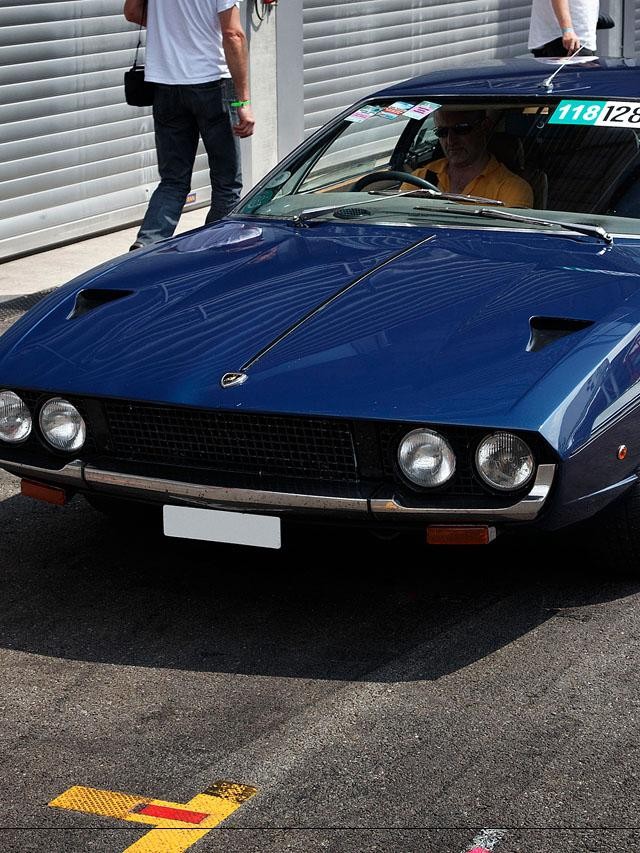
A V12 Grand Tourer Meets Pall Mall and a Zebra Crossing
In October 2018, Lamborghini loaded a blue 1976 Espada Series III onto a transporter in Sant’Agata Bolognese and sent it to London for a two-stop anniversary tour that was equal parts brand theater and genuine affection for one of the company’s most unusual cars. Chassis #9090, owned by the Lamborghini Museum, was chosen to represent the model’s half-century milestone in a city that knows a thing or two about automotive pageantry. The choice of London, and the specific landmarks the car visited, turned what could have been a routine heritage photo op into something more revealing: a statement about where the Espada sits in Lamborghini’s identity, and why the company believes its grand touring lineage deserves the same spotlight as its mid-engine legends.
The first engagement was a gala dinner at the Royal Automobile Club on Pall Mall, the institution founded in 1897 that remains one of the most prestigious motoring clubs in the world. Lamborghini says the Espada was displayed in the RAC’s Rotunda, a space traditionally reserved for the most significant automobiles in the club’s collection. RAC members and Lamborghini guests attended the celebration, which positioned the Espada alongside the kind of British motoring aristocracy that Ferruccio Lamborghini originally set out to challenge.
From Pall Mall, the car traveled to Abbey Road, where it was photographed on the pedestrian crossing in front of Abbey Road Studios, a deliberate nod to the 1969 Beatles album cover. The timing was no accident: August 2018 marked 50 years since the Beatles recorded “Hey Jude” at those same studios. Lamborghini paired two fiftieth anniversaries, one automotive and one musical, into a single visual that practically begged to be shared. The result was the kind of image that transcends car-enthusiast circles and reaches a broader cultural audience, which is precisely the point.
Why the Espada Matters: Lamborghini’s First Real Grand Tourer
Most Lamborghini enthusiasts can recite the Miura‘s legend by heart. The Espada’s story requires a bit more context, and that context is what makes the London tour more than a corporate anniversary exercise.
The Espada was Lamborghini’s first series production four-seater, a genuine 2+2 grand tourer that debuted in 1968 and stayed in production for a full decade. Marcello Gandini penned its sleek lines at Carrozzeria Bertone, the same designer responsible for the Miura and, later, the Countach. Where those cars prioritized visual drama and mid-engine purity, the Espada placed its 4-liter V12 up front and wrapped it in a body that could actually accommodate four adults and their luggage. Ferruccio Lamborghini’s original ambition was to build superlative grand touring cars for wealthy buyers who wanted style, comfort, and real long-distance capability. It arguably the purest expression of that vision.
One source reports that over 1,200 Espadas were produced during its ten-year run, making it one of the best-selling Lamborghinis of its era. That number speaks to genuine commercial success, not just critical admiration. In a period when the company’s finances were anything but stable, the Espada brought in consistent revenue and proved that a Lamborghini could appeal to buyers who needed rear seats and didn’t want to fold themselves into a cockpit designed for a racing driver.
The Series III model used for the London tour represents the final evolution of the design, with refinements to the dashboard, improved air conditioning, and power steering that made the car more livable on the kind of cross-continental journeys Ferruccio envisioned. Chassis #9090 is a late-production example, benefiting from a decade of incremental improvements. For a museum piece, it was a smart choice: polished enough to represent the model’s mature form, authentic enough to carry real provenance.
From Pall Mall to Abbey Road: Staging Heritage as Cultural Currency
Lamborghini could have parked the Espada at any number of London car shows or dealer events. Instead, the company chose two locations that carry cultural weight far beyond the automotive world, and that deliberate staging is what elevates the tour from nostalgia into strategy.
The Royal Automobile Club is not a car dealership with canapes. Founded over 125 years ago, it occupies a Pall Mall address that places it among London’s most exclusive private clubs, and its Rotunda display space carries genuine prestige in British motoring circles. Displaying the Espada there was a statement about the car’s standing as a serious grand tourer, not merely an Italian curiosity. For the RAC’s membership, many of whom collect and drive classic cars at the highest level, the Espada’s V12 credentials and Gandini lines needed no introduction.
The Abbey Road stop was a different kind of calculation entirely. By photographing the Espada on the world’s most famous pedestrian crossing, Lamborghini created an image that connects the car to a broader cultural moment. The visual reference to the Beatles’ album cover is immediately legible to millions of people who may never set foot in a supercar showroom. That kind of crossover appeal is difficult to manufacture, and Lamborghini’s timing, pairing the dual 50th anniversaries of both the Espada and “Hey Jude,” gave the whole exercise a narrative coherence that felt earned rather than forced.
This approach mirrors a broader trend in luxury automotive marketing: heritage events that function less as product launches and more as brand-identity exercises. Lamborghini’s Espada tour operated on a smaller scale than some rival programs, but the intent was similar. The company was reminding its audience that the brand’s history extends well beyond the Countach poster on a teenager’s wall, and that its grand touring lineage is both legitimate and culturally resonant.
The Espada’s Quiet Influence on Modern Lamborghini
If you squint at the Espada’s proposition, a V12-powered, four-seat Lamborghini designed for long-distance comfort and everyday usability, it starts to look like a distant ancestor of a vehicle that now accounts for a substantial share of Lamborghini’s sales: the Urus. The connection is not direct in any engineering sense. The Urus is a twin-turbo V8 SUV built on a shared Volkswagen Group platform, while the Espada was a hand-built front-engine GT with a Bizzarrini-derived V12. But the commercial logic is identical. Both cars exist because Lamborghini recognized that not every buyer wants a two-seat, mid-engine weapon. Some want the badge, the engine note, and the design language wrapped around a vehicle they can actually live with.
The Espada proved that idea could work in 1968. The Urus proved it again, at vastly larger scale, fifty years later. Lamborghini’s willingness to celebrate the Espada so publicly, rather than defaulting to another Miura retrospective, suggests the company understands this lineage and wants its audience to understand it too.
Lamborghini’s Polo Storico division restored one Espada and one Islero for the anniversary celebrations, a detail that underscores the company’s investment in keeping these cars alive as more than static museum displays. The Islero, which also marked its 50th anniversary in 2018, was designed by Mario Marazzi and occupied a more understated position in the lineup. Together, the two models represent a period when Lamborghini was exploring what a grand tourer could be, experiments that ultimately validated the idea of a practical, luxurious Lamborghini decades before the Urus made it a global sales phenomenon.
Mitja Borkert, Head of Design at Centro Stile Lamborghini, described sitting at the wheel of the Espada as a “once-in-a-lifetime experience.” Coming from the man responsible for the current design language, that comment carries weight. Borkert’s team draws on the entire Lamborghini archive for inspiration, and the Espada’s proportions, that impossibly long hood, the distinctive rear quarter windows, the low roofline that somehow accommodates four seats, represent a design challenge that remains relevant. How do you make a practical Lamborghini look like it belongs in the family? Gandini solved it in 1968. Borkert and his successors keep solving it today.
What This Means for Espada Collectors and Enthusiasts
Anniversary celebrations like this one tend to have a measurable, if sometimes delayed, effect on collector interest. When a manufacturer publicly validates a model’s significance, auction houses and private sellers take notice. Lamborghini did not announce any pricing data or market valuations as part of the London event, and specific collector values for the Espada remain outside the scope of what the company disclosed. What the source confirms is that Lamborghini considers the Espada important enough to send a museum car across Europe and stage it at two of London’s most recognizable landmarks.
For current Espada owners, the Polo Storico restorations signal that factory-correct parts and expertise remain available, a practical consideration that directly affects the cost and feasibility of maintaining these cars. Lamborghini’s heritage division exists precisely to support owners who want to keep their classic cars on the road rather than in climate-controlled storage, and the anniversary restorations serve as both marketing and proof of capability.
Forum discussion among Espada and Islero owners around the time of the anniversary reflected genuine enthusiasm for the factory’s attention. Collectors organized their own driving tours in Italy during September 2018 as part of the broader celebration, suggesting that the anniversary functioned as a community event and not merely a corporate exercise. That kind of organic owner engagement is something money alone cannot buy, and it reinforces the Espada’s position as a car that inspires loyalty rather than mere speculation.
Lamborghini’s public commitment to the model’s heritage, combined with Polo Storico’s restoration infrastructure, makes the Espada a more supportable classic than many cars of its era. Whether that translates into rising values depends on factors well beyond a single London dinner. But the institutional backing is real, and for a car that once languished in relative obscurity compared to its mid-engine siblings, that backing matters.

A classic blue Lamborghini Espada is captured on a zebra crossing, showcasing its timeless design on a London street.
Heritage as Strategy, Not Nostalgia
Lamborghini’s decision to stage the Espada’s 50th anniversary in London, at venues chosen for cultural resonance rather than automotive convenience, reveals how the company thinks about its own history. This was not a retrospective for the sake of retrospective. It was a calculated exercise in positioning the brand’s grand touring credentials alongside its more famous supercar identity.
The Espada was never the fastest Lamborghini, never the most dramatic, never the one that ended up on the poster. What it offered was something rarer: proof that Lamborghini could build a car you might actually want to drive to the south of France with your family, powered by a V12, drawn by one of the twentieth century’s great automotive designers, and wearing a badge that meant something entirely different from the competition. That the company chose to celebrate this car, at this scale, tells you that Sant’Agata Bolognese sees its future in more than two-seat exotica.
The Urus already proved the commercial case. The Espada’s anniversary tour made the emotional one.


