Lamborghini’s Latest Few-Off Arrives with Record Power and a Pointed Message
Every one of the 29 Lamborghini Fenomenos sold before the car broke cover at Monterey Car Week 2025. The new few-off limited edition pairs Lamborghini’s most powerful V12 with three electric motors for a combined 1,080 CV, making it the fastest road car Sant’Agata Bolognese claims to have built. Yet the numbers, impressive as they are, serve a broader purpose. Lamborghini describes the Fenomeno as a “design manifesto,” a phrase chosen to mark the 20th anniversary of Centro Stile, the in-house design department that opened in 2005 and shaped every Lamborghini from the Reventón onward.
That dual identity, record-breaking powertrain wrapped in a forward-looking design thesis, is what separates the Fenomeno from the few-offs that preceded it. Previous limited editions rewarded loyal collectors and tested isolated ideas. This one attempts something more ambitious: codifying a visual grammar for the next generation of Lamborghinis while simultaneously pushing the naturally aspirated V12 closer to its physical ceiling.
The car is based on the Revuelto, but calling it a reskinned version undersells the scope of the changes. The naturally aspirated 6.5-liter V12 now produces 835 CV at 9,250 rpm, with specific output exceeding 128 CV per liter, the highest figure in the history of Lamborghini’s twelve-cylinder engines. Combined with 245 CV from the three electric motors, the Fenomeno reaches 0-100 km/h in 2.4 seconds and tops 350 km/h. Its weight-to-power ratio of 1.64 kg/CV is another internal record. Stephan Winkelmann, Lamborghini’s Chairman and CEO, framed the car in terms of lineage: the Fenomeno “carries forward the same philosophy of distinction and innovation that is a fundamental part of our DNA.”
Centro Stile at Twenty: A Design Language Built to Migrate
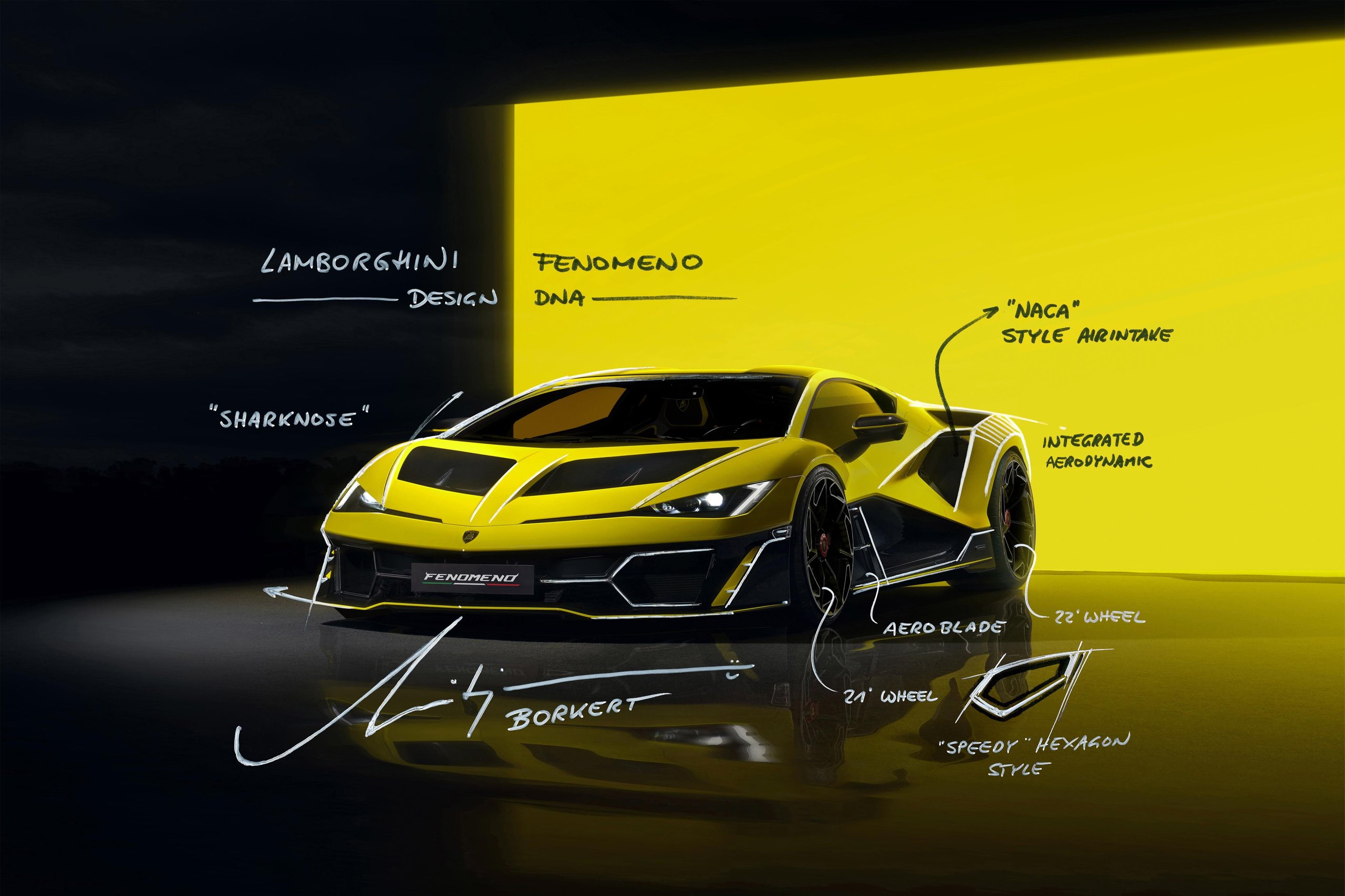
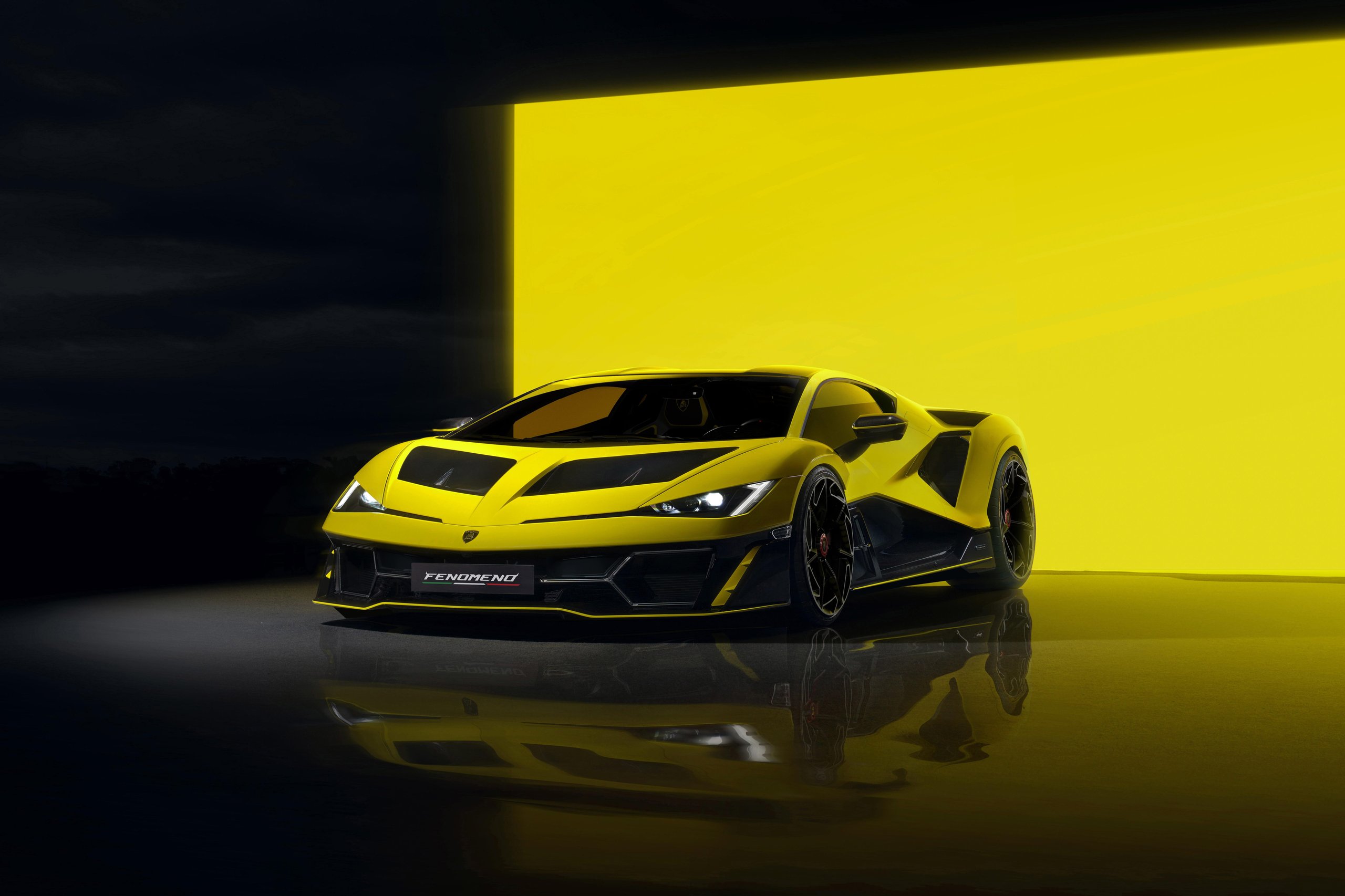
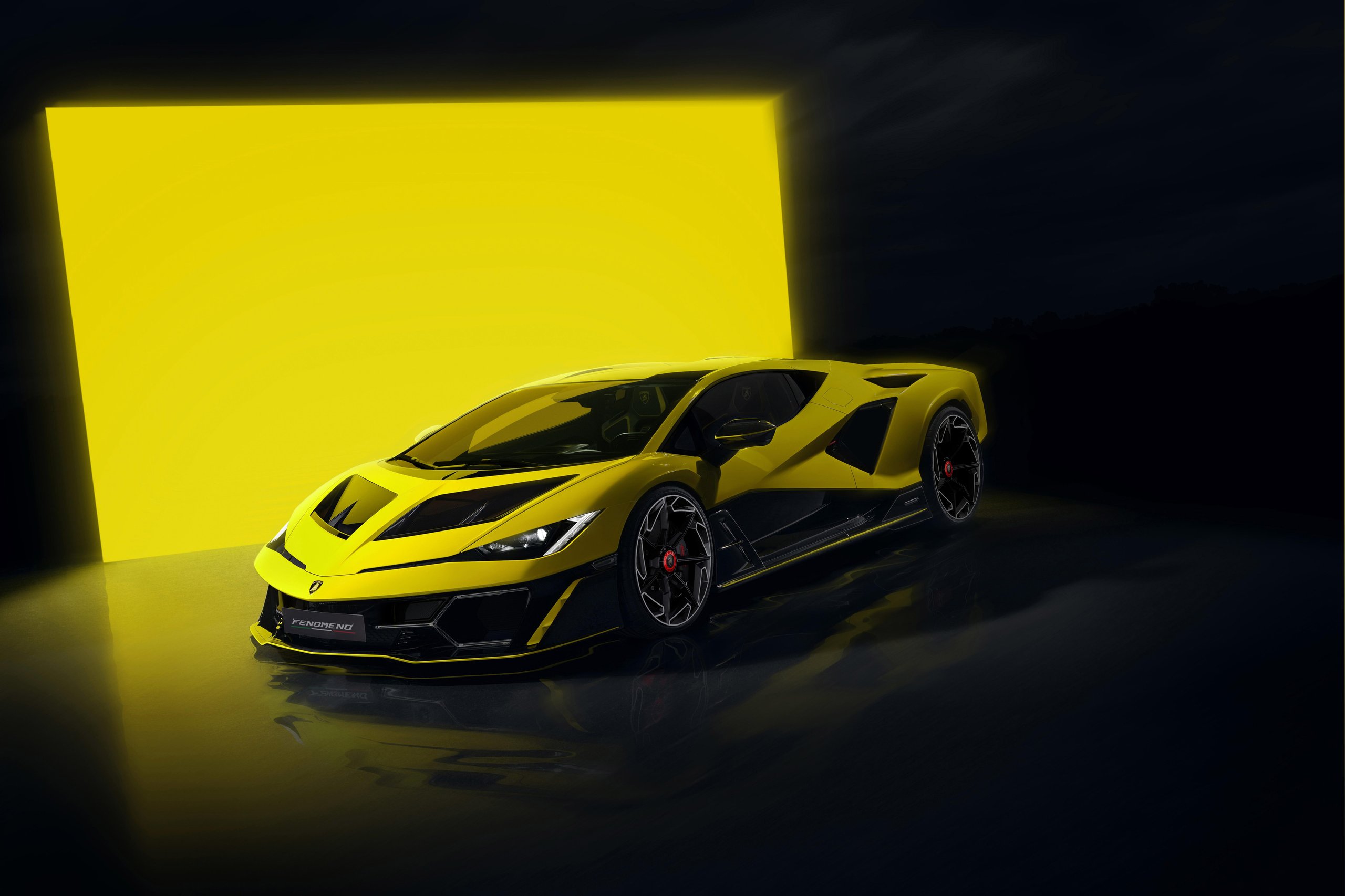
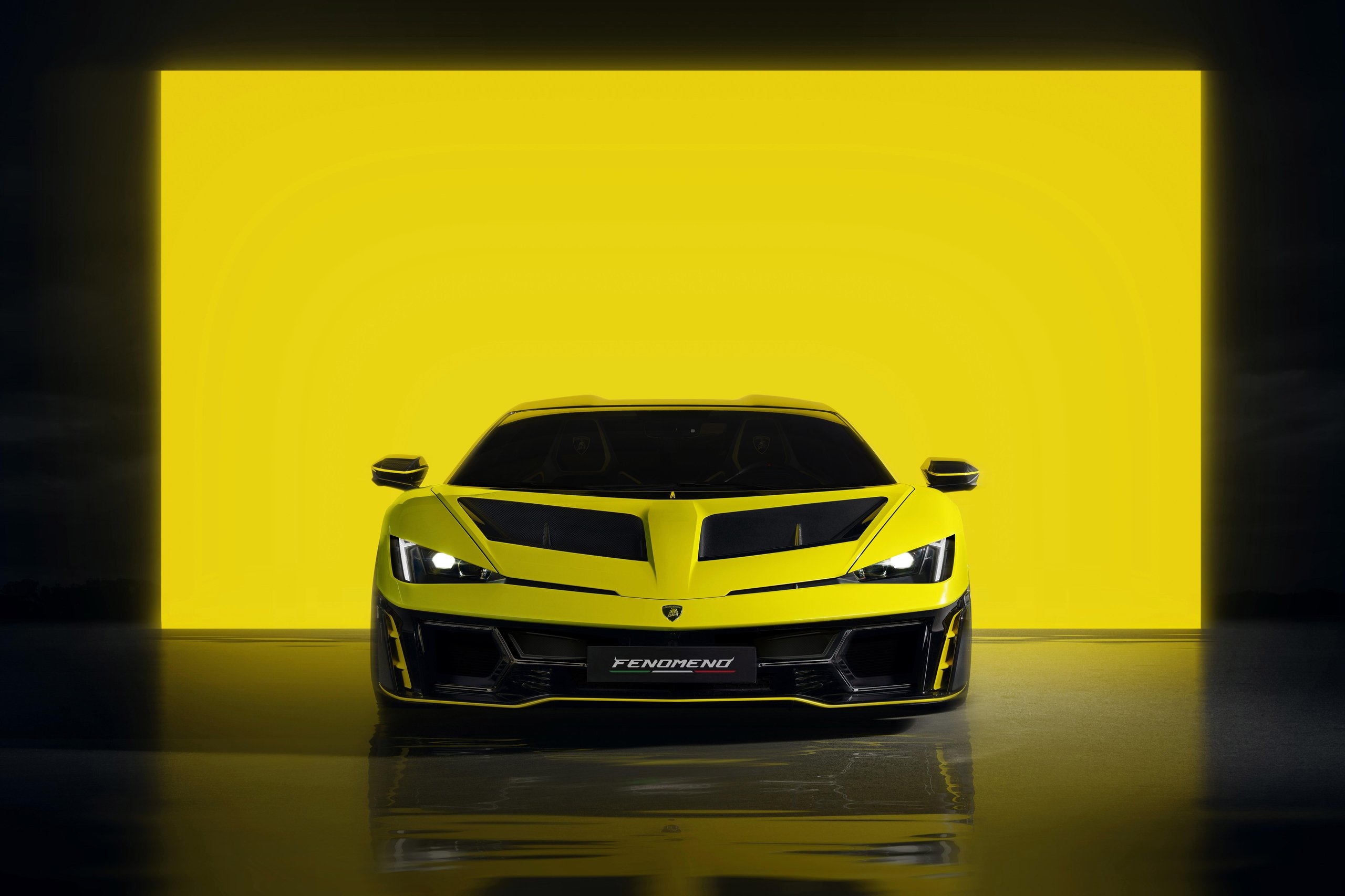
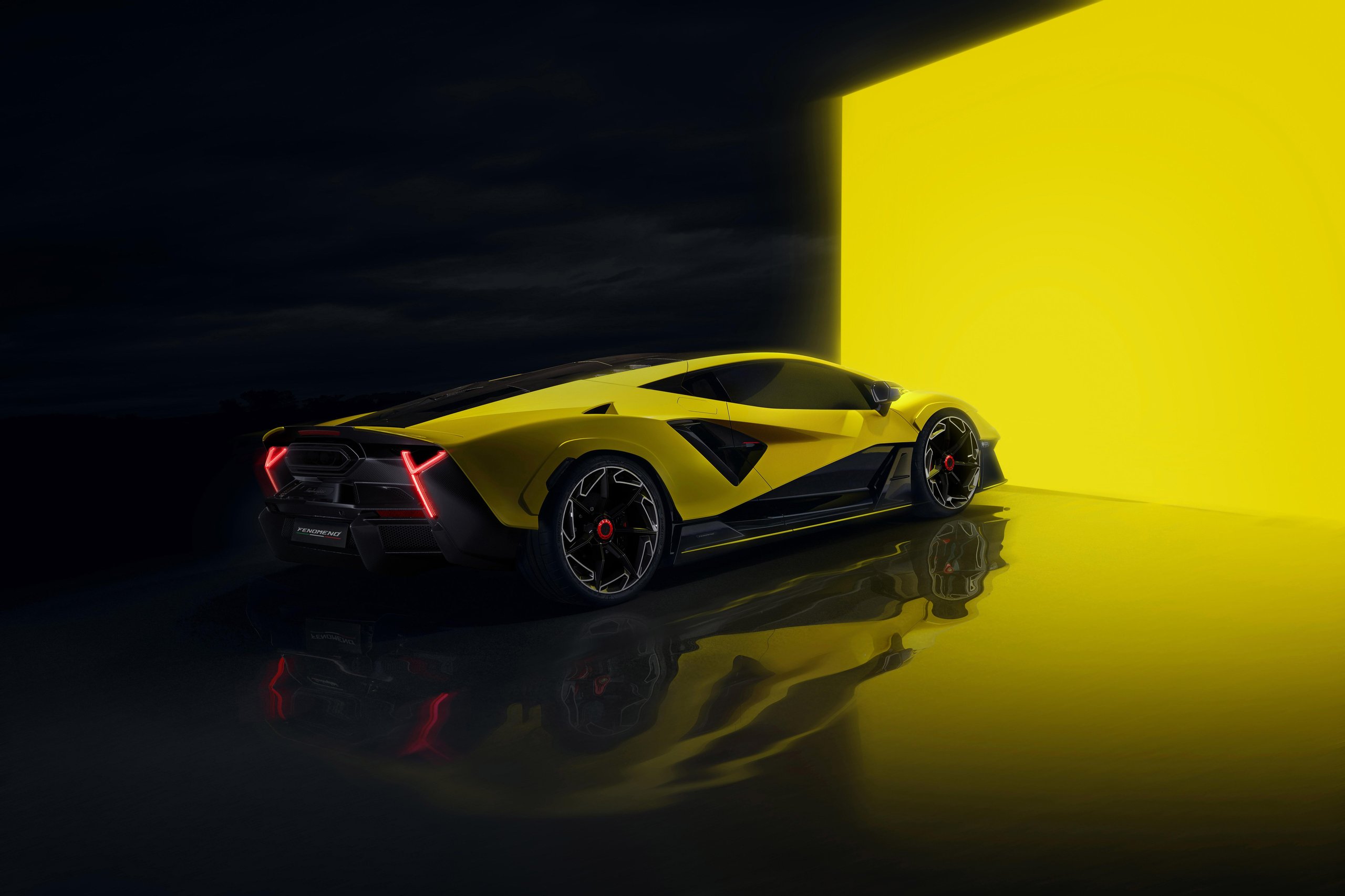
Lamborghini’s design infographics, signed by Director of Design Mitja Borkert, reveal specific nomenclature for the Fenomeno’s styling elements: a “Sharknose” front profile (internally called Il Squalo), a “Naga Style” air intake treatment, and “Speedy Hexagon” turbine-pattern wheels. The DRL light signature draws from the horns of the Lamborghini bull, while the side profile borrows its longtail proportions from the track-only Essenza SCV12. These are not decorative flourishes. They represent a codified design grammar that Centro Stile can deploy across future models.
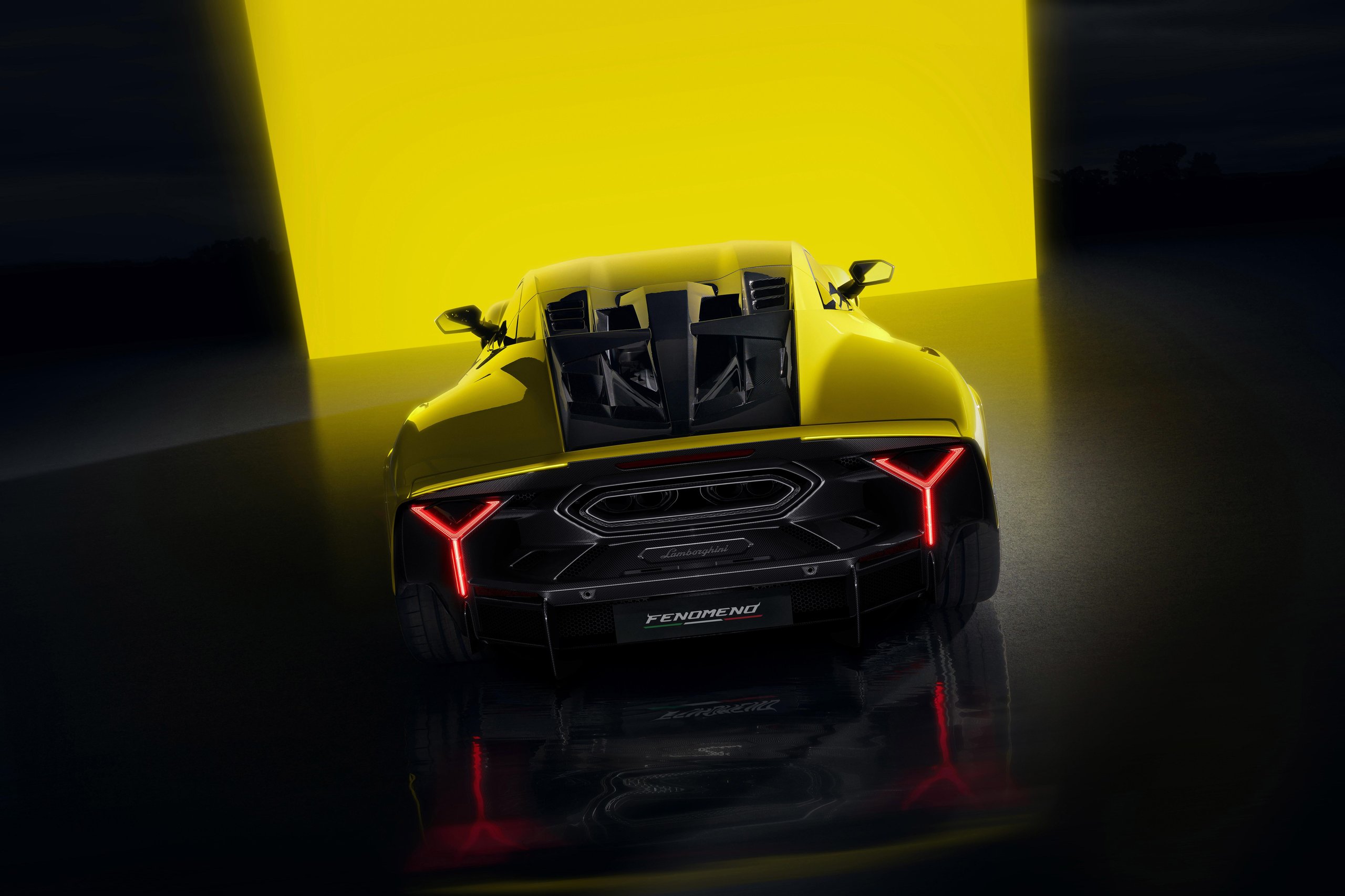
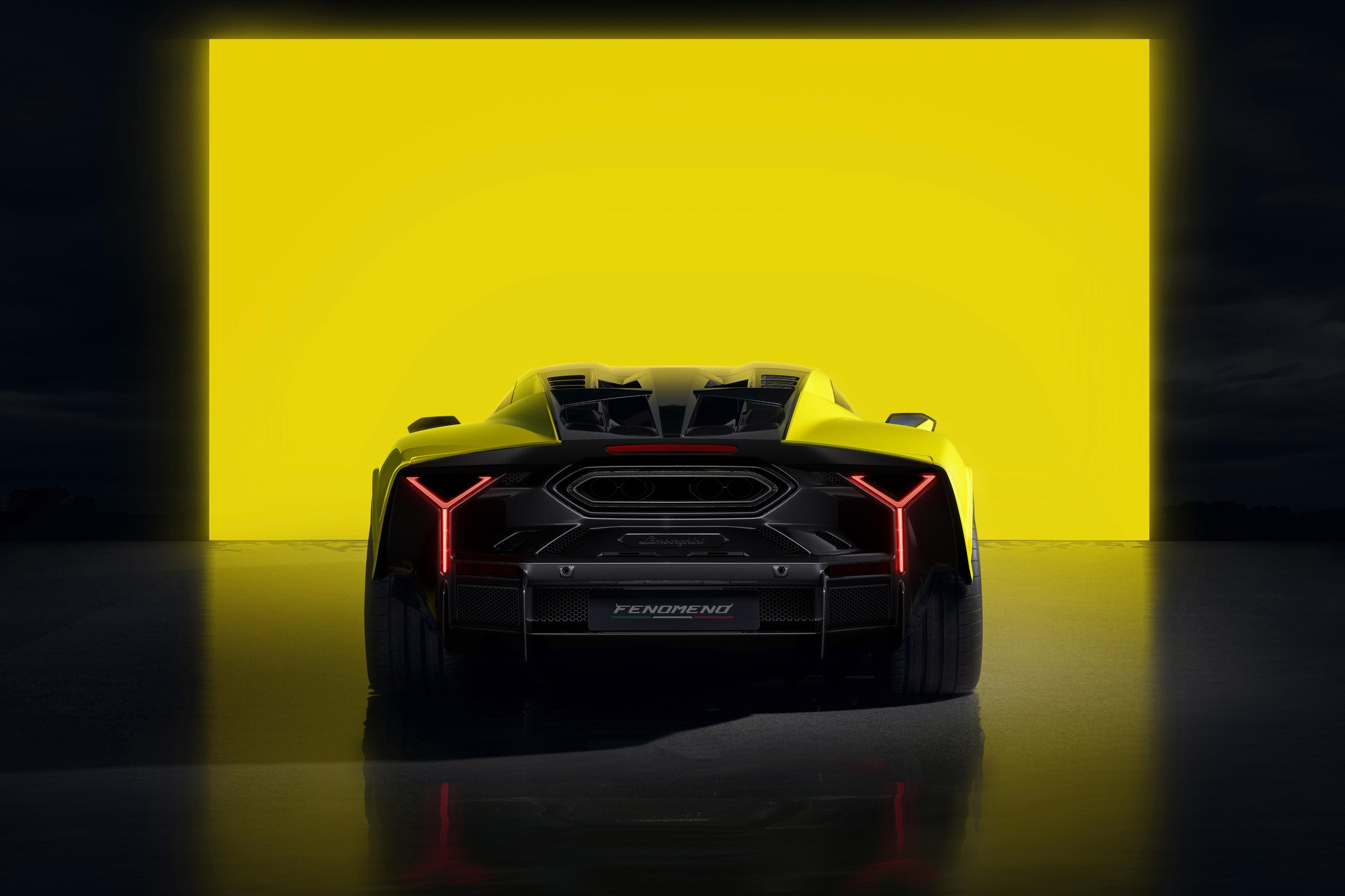
Borkert stated the team is “setting a new, authentic and brave course for our future-oriented design language.” Strip away the marketing polish and the implication is concrete: the Fenomeno’s reduced, cleaner surfaces and vertical Y-motif rear lighting are meant to preview where series-production Lamborghinis are heading. The new Automobili Lamborghini logo, unveiled in 2024, also makes its first appearance on a car here.
The NACA duct, a feature unique to Lamborghinis since the original Countach, receives a new stylistic interpretation on the Fenomeno’s doors, directing airflow to side-mounted radiators. Lamborghini says this arrangement delivers over 30% more efficient side-cooling compared to its series-production V12 models. When a design element simultaneously improves thermal management and establishes a visual signature, it tends to migrate into the lineup quickly. That convergence of form and function is the clearest evidence that the Fenomeno is less a celebration of the past than a blueprint for what comes next.

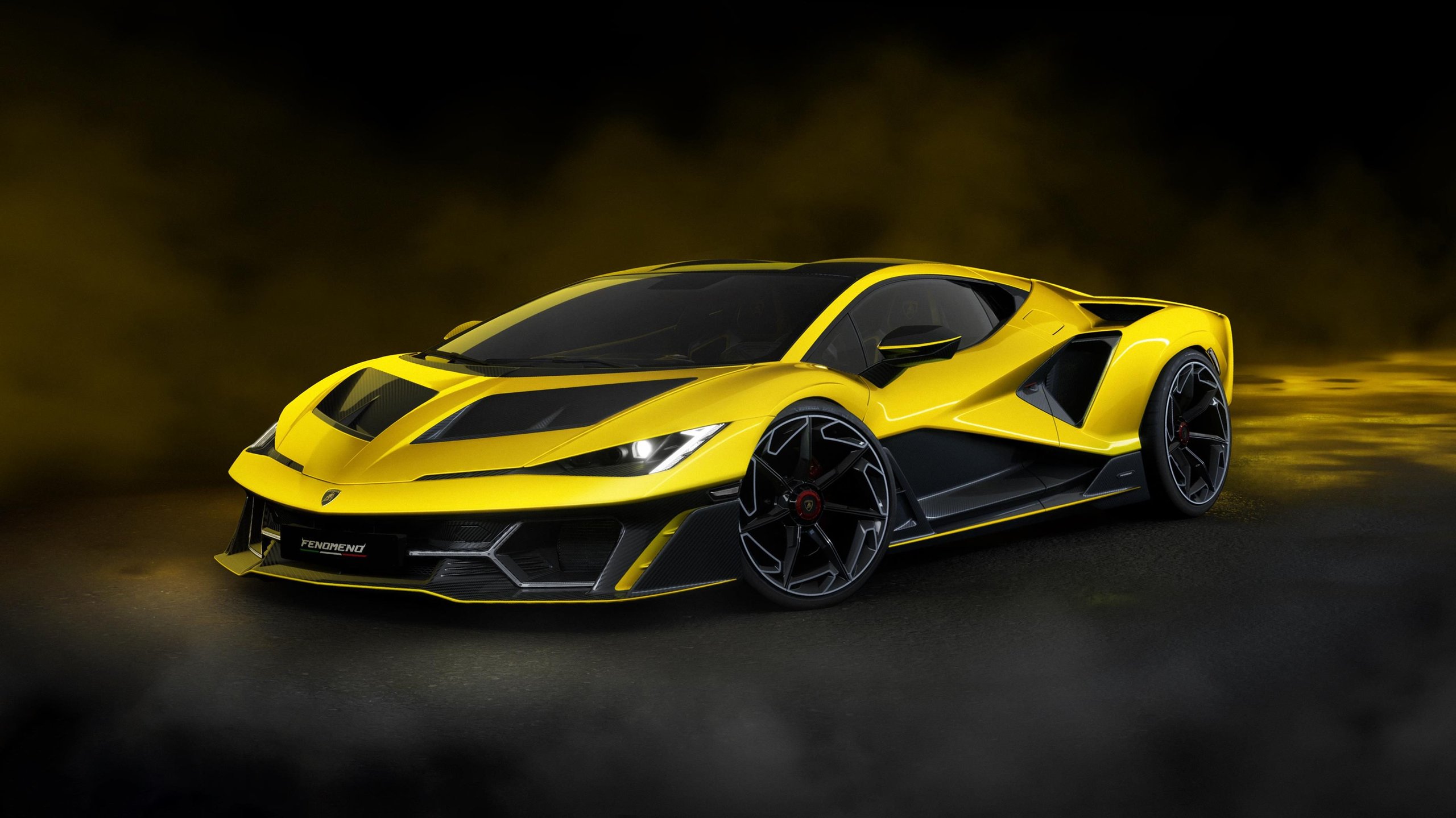
The Lamborghini Fenomeno's side profile showcases its iconic silhouette and 'sharknose' front design.
Race-Bred Hardware in a Road Car Shell
The powertrain architecture mirrors the Revuelto‘s layout: the V12 drives the rear wheels through an eight-speed dual-clutch gearbox, two oil-cooled axial-flux motors power the front axle (350 Nm each), and a third radial-flux motor sits above the gearbox to provide rear torque boost or enable electric-only driving via a 7 kWh lithium-ion battery. Each front motor weighs just 18.5 kg while producing 110 kW, a ratio that underscores how seriously Lamborghini’s engineers pursued mass reduction.
The chassis is where the Fenomeno diverges most sharply from its Revuelto foundation. CCM-R Plus carbon-ceramic brakes borrow technology from the SC63 LMDh prototype, and a 6D sensor feeds real-time speed and side-slip angle data to the dynamic control system. Single-nut forged wheels (21-inch front, 22-inch rear) wear custom Bridgestone Potenza Sport rubber developed specifically for this application. Sport-tuned suspension rounds out a package clearly calibrated for track credibility rather than boulevard posing.
As Road & Track reported in an interview with CTO Rouven Mohr, the Fenomeno represents a new type of few-off for Lamborghini, one where the engineering delta from the donor car goes substantially deeper than previous limited editions built from the Murciélago or Aventador platform. That deeper engineering commitment reinforces the manifesto thesis: when the design language and the mechanical underpinnings evolve in lockstep, the few-off becomes a proving ground rather than a cosmetic exercise.

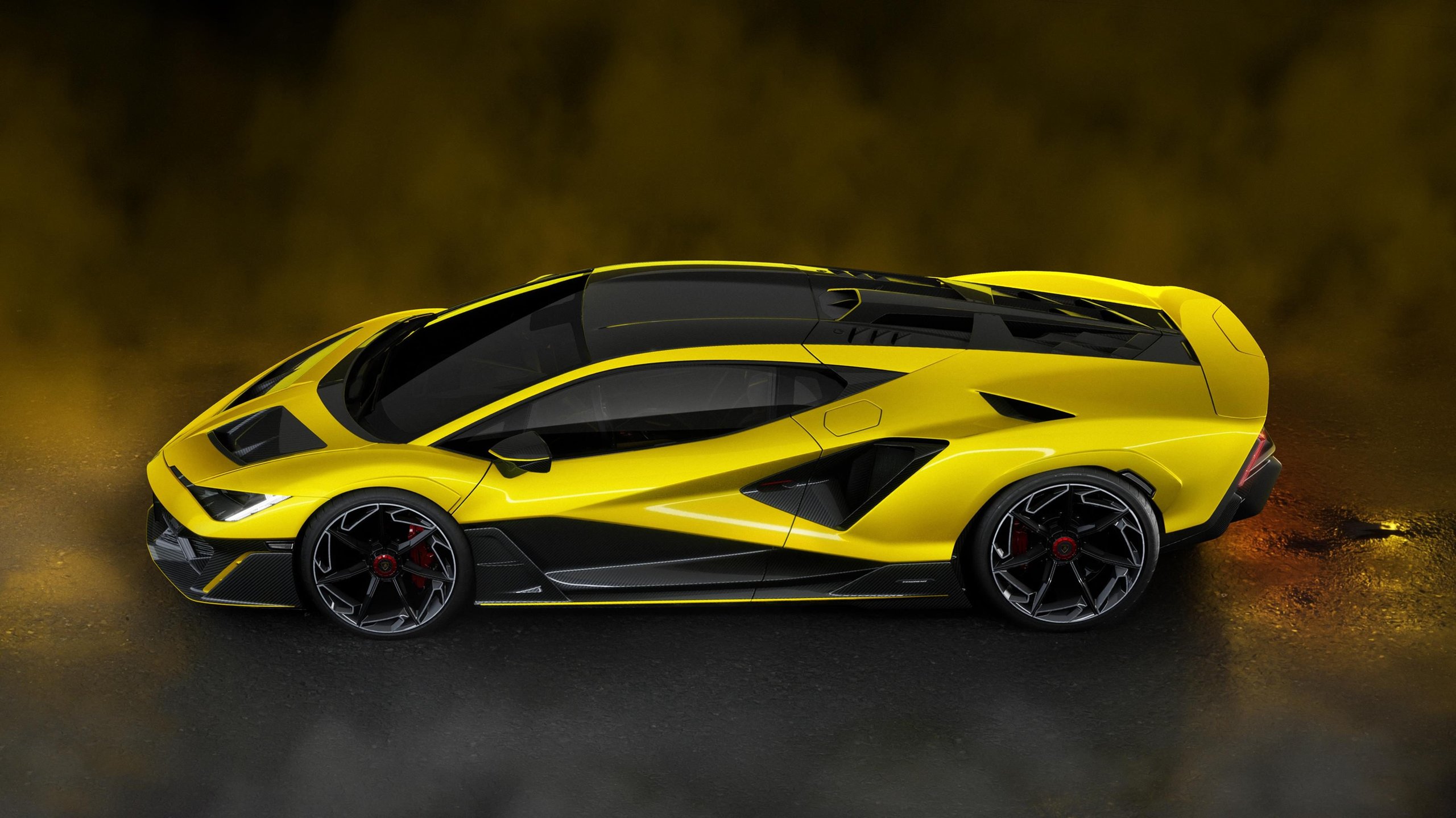
The Lamborghini Fenomeno concept car's side profile reveals its sleek, aerodynamic form and distinctive wheel design.
From Reventón to Fenomeno: The Few-Off Lineage in Context
The Fenomeno continues a sequence that began with the Reventón in 2007 and ran through the Sesto Elemento (2010), Veneno (2013), Centenario (2016), Sián (2019), and the reborn Countach (2021). Each car served a dual purpose: reward the most loyal collectors with something unobtainable, and use the freedom of limited production to test ideas that could filter into volume models. The Sián’s supercapacitor experiment, for instance, informed the hybrid thinking that eventually produced the Revuelto.
The Fenomeno follows that pattern but pushes the technical ambition further. Its Forged Composite front structure traces a direct material lineage back to the Reventón, where the chopped-carbon-fiber-in-resin technology first appeared on a Lamborghini road car. The monocoque itself uses multi-technology carbon fiber throughout. Naming the car after a pardoned fighting bull from Morelia, Mexico, in 2002 keeps the tradition of bovine nomenclature intact, while “Fenomeno” conveniently translates to “phenomenal” in both Italian and Spanish. Where earlier few-offs tested a single breakthrough, whether material science or electrification, the Fenomeno bundles design language, powertrain refinement, and chassis technology into a single statement of intent.
Inside the Cockpit and the Ad Personam Equation
The interior advances Lamborghini’s “Feel like a pilot” philosophy by stripping away most physical buttons in favor of three digital screens. Carbon fiber dominates: the center console, door panels, and bespoke bucket seats all use it as a primary structural material. 3D-printed air vents in the instrument cluster add a manufacturing detail that few competitors bother with at this production scale. Ambient lighting accentuates the cabin’s angular geometry.
Customization through the Ad Personam program offers over 400 exterior colors and what Lamborghini calls an “almost unlimited” range of interior configurations. For a 29-unit car, that personalization depth is commercially shrewd: it guarantees that no two Fenomenos will look alike at a concours, which matters enormously to collectors who measure exclusivity in details, not just production numbers. Lamborghini has not disclosed pricing, but every allocation sold before the public reveal, suggesting demand vastly exceeded supply and the window for prospective buyers appears firmly shut.

The Fenomeno's driver-centric cockpit features vibrant yellow accents, advanced digital displays, and a race-inspired steering wheel.
Where the Fenomeno Positions Lamborghini Against Its Rivals
Ferrari’s SF90 XX Stradale and McLaren’s ultimate-series models occupy adjacent territory, but neither competitor frames a limited-edition car as an explicit design thesis for the brand’s future. Ferrari’s few-offs tend to celebrate engineering milestones; McLaren’s lean on weight reduction and lap times. Lamborghini is doing something different by making the Fenomeno carry the weight of a 20-year design retrospective and a forward-looking aesthetic statement simultaneously.
The competitive edge is philosophical as much as mechanical. Lamborghini remains the only manufacturer in this segment extracting 835 CV from a naturally aspirated twelve-cylinder engine, a fact that resonates with enthusiasts who view turbocharging as a compromise regardless of the output it enables. Pair that engine character with hybrid torque-fill and race-derived hardware, and the Fenomeno makes a persuasive case that Lamborghini’s approach to electrification preserves what collectors actually value: the visceral, high-revving personality of the V12, supplemented rather than replaced by electric assistance.
As Car and Driver noted, the Fenomeno’s V12 produces nine more horsepower than the Revuelto’s unit. A modest gain in isolation, but in a naturally aspirated engine already operating near the limits of displacement and compression, every additional horsepower costs exponentially more engineering effort. That incremental climb is the quiet story behind the headline figures, and it captures the Fenomeno’s larger argument in miniature: Lamborghini’s future will be built not on revolution but on relentless, purposeful refinement of what already makes these cars phenomenal.

The Lamborghini Fenomeno concept reveals its powerful rear design, featuring signature Y-taillights and a prominent diffuser.
Gallery