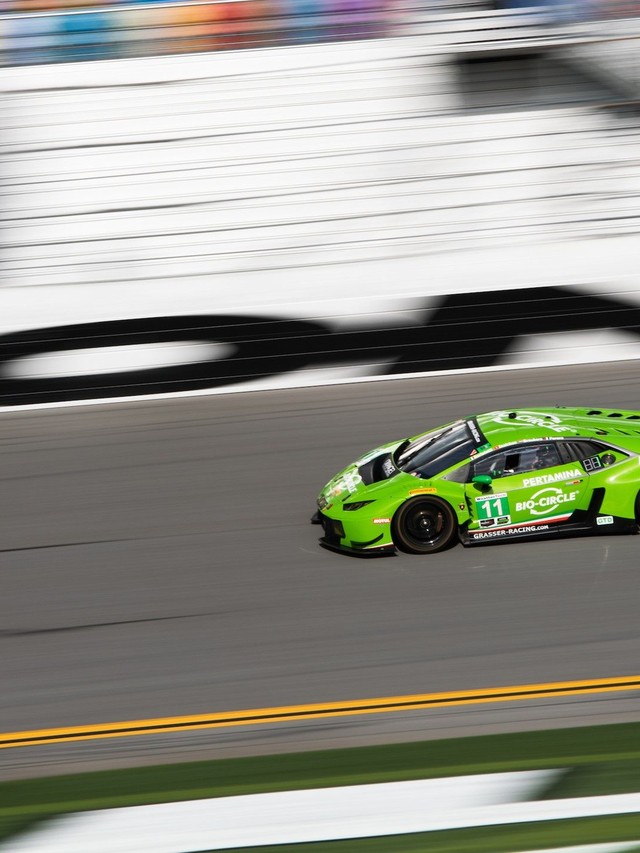
Lamborghini’s First GTD Triumph at Daytona
Grasser Racing Team‘s Lamborghini Huracán GT3 crossed the finish line first in the GTD category at the 24 Hours of Daytona, handing the brand from Sant’Agata Bolognese its inaugural victory at one of the world’s most demanding endurance races. The Austrian squad, already proven as winners of the 2017 Blancpain GT Series, fielded a crew of Lamborghini Factory Driver Mirko Bortolotti, Lamborghini Young Driver Rik Breukers, Franck Perera, and Rolf Ineichen. The breakthrough came just three years after the marque first raced on the Daytona tri-oval in 2016.
The result was not a solitary highlight. Paul Miller Racing’s #48 Huracán GT3 finished third in the same GTD class, with Lamborghini Factory Driver Andrea Caldarelli joined by Bryan Sellers, Madison Snow, and Brice Miller. Two Lamborghinis on the podium in a class populated by established GT racing brands carried weight well beyond a single result, and it set the tone for everything that followed.
Why This Win Reshaped Lamborghini’s Competitive Standing
For decades, Lamborghini occupied a peculiar position in the supercar world: a manufacturer whose road cars could match or exceed the performance of anything from Maranello or Stuttgart, yet whose motorsport presence remained thin enough to be an easy punchline. Ferrari’s racing DNA stretches back to the 1940s. Porsche’s endurance record at Le Mans and Daytona fills textbooks. Lamborghini, by contrast, built its identity around road car theater, its competitive racing history largely confined to one-make series.
A GTD victory at Daytona altered that narrative in a concrete way. The class features cars derived from recognizable production models and modified for racing, so a win here reflects directly on the underlying engineering of the road car platform. When a Huracán GT3 survives 24 hours of flat-out racing on Daytona’s punishing tri-oval and infield combination, it validates the V10 architecture, the chassis rigidity, and the cooling systems in a way no press event or track day ever could.
The GTD field at Daytona routinely includes entries from multiple manufacturers. Beating factory-supported programs from brands with far deeper endurance racing budgets, using customer teams rather than a full works effort, made the achievement sharper still. Grasser Racing and Paul Miller Racing are independent operations. They buy the car, they run the car, and Squadra Corse provides technical support. That model puts the burden of reliability squarely on the machine itself, and the machine proved equal to the task.
The Huracán GT3: Built to Last 24 Hours
Endurance racing is a brutal filter. A car can be the fastest thing on track for three hours and still fail spectacularly over twenty-four. The Huracán GT3’s ability to finish first and third in the same race speaks to something more interesting than outright speed: consistent, repeatable performance under sustained stress.
Giorgio Sanna, Lamborghini’s Head of Motorsport, framed the result as validation of both performance and reliability, calling it a target Squadra Corse set deliberately. That language matters. Lamborghini was not treating Daytona as a hopeful experiment. The team in Sant’Agata Bolognese engineered the GT3 program with this kind of result in mind, and the car delivered.
Cooling system upgrades, sequential gearbox calibration for sustained high-load running, and fuel system reliability over hundreds of pit cycles are all areas where the engineering team would have invested heavily, though the company’s official account focuses on the result rather than the recipe. That reticence is typical of Squadra Corse communications, but the 24-hour survival rate tells its own story. Finishing two cars on the podium is not luck; it is the product of engineering depth that only reveals itself under extreme duration.
Squadra Corse’s Strategy and the US Market
Stefano Domenicali, then Chairman and CEO, made a telling point in his public comments: he specifically highlighted the United States as a reference market and connected the racing victory to both motorsport and product ambitions. The link is deliberate. The US is Lamborghini’s largest single market, and American buyers tend to respond to racing success more directly than European customers, who often prioritize heritage and design lineage.
Squadra Corse’s approach to customer racing reinforced this strategy. Rather than fielding a single expensive factory team, Lamborghini built its GT3 program around supporting independent customer teams with a competitive, reliable car. Grasser Racing and Paul Miller Racing buy the Huracán GT3 and operate it themselves, with factory driver support and technical assistance from Sant’Agata. The advantage is reach: more cars on more grids, more visibility, and more teams invested in the brand’s success.
For anyone who follows GT racing closely, this represents a smart allocation of resources. Lamborghini’s motorsport budget is smaller than Porsche’s or Ferrari’s. Spending it on a GT3 car that wins in the hands of customer teams generates outsized return compared to pouring the same money into a single prototype effort. The subsequent introduction of the SC63 hybrid in the GTP class shows Lamborghini eventually pursued both strategies, but the GTD customer program was the foundation that proved the brand belonged at this level.
What Daytona Started: A Winning Streak and a New Identity
The 2018 victory was not a one-off. Reporting indicates Lamborghini went on to win the GTD class at Daytona three consecutive years, from 2018 through 2020, with Paul Miller Racing taking the 2020 edition. That kind of sustained dominance in a class designed to keep competition close through Balance of Performance regulations is remarkable. It suggests the Huracán GT3 platform offered something beyond raw pace: a combination of driver confidence, mechanical sympathy, and race-day adaptability that allowed different teams and driver lineups to extract winning results.
For Lamborghini owners and prospective buyers, the practical takeaway is straightforward. The Huracán’s engineering credibility was proven under the most severe conditions available in North American motorsport. When you buy a Huracán or its successor, you are buying a platform that survived Daytona repeatedly, not a car whose racing credentials exist only in marketing copy.
Lamborghini’s motorsport trajectory since this first win tells the broader story. The brand moved from GT3 customer racing into the top tier of prototype endurance competition with the SC63 hybrid, competing directly against the likes of Porsche, Ferrari, BMW, and Cadillac in the GTP class. Whether the SC63 program matures into a regular winner remains to be seen, but the confidence to attempt it traces directly back to what Grasser Racing Team accomplished on that January weekend at Daytona. A brand that once defined itself in opposition to racing now treats the racetrack as essential to its identity.
Gallery


