Lamborghini’s Electric Blueprint Lands in Paris
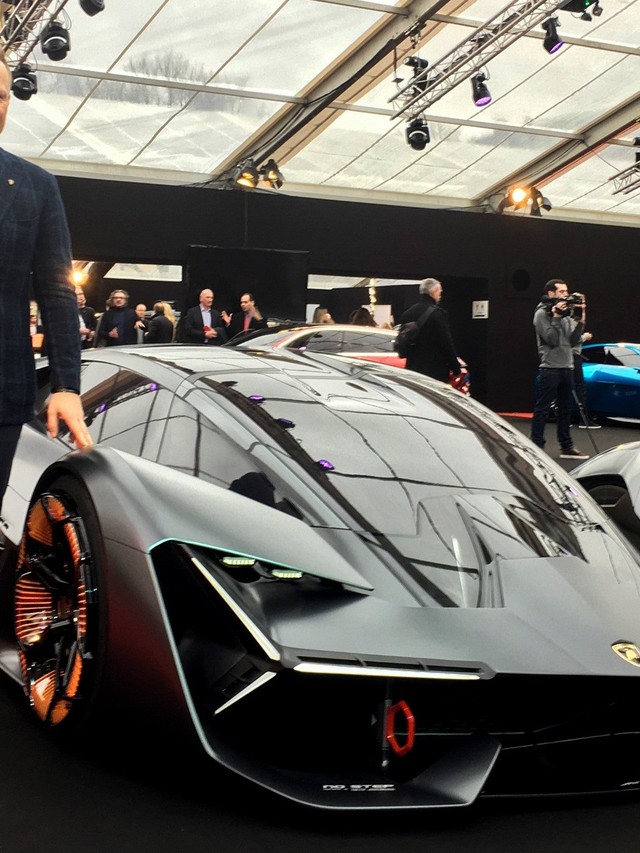
When the Lamborghini Terzo Millennio appeared at the 33rd Festival Automobile International in Paris from January 31 to February 4, 2018, it carried a question that no amount of carbon fiber and supercapacitor research could answer on its own: can a Lamborghini still feel like a Lamborghini without a combustion engine? The concept had already turned heads at its initial unveiling at the EmTech conference in Cambridge, Massachusetts, in November 2017, but Paris marked its first major European public showing, placing it alongside the automotive world’s most celebrated design exercises.
The name translates from Italian to “Third Millennium,” and the ambition matches the grandiosity. Realized by Lamborghini’s Centro Stile design center, the Terzo Millennio exists not as a preview of any specific production model but as a technology and design manifesto. It frames how Sant’Agata Bolognese intends to build a supercar that runs on electrons rather than hydrocarbons without surrendering the qualities that define the brand. That tension between radical propulsion and visceral emotion runs through every detail of the concept, and it continues to shape the cars Lamborghini builds today.
The Real Challenge: Emotion Without Exhaust Note
Every supercar manufacturer flirting with electrification faces the same uncomfortable question from its core buyers: will it still feel like our car? For Lamborghini, the stakes are unusually high. The brand’s identity has been woven around naturally aspirated engines, from the Miura’s transverse V12 to the Huracán’s screaming V10, for more than half a century. Strip the combustion engine away entirely and you remove the single most visceral element of the ownership experience.
The Terzo Millennio tackles this head-on by organizing its engineering research around five stated dimensions: energy storage systems, innovative materials, propulsion, visionary design, and, pointedly, emotion. Listing emotion as a formal engineering objective alongside battery chemistry and drivetrain architecture is a deliberate signal that the problem of how a future electric car feels is being treated with the same rigor as how it stores energy or puts power to the ground.
Whether that promise can be kept remains an open question. Lamborghini has not detailed how it would replicate the sensory drama of a high-revving engine in a silent electric powertrain, and the concept offers no answers on sound synthesis, haptic feedback, or cabin theatrics. The earlier Asterion plug-in hybrid concept, which debuted at the 2014 Paris Auto Show, was reportedly scrapped because it did not deliver the performance experience Lamborghini’s customers expected. That failure clearly informed the Terzo Millennio’s more ambitious, clean-sheet approach, one that treats emotion not as a byproduct of engineering but as its organizing principle.
MIT Partnership: Supercapacitors, Self-Healing Carbon Fiber, and Why They Matter
If emotion is the thesis, the technological backbone is a collaboration with two laboratories at the Massachusetts Institute of Technology, focused on the first two of those five dimensions: energy storage and innovative materials. One source reports the partnership represents a three-year, £100 million commitment, making it one of the more substantial academic-industry research programs in the supercar world.
On the energy storage front, the research targets supercapacitors rather than conventional lithium-ion battery packs. Supercapacitors can charge and discharge far more rapidly than batteries, which suits the burst-power demands of a track-focused supercar. The trade-off has always been energy density: supercapacitors store far less total energy per kilogram than lithium-ion cells. The MIT collaboration aims to close that gap, researching supercapacitors with capacities approaching those of current battery packs. One particularly inventive line of inquiry involves using the car’s carbon fiber body panels themselves as an energy storage medium, effectively turning the structure into its battery. For a brand that needs its electric future to feel instantaneous and explosive rather than smooth and muted, supercapacitors offer a character advantage that aligns with the concept’s emotional mandate.
The materials research is equally speculative and equally fascinating. Lamborghini and MIT are investigating carbon fiber components capable of detecting and repairing minor cracks autonomously before they propagate into structural failures. For an ultra-lightweight supercar built almost entirely from carbon fiber, this kind of self-healing capability could meaningfully extend the structural lifespan of the vehicle and, in theory, reduce long-term ownership costs for cars that currently demand expensive composite inspections and repairs after even minor incidents.
Both technologies remain firmly in the research phase. No timelines for production readiness exist, and Lamborghini has been careful not to promise specific applications. The value of the Terzo Millennio is directional, not calendrical.
Design Language: Angular, Aggressive, and Unmistakably Lamborghini
Chief designer Mitja Borkert and the Centro Stile team shaped the Terzo Millennio as a hatch-top coupé with proportions that push Lamborghini’s existing design vocabulary to an extreme. The concept’s surfaces are deeply sculpted and angular, with exposed wheel structures and integrated lighting elements that dissolve the boundary between aerodynamic function and visual drama. Viewed from any angle, it reads as a Lamborghini, which is precisely the point: a future electric supercar from Sant’Agata cannot afford to look like a generic EV with a raging bull badge.
The propulsion layout reinforces that identity. Individual electric motors mounted on each wheel eliminate the need for a central engine bay, transmission tunnel, or traditional drivetrain packaging. That architectural liberation allows the designers to lower the roofline, widen the stance, and create interior volume in ways that a mid-engine combustion car simply cannot. Whether production constraints would preserve those proportions is another matter entirely, but as a design statement, the Terzo Millennio demonstrates that Lamborghini’s visual aggression can survive, and perhaps even intensify, in the transition to electric power. The concept’s form argues that emotion is not only auditory; it can be sculpted into a silhouette.
From Concept to Production: Tracing the Terzo Millennio’s Influence
The Terzo Millennio did not lead directly to a production car, but its fingerprints are visible across Lamborghini’s current electrification strategy, branded “Direzione Cor Tauri.” One report describes the Revuelto, launched in 2023 as the Aventador’s successor, as the brand’s first V12 plug-in hybrid, combining its naturally aspirated 6.5-liter twelve-cylinder with three electric motors for a combined output of 1,001 horsepower. The same source notes the Temerario, replacing the Huracán, pairs an all-new twin-turbo V8 with three electric motors for 907 horsepower. Both models reportedly use lightweight axial-flux electric motors from YASA, and both offer electric-only driving modes for short distances.
Neither car is the fully electric supercar the Terzo Millennio envisioned, but they represent intermediate steps shaped by the same emotional imperative. The concept’s quad-motor, all-wheel-drive architecture anticipated the electric torque vectoring now central to both the Revuelto and Temerario. Its emphasis on lightweight materials and structural innovation echoes in every carbon-fiber tub rolling out of Sant’Agata today. And Lamborghini’s broader product roadmap, with a fully electric model reportedly planned toward the end of the decade (the Lanzador concept previews that direction), suggests the Terzo Millennio’s ambitions remain very much alive, just on a longer timeline than the concept’s dramatic styling might have implied. The thread connecting all of these cars is the same question the Terzo Millennio posed in Paris: how do you electrify a Lamborghini without losing the thing that makes it a Lamborghini?
Where Lamborghini Stands Against Electric Rivals
By 2018, the electric hypercar conversation was already heating up. Rimac was demonstrating that massive battery packs could produce staggering straight-line performance. Porsche was deep into Taycan development. Ferrari’s hybrid strategy, starting with the LaFerrari, had proven that electrification could enhance rather than dilute a supercar’s character. Lamborghini’s approach with the Terzo Millennio was distinct: rather than bolting electric motors onto an existing architecture or building a heavy, battery-dense grand tourer, the concept proposed rethinking the fundamental materials and energy storage chemistry from scratch.
That academic, research-first posture carries both advantages and risks. The advantage is that if supercapacitor or self-healing carbon fiber technology matures, Lamborghini could leapfrog competitors who committed early to conventional lithium-ion solutions. The risk is time. Rivals are delivering production electric and hybrid supercars now, while Lamborghini’s fully electric car remains years away.
For buyers watching this space, the practical takeaway is straightforward. Lamborghini’s current hybrid lineup, the Revuelto and Temerario, represents the company’s real-world answer to electrification today. The Terzo Millennio’s more radical technologies, supercapacitors as structural elements, self-healing bodywork, in-wheel motors, remain research propositions without confirmed production timelines. Yet the concept’s greatest contribution may be less about any single technology and more about forcing Sant’Agata to define, in concrete engineering terms, what “emotion” means when there is no V12 to do the talking. That definition, still evolving, still incomplete, is the real blueprint the Terzo Millennio left behind in Paris.
Gallery


