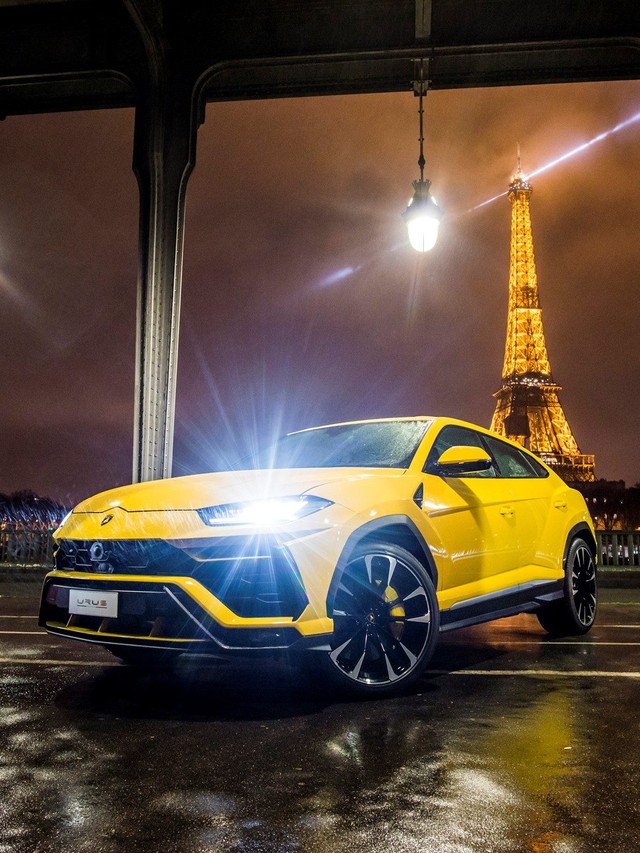
A Parisian Statement Wrapped Around a Super SUV
When Lamborghini chose the opening of its new Paris showroom to stage the French premiere of the Urus, the pairing told you everything about where Sant’Agata Bolognese was heading. A brand built on low, mid-engined supercars placed a bright yellow SUV under the lights of a flagship retail launch, and the message was unmistakable: the volume era had arrived.
Located at 2 Rue Bellini in Puteaux, the facility spans over 1,200 square meters and represents Lamborghini’s fifth sales point in France, joining existing locations in Lyon, Mulhouse, Cannes, and Monaco. The commercial partner is the Schumacher Group, a French family operation with seven decades in the automotive business. Lamborghini says the inauguration marked the Super SUV‘s first official French appearance ahead of European deliveries beginning in spring 2018.
Record Sales and the Math Behind Doubling Down
The timing was no accident. Lamborghini reported 127 deliveries in France and Monaco during 2017, a 35% jump over 2016 that made France the brand’s third strongest European market behind the UK and Germany. Globally, deliveries climbed from 3,457 to 3,815 units, a 10% increase that extended a seven-year growth streak. For context, Lamborghini delivered just 1,302 cars worldwide in 2010.
“With Urus market introduction we forecast a new record year in France in 2018,” said CEO Stefano Domenicali at the inauguration.
The company announced plans to double its total sales by 2019. For a manufacturer whose entire annual output a few years earlier could be swallowed by a single busy Porsche dealership region, that ambition required a fundamentally different kind of car. The Urus was the instrument, and the Paris showroom was the retail infrastructure being built to receive it.
Why the Urus Changed the Equation
Lamborghini says the Urus is powered by a 4.0-liter V8 twin-turbo engine producing 650 hp at 6,000 rpm and 850 Nm of torque from just 2,250 rpm. At the time of its launch, the company claimed a 0-100 km/h sprint of 3.6 seconds, a 0-200 km/h time of 12.8 seconds, and a top speed of 305 km/h, numbers Lamborghini used to position the Urus as the fastest SUV available.
Those figures mattered less for bragging rights than for credibility. A Lamborghini SUV needed to feel fast enough that the badge on the nose was not aspirational fiction. The twin-turbo V8 departed from the naturally aspirated engines defining the Huracán and Aventador, but it delivered the kind of low-end torque and all-weather usability an SUV buyer actually needs. Purists could argue about cylinder counts and aspiration philosophy. Lamborghini was betting that a much larger audience would argue with their wallets.
The new Paris showroom reflected this bet physically. Lamborghini says the display area was sized to accommodate the full product range, including the Urus, with a client lounge featuring the brand’s car configuration system and a dedicated service center. It was the first French facility built to Lamborghini’s updated showroom design language, essentially a retail environment engineered for a three-model lineup rather than two.
The Exclusivity Question Lamborghini Knew Was Coming
Every supercar brand that launches an SUV faces the same tension: volume pays for the halo cars, but volume also dilutes the mythology. Porsche navigated this with the Cayenne over a decade earlier, enduring years of purist backlash before the SUV’s profits funded development of cars like the 918 Spyder and the current GT division lineup. Lamborghini was following a proven playbook, but with far less margin for error given its smaller scale and more extreme brand positioning.
The skepticism was real. Forum discussion among Lamborghini enthusiasts at the time frequently questioned whether the Urus was a genuine Lamborghini or simply a rebadged product from elsewhere in the Volkswagen Group. The car sits on the MLB Evo platform shared with the Audi Q7, Bentley Bentayga, and Porsche Cayenne, a detail that fueled the debate. Lamborghini’s counter-argument was in the execution: the sharpest styling in the segment, the most aggressive performance targets, and a driving character tuned to feel distinct from its platform siblings.
With hindsight, we know how this story played out. The Urus rapidly became Lamborghini’s best-selling model by a wide margin and funded the development of the Revuelto and Temerario. The company eventually crossed the 10,000-unit annual delivery barrier, then chose to cap production rather than chase unlimited growth, a move designed to protect residual values and desirability. The strategy worked commercially. Whether it preserved the soul of the brand depends entirely on which Lamborghini owner you ask.
What the Paris Playbook Meant for Buyers
For prospective Urus buyers in France, the practical takeaway was straightforward: a proper showroom with service capability in the Paris region meant you no longer needed to travel to Lyon or the Riviera for purchase, configuration, or maintenance. The Schumacher Group’s long automotive pedigree suggested a dealer partner chosen for operational competence rather than just financial capacity.
The broader signal ran deeper. Lamborghini was building retail infrastructure sized for a future in which it sold roughly twice as many cars annually. Existing Huracán or Aventador owners in France faced the question of whether sharing their showroom with an SUV clientele changed anything about their ownership experience. New buyers drawn to the brand specifically because of the Urus had a simpler answer: Lamborghini was making it easier than ever to walk through the door.
That tension between welcoming new customers and reassuring existing ones defined the Urus era from its first public appearance. The Paris showroom opening, modest as a ribbon-cutting might seem, was one of the earliest physical manifestations of a strategy that would fundamentally alter Lamborghini’s commercial scale and, inevitably, its character.
Gallery


