Lamborghini Earns a Seat at Italy’s Most Exclusive Tax Table
Automobili Lamborghini announced its formal admission to the Italian Revenue Agency’s cooperative compliance program, effective from the 2022 tax year. The application process began in May 2022 and concluded on December 18, 2023. This voluntary program, established under Legislative Decree 128/2015, replaces the adversarial cycle of post-filing audits and potential litigation with an ongoing, transparent dialogue between a company and Italian tax authorities. Rather than waiting for a tax dispute to land on a lawyer’s desk, both sides resolve questions in advance.
For a company that builds six-figure supercars in Sant’Agata Bolognese, the practical benefit is certainty. Lamborghini says the agreement enables preventive tax risk management and fast-track resolution of disputes, eliminating drawn-out legal battles and increasing clarity on significant tax matters before they become contentious. Think of it as Lamborghini choosing to open its financial books proactively rather than waiting for someone to knock.
The reason any enthusiast should care about Italian fiscal bureaucracy is simple: the boring infrastructure of corporate governance is precisely what keeps exciting cars coming off the line. A company tangled in tax litigation, reputational damage, or regulatory uncertainty cannot invest confidently in the next hybrid powertrain or fund a Squadra Corse season. This admission signals that Lamborghini’s financial house is in order, and that the company intends to keep it that way.
Why a Supercar Maker Volunteers for More Scrutiny
Luxury automakers do not typically rush to invite tax authorities deeper into their operations. The decision to pursue cooperative compliance, rather than simply meeting minimum reporting requirements, reflects a deliberate strategic posture. Lamborghini says the move responds to increasing stakeholder interest in the company’s fiscal policies, framing it as a way to strengthen its ESG governance pillar through improved financial accuracy.
Strip away the acronyms, and the logic is commercial. Investors, partners, and the Volkswagen Group itself all benefit when a subsidiary can demonstrate airtight financial discipline. For Lamborghini specifically, voluntary transparency reinforces the brand’s credibility as a well-managed luxury enterprise, not just a factory that happens to produce beautiful machines. In an era when even supercar buyers pay attention to corporate responsibility, particularly in European markets where ESG scrutiny shapes institutional investment, the move carries weight well beyond compliance.
Lamborghini also adopted a comprehensive Tax Policy document aligned with Audi Group guidelines and international best practices, according to web-sourced reporting. That policy covers tax management, compliance, benefits, and incentives, codifying how the company approaches its fiscal obligations across every dimension. Paired with the cooperative compliance admission, it paints a picture of a company building institutional guardrails well beyond what Italian law requires.
The competitive context adds perspective. Ferrari, as a publicly traded company, faces relentless quarterly scrutiny from shareholders and analysts. McLaren operates as a privately held group with less public financial visibility. Lamborghini occupies a middle ground: privately held within the Volkswagen Group structure, but now voluntarily subjecting itself to a level of fiscal transparency that few competitors in the supercar segment pursue. That willingness to be examined is, in itself, a competitive advantage when courting institutional stakeholders and justifying continued investment from Wolfsburg.
Paolo Poma’s Perspective and the VW Group Connection
Paolo Poma, Lamborghini’s Chief Financial Officer and Managing Director, positioned the admission as a natural extension of how the company already operates.
“Cooperative compliance is the natural continuation of the collaborative and transparent relationship Lamborghini has always had with the government institutions, which has produced tangible results over the years in the important development of the company, to the benefit of all its stakeholders.”
Poma also emphasized that the program fits squarely within the integrity and compliance model adopted by the Volkswagen Group, and that it advances Lamborghini’s own sustainability goals. That VW Group alignment matters more than it might appear at first glance. After the diesel emissions scandal that rocked Wolfsburg in 2015, the entire group overhauled its compliance architecture. Every subsidiary, from Porsche to Bentley to Lamborghini, now operates under a governance framework designed to prevent exactly the kind of institutional failure that nearly destroyed the parent company’s reputation.
For Lamborghini, conforming to that framework is both an obligation and an opportunity. VW Group standards are non-negotiable for subsidiaries. Yet a subsidiary that demonstrates exemplary governance earns credibility within the group hierarchy, credibility that translates into influence over budget allocation, product planning autonomy, and strategic independence. Lamborghini’s current position within VW Group is enviable: record financial results, a fully refreshed product lineup, and the freedom to pursue its Direzione Cor Tauri electrification strategy on its own terms. None of that happens if the financial side of the house is messy.

A confident executive stands in a modern Lamborghini factory, with the striking orange Revuelto visible in the background. Image: Automobili Lamborghini.
The Financial Engine Behind the Supercars
Corporate governance stories rarely generate the same excitement as a new model reveal, but the financial health they protect is what makes those reveals possible. According to Road & Track, Lamborghini reported record deliveries and revenue in 2025, with multiple new cars expected to debut in 2026 and the company’s first EV potentially back in the mix. Revenue reportedly reached €3.20 billion with an operating income of €768 million, based on web-sourced financial reporting.
Those are extraordinary numbers for a company that produces a fraction of the volume of mainstream automakers, and they explain why Lamborghini can afford to invest in projects like the Revuelto’s hybrid V12 architecture, the Temerario’s twin-turbo V8, the Urus SE plug-in hybrid, and the eventual Lanzador electric GT. Each of those programs requires billions in development capital. A company that cannot demonstrate financial discipline and transparency to its parent group simply does not get that kind of investment latitude. The cooperative compliance admission is, in effect, another piece of evidence Lamborghini can present to Wolfsburg when the next budget conversation begins.
Enthusiast forum discussion around Lamborghini’s financial trajectory reflects genuine interest in the brand’s business health. Multiple threads on Lamborghini-Talk analyze annual results and debate whether the company can sustain its current momentum. The consensus among engaged owners and followers appears to be cautious optimism: the product lineup is strong, the order books are full, and the brand’s positioning in the ultra-luxury segment continues to sharpen.
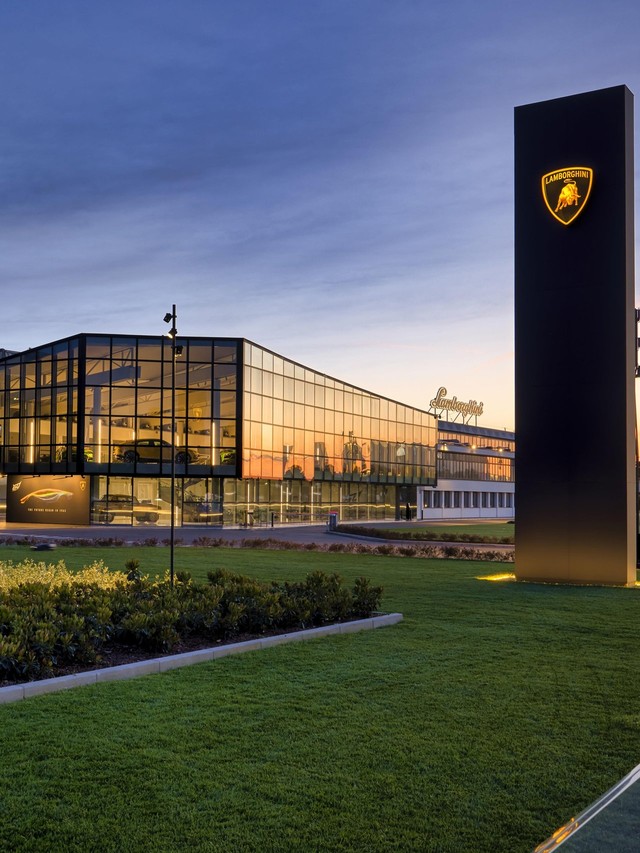
Lamborghini’s Sant’Agata Bolognese headquarters reinforces this narrative of reinvestment. The facility has maintained carbon neutrality on balance since 2015, according to independent reporting. Self-generated energy at the plant increased by 22% in 2024, and waste recovery improved by 15% over the same period. Lamborghini also published its first voluntary Sustainability Report, aligned with both GRI and European ESRS standards, as reported by Automotive World. These are not vanity metrics. They represent the kind of operational discipline that justifies continued group investment and regulatory goodwill, the same discipline that the cooperative compliance program now extends to the fiscal domain.

A stunning lineup of Lamborghini supercars, including the new Revuelto, parked outside the iconic factory building at twilight. Image: Automobili Lamborghini.
What This Means for Buyers and the Brand’s Future
If you are waiting on a Revuelto allocation, configuring a Urus SE, or watching the Lanzador concept evolve toward production, this corporate compliance story affects you more directly than it might seem. A financially stable, well-governed Lamborghini is one that can honor its product commitments, maintain residual values, and invest in the after-sales infrastructure that ownership demands. Nobody wants to buy a half-million-dollar supercar from a company whose corporate house is in disarray.
Lamborghini’s voluntary pursuit of enhanced fiscal transparency, combined with record financial performance and a fully refreshed product lineup, suggests the brand is operating from a position of unusual strength. For prospective owners, that stability translates into confidence that the car you order today will be supported by a company that plans to be around, and thriving, for decades.
The contrast with competitors is instructive. Ferrari’s public listing provides transparency through mandatory quarterly disclosures, but also subjects the company to the short-term pressures of equity markets. McLaren’s private structure offers flexibility but less public accountability. Lamborghini, sheltered within VW Group but now voluntarily exceeding its compliance obligations to Italian authorities, occupies a distinctive position: the financial rigor of a publicly accountable company without the quarterly earnings pressure that can distort product decisions.
One detail worth watching: Lamborghini confirmed that the cooperative compliance program allows for ongoing, continuous tax assessment rather than periodic audits. That structural shift from reactive to proactive financial management mirrors the company’s broader strategic philosophy under Stephan Winkelmann’s leadership. Whether the subject is electrification timing, motorsport investment, or production volume discipline, Lamborghini consistently chooses controlled, deliberate action over reactive scrambling. The fiscal compliance admission is the financial expression of that same instinct.
The supercar industry rewards brands that combine engineering brilliance with institutional discipline. Lamborghini’s admission to Italy’s cooperative compliance program will never generate the visceral excitement of a new model launch, but it builds the foundation that makes every future launch possible. For a brand currently delivering record revenue while simultaneously electrifying its entire lineup, that foundation matters enormously.

The iconic Lamborghini emblem, featuring the charging bull, gleams on a metallic bronze-orange surface. Image: Automobili Lamborghini.
Gallery


