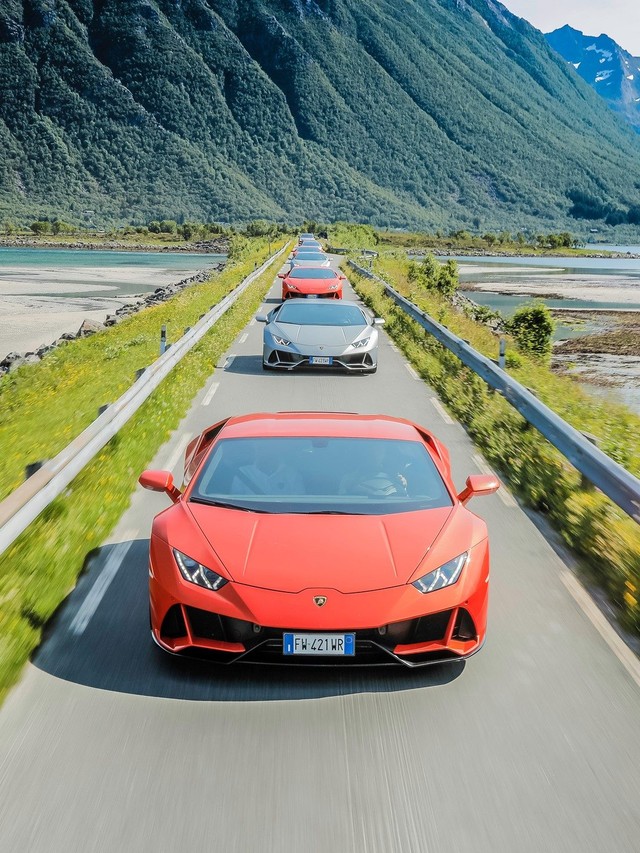
Lamborghini’s Arctic Avventura: Supercars Meet the Midnight Sun
In the summer of 2019, Lamborghini dispatched seven Huracán EVO supercars on a 630-kilometer loop through Norway’s Lofoten Islands, a remote archipelago above the Arctic Circle connected by tunnels and roads that seem to hover over open water. The Avventura expedition, Lamborghini’s curated driving adventure series, chose this setting deliberately: not a racetrack, not a closed highway in the desert, but a working fishing region where single-lane coastal roads thread between glacier-carved peaks and tiny harbor villages with populations measured in the hundreds.
The convoy departed from Harstad in northern Norway, wound south through the fishing village of Henningsvær, known improbably for a football pitch that practically dangles over the North Atlantic, then continued past landscapes dotted with traditional pyramid-shaped wooden racks used for drying cod. The first day ended in Nusfjord, one of Norway’s oldest preserved fishing settlements. Day two brought a stop at Ramberg on the island of Flakstadøya, then a run through Svolvær, which Lamborghini identifies as the oldest town in the Arctic Circle, before the cars returned to Harstad for a closing view of the midnight sun from the summit of Mount Keipen.
What makes this particular Avventura worth revisiting today is not the scenery, gorgeous as it was. The expedition quietly tested a proposition that Lamborghini would build an entire production car around three years later: that a mid-engine supercar can be a credible grand touring instrument in terrain that would make most owners nervous about a pothole, let alone a gravel shoulder above the Norwegian Sea.
The Avventura Legacy: Selling a Lifestyle, Not Just Lap Times
Lamborghini staged its first Avventura in Andalusia, then moved through Transylvania, the Norwegian fjords, and Iceland before returning to Norway for the Lofoten chapter. Each expedition follows a similar formula: a small convoy of current-model Lamborghinis, a multi-day route through visually dramatic and logistically inconvenient terrain, and a participant list drawn from owners and media who can tell the story afterward. The format is part brand experience, part content engine, and part product validation exercise disguised as a holiday.
Ferrari runs a comparable program with the Cavalcade, which tends toward Mediterranean glamour and large convoy sizes. Porsche offers bespoke driving tours and its Travel Experience program. Lamborghini’s Avventura series leans harder into remoteness and mild adversity, choosing locations where the roads themselves become part of the narrative. That distinction matters because it feeds directly into how Sant’Agata Bolognese positions its cars. A Cavalcade through Sardinia reinforces Ferrari’s grand touring elegance. An Avventura through Arctic fishing villages reinforces something different: the idea that a Lamborghini belongs wherever the road gets interesting, even if the road barely qualifies as one.
For the brand, these expeditions generate months of social and editorial content at a fraction of the cost of a traditional advertising campaign. For owners, they create a sense of belonging to a club with experiences money alone cannot replicate. And for the product team back in Sant’Agata, they produce real-world data about how a supercar handles conditions no test track can simulate: rough pavement, variable weather, salt air, tunnels carved through sea cliffs, and the kind of undulating coastal roads where ride quality matters as much as cornering grip.
From Lofoten to Sterrato: The Off-Road Thread Lamborghini Was Already Pulling
Viewed in isolation, sending Huracán EVOs through the Lofoten Islands looks like an ambitious photo opportunity. Viewed in the context of what followed, it looks like a proof of concept.
The Huracán Sterrato arrived in 2022 as a raised, cladded, rally-inspired variant of the V10 supercar, complete with underbody protection, wider wheel arches, and recalibrated all-wheel drive. It was a production car that codified exactly the kind of driving the Avventura series had been staging for years: supercar performance on surfaces and in settings that conventional wisdom said were off-limits. The Sterrato sold out almost immediately, validating a market appetite that Lamborghini’s experiential program had been quietly mapping.
According to Car and Driver, Lamborghini’s sales and marketing chief Federico Foschini indicated the brand is planning “crazier” models following the Sterrato’s success, with off-road variants of the Revuelto and Temerario reportedly under consideration. The Avventura expeditions did not cause the Sterrato or its potential successors to exist, but they built the cultural permission structure. By the time Lamborghini offered a raised supercar with gravel tires, its audience already associated the brand with exactly that kind of adventure. The Lofoten expedition was one brick in that wall.
The Huracán EVO’s own engineering made it a plausible candidate for the role. Its LDVI (Lamborghini Dinamica Veicolo Integrata) system coordinated the all-wheel-drive torque vectoring, rear-wheel steering, and adaptive dampers into a single predictive control architecture. On a smooth circuit, LDVI optimizes cornering. On a narrow Arctic coastal road with inconsistent surfaces, it quietly manages traction and stability in ways the driver may never consciously notice. Lamborghini positioned the EVO as a technological leap over its predecessor, and the Avventura served as a public demonstration that the technology worked outside a controlled environment.

A vibrant orange Lamborghini Huracán EVO leads a convoy of supercars on a breathtaking coastal road adventure.
The Huracán EVO on Arctic Roads: What 630 Kilometers Actually Tests
The Lofoten Islands present a peculiar driving challenge. The roads are generally well-maintained by Norwegian standards, but they are narrow, winding, and frequently interrupted by single-lane tunnels bored through solid rock. Elevation changes are constant. The climate, even in summer, can shift from clear skies to fog and rain within minutes. And the scenery is so relentlessly dramatic that driver distraction becomes a legitimate concern.
Lamborghini says the Lofoten landscape features mountains composed of some of Europe’s oldest rocks, shaped by glaciation into sharp peaks above coastal plains. The route passed through environments ranging from exposed headlands to sheltered fjord roads, with the archipelago’s characteristic bridges linking islands across open water. For a car with a 5.2-liter naturally aspirated V10 and a ground clearance designed for Emilia-Romagna’s smooth tarmac, this is not a trivial outing.
The 630 kilometers unfolded over multiple days, which tells you something about the pace. This was not a high-speed blast but a sustained grand touring exercise, the kind of driving that exposes ride comfort, fuel range, cabin ergonomics, and the fatigue characteristics of a car’s steering and suspension over hours of continuous use. Most supercar reviews focus on the first twenty minutes of a test drive. An Avventura tests the second day.
Lamborghini did not publish detailed driving impressions from the event, and the specific challenges the cars encountered remain undisclosed. What the company did confirm is that seven standard-specification Huracán EVOs completed the route without incident. For a car with roughly 120 millimeters of ground clearance navigating Arctic infrastructure, that counts as its own kind of performance validation, and it connects directly to the off-road credibility Lamborghini would later formalize with the Sterrato.
What the Avventura Tells Enthusiasts About Lamborghini’s Direction
Supercar manufacturers face a persistent branding tension. The cars are engineered for extreme performance, but the vast majority of owners use them for Sunday drives, car shows, and the occasional track day. The Avventura series addresses this gap by creating sanctioned contexts for owners to actually use their cars in ways that feel adventurous without being reckless. It is, in a sense, Lamborghini giving its customers permission to drive.
For prospective buyers, the practical takeaway from the Lofoten expedition is straightforward: the Huracán EVO‘s all-wheel-drive system and adaptive dynamics were robust enough for sustained use on varied, imperfect surfaces in a remote region. That matters if you are considering a Lamborghini as something more than a garage ornament. The Avventura program implicitly promises that these cars can handle real roads, real weather, and real distances.
The broader strategic signal is more revealing. Lamborghini’s willingness to push its cars into unconventional settings predates and informs its product decisions. The Sterrato did not emerge from a vacuum; it emerged from a brand culture that had spent years demonstrating, through events like the Lofoten Avventura, that supercars and rough terrain are not mutually exclusive. With Foschini’s comments about “crazier” future models now on record, the Avventura series looks less like a marketing exercise and more like an ongoing feedback loop between real-world driving and product development, wrapped in beautiful photography.
One detail worth noting for anyone who follows Lamborghini’s special editions and limited runs: the Avventura program tends to feature standard production cars, not prototypes or pre-production mules. The vehicles participants drive are mechanically identical to what a buyer would receive from a dealer. When Lamborghini puts seven Huracán EVOs through 630 kilometers of Arctic roads, it is staking its warranty reputation on the result. Few brands are willing to do that publicly, and fewer still choose to do it above the Arctic Circle.
The Huracán generation concluded with the STJ in 2024, and its successor, the Temerario, brings a twin-turbo V8 hybrid powertrain that represents a fundamental architectural shift. Whether the Avventura series continues with the new model remains to be seen. If it does, the question will be whether a turbocharged hybrid can deliver the same visceral, naturally aspirated soundtrack that made a V10 convoy through the Lofoten Islands feel like something worth staging in the first place. The engineering will almost certainly be superior. The emotion is the harder problem.


