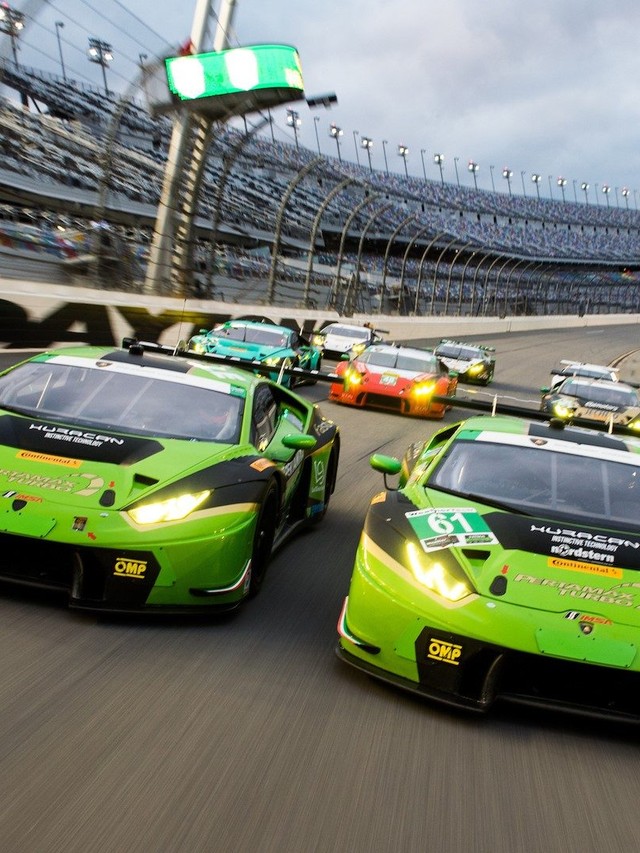
Lamborghini’s Unprecedented Eight-Car Assault on the 2017 Daytona 24 Hours
For the 55th running of the Daytona 24 Hours, scheduled January 26 through 29 of 2017, Lamborghini committed eight Huracán GT3s to the GTD class, making Sant’Agata the manufacturer with the most cars in the category. The class itself accounted for 29 of the 55 total entries, the most densely contested field on the grid. Just twelve months earlier, Lamborghini had shown up with five cars for the Huracán GT3’s North American debut. Going from five to eight in a single year told a clear story about demand from customer teams and about Squadra Corse’s appetite for a market it considered essential.
Four of the eight entries came from teams making their first Daytona appearance: Grasser Racing Team, Ebimotors, Dream Racing, and DAC Motorsports. Twelve drivers with roots in the Lamborghini Super Trofeo one-make series filled seats across the lineup. Those two details matter more than the raw car count, because they reveal the infrastructure behind the number. Lamborghini was not simply selling race cars. It was selling a pathway, from arrive-and-drive one-make competition all the way to one of the world’s most demanding endurance events. That pathway, and the ecosystem it created, is the thread connecting every element of the 2017 Daytona record to the victories and platform changes that followed.
Why Eight Cars? The Strategic Logic Behind Lamborghini’s North American Push
Fielding eight GT3 entries at a single endurance race is expensive, logistically complex, and carries real reputational risk. If every car retires, the headline writes itself. Lamborghini accepted that risk because IMSA’s WeatherTech SportsCar Championship was the most visible stage for proving that your product could take punishment, and the North American sports car market was the growth engine every European supercar manufacturer wanted to own.
Squadra Corse’s focus on customer racing was not a slogan. The Huracán GT3, based on the road car and sharing its 5.2-liter naturally aspirated V10, existed specifically to be sold to independent teams. Its chassis combined aluminum and carbon fiber, it weighed 2,731 pounds, and its engine delivered 585 horsepower through a six-speed sequential gearbox. All GT3 cars run under Balance of Performance regulations that equalize lap times across manufacturers, so the real competitive advantage comes from reliability, drivability, and the quality of factory support. A massive grid presence at Daytona would prove to prospective buyers watching from pit lane that the Huracán GT3 could deliver on all three.
The calculation was also one of visibility. Every one of those eight cars carried Lamborghini’s identity around the Daytona banking for 24 hours of television coverage. For a brand that sold roughly 3,500 cars globally in 2016, that kind of sustained American exposure was worth more than any billboard campaign. But sustained exposure only works if the ecosystem behind it can support the teams on track, and that is where the Super Trofeo pipeline proved its value.

A white and blue Lamborghini Huracán GT3 race car with number 8 on its side drives on the track at Daytona.
From Super Trofeo to the Rolex 24: Building a Driver Pipeline
The twelve Super Trofeo graduates scattered across the 2017 Daytona entry list represent the part of Lamborghini’s racing strategy that competitors rarely discuss but that quietly determines long-term success. The Super Trofeo series, running identical Huracán race cars in regional championships across North America, Europe, and Asia, functions as a controlled environment where gentleman drivers and young professionals alike learn the platform. Graduate from Super Trofeo, and you already know the V10’s power delivery, the car’s braking characteristics, and the team structures that support it. The step to GT3 is significant, but it is not a leap into the unknown.
Change Racing’s #16 car illustrated this pipeline clearly. Corey Lewis and Jeroen Mul, both designated GT3 Junior Drivers by Squadra Corse, came directly from Super Trofeo competition. They were joined by NASCAR driver Kaz Grala and Brett Sandberg, who had contested IMSA endurance rounds with the team in 2016. DAC Motorsports, one of the leading Super Trofeo North America teams, made the jump to GT3 entirely with drivers from that series: Emmanuel Anassis, Brandon Gdovic, and Anthony Massari.
Raffaele Giammaria’s dual role underlined how seriously Lamborghini treated the talent development side. An experienced endurance racer, Giammaria joined Dream Racing’s #27 car while simultaneously taking on the role of supervisor for Squadra Corse’s Youngster Programs. That appointment, effective from 2017, meant the person responsible for identifying and mentoring future Lamborghini factory talent was also racing alongside the very drivers he would evaluate. Few other manufacturers embedded their development leadership that deeply into the customer racing grid, and it is precisely this kind of structural investment that allowed Lamborghini to scale from five Daytona entries to eight without diluting the quality of its teams.
The Teams: A Mix of Ambition, Experience, and New Blood
The eight-car entry blended established IMSA competitors with newcomers, and the contrast between them reveals the breadth of Lamborghini’s customer base.
Paul Miller Racing arrived as the most credentialed Lamborghini team in North America, coming off a third-place finish in the 2016 GTD championship standings. Bryan Sellers and Madison Snow, a Squadra Corse GT3 Junior Driver, formed the core pairing for the full 2017 season, with Bryce Miller and the young Italian Andrea Caldarelli joining for endurance rounds. Konrad Motorsport brought German endurance experience, pairing team principal Franz Konrad and Lance Willsey, both 2016 Daytona veterans, with Lamborghini tester Marco Mapelli and GT3 Junior Driver Luca Stolz.
Grasser Racing Team, an Austrian outfit that introduced the Huracán GT3 to competition in the 2015 Blancpain GT championship, entered two cars. The #11 featured Lamborghini factory driver Mirko Bortolotti alongside Christian Engelhart, Rolf Ineichen, and Ezequiel Perez Companc. The #61 ran an all-Super Trofeo lineup of Milos Pavlovic, Roberto Pampanini, and Christoph Lenz. Ebimotors, an Italian team with GT Open and Michelin GT3 Le Mans Cup experience, brought Emanuele Busnelli and Fabio Babini for their first Daytona attempt.
Dream Racing rounded out the debutants with a five-driver roster that included Lawrence DeGeorge, Luca Persiani, Paolo Ruberti, Cedric Sbirrazuoli, and Giammaria. Five drivers in one car for a 24-hour race is standard practice, but Dream Racing’s lineup was notable for mixing proven endurance hands with a Squadra Corse Junior Driver, the same developmental blend that defined the entire eight-car effort. Across every garage, the pattern held: experienced professionals anchoring cars alongside drivers who had earned their seats through the Super Trofeo ecosystem Lamborghini had spent years constructing.

A teal green Lamborghini Huracán GT3 race car with number 21 races on the track at Daytona International Speedway.
Competitive Context: Lamborghini Against the GT3 Establishment
In 2017, the GTD class was contested by GT3 machinery from Porsche, Ferrari, Mercedes-AMG, BMW, Audi, and Acura, among others. Most manufacturers relied on three to five customer entries. Lamborghini’s eight cars gave it a numerical presence no rival could match at that event, along with a statistical advantage in finishing probability: more cars mean a better chance that at least one survives 24 hours intact.
What Lamborghini lacked was a Daytona class victory. The Huracán GT3 debuted in the Blancpain GT championship in 2015, and its North American career was barely a year old. The platform was competitive, but it had not yet proven it could win the race that mattered most in the American market. The eight-car entry was, in that sense, a calculated investment in future credibility, one that depended on the team relationships and driver pipeline Squadra Corse had been building through Super Trofeo.
That investment paid off sooner than most observers expected. According to multiple reports, Grasser Racing Team’s #11 Huracán GT3 won the GTD class at the 2018 Daytona 24 Hours, giving Lamborghini its first victory at the event. In 2019, Lamborghini achieved its second successive Daytona victory with the Huracán GT3 Evo. The operational experience and competitive knowledge accumulated during the 2017 record entry, with its emphasis on team diversity and driver development, built the foundation that made those victories possible.
From Huracán to Temerario: What the 2017 Daytona Record Means for Lamborghini’s Next GT3 Chapter
The Huracán GT3 evolved through EVO and EVO2 specifications over the following years, accumulating victories at Spa, in the GT World Challenge, and in British GT competition. Its successor, the Temerario GT3, represents a fundamental shift. According to Autoblog, the Temerario GT3, unveiled at the 2025 Goodwood Festival of Speed, is Lamborghini’s first competition car to be fully designed, developed, and built in-house, without the Dallara partnership that shaped every iteration of the Huracán GT3.
That distinction carries real weight. Dallara’s involvement in the Huracán GT3’s chassis development was a strength, but it also meant Lamborghini depended on an external partner for its most visible racing product. Bringing GT3 development entirely within Squadra Corse signals that the customer racing infrastructure Lamborghini built through events like the 2017 Daytona entry now supports a level of in-house capability that did not exist a decade ago. The ecosystem of teams, drivers, and factory support that made eight Daytona entries possible is the same ecosystem that gave Squadra Corse the confidence and the operational knowledge to take full ownership of its next GT3 platform.
The Temerario GT3 will also mark Lamborghini’s transition from a naturally aspirated V10 racing platform to a twin-turbo V8 hybrid architecture. For the customer teams and drivers who cut their teeth on the Huracán GT3’s linear, high-revving power delivery, that transition will demand adaptation. The broader question is whether the operational depth Lamborghini demonstrated in 2017, the team relationships, the driver pipeline, the factory support network, can survive a platform change that alters the fundamental character of the car.
Looking back at the 2017 Daytona grid, the answer is probably yes. The eight-car entry was not a stunt. It was the visible surface of a customer racing ecosystem that Lamborghini spent years constructing, and the results that followed in 2018 and 2019 confirmed the approach worked. The Temerario GT3 inherits that ecosystem. Whether it inherits the Huracán’s naturally aspirated soul is a different question, and one that Lamborghini’s next generation of customer teams will answer on track.
Gallery


