A Chelsea Loft, a Green V10, and Lamborghini’s Entire Leadership Team
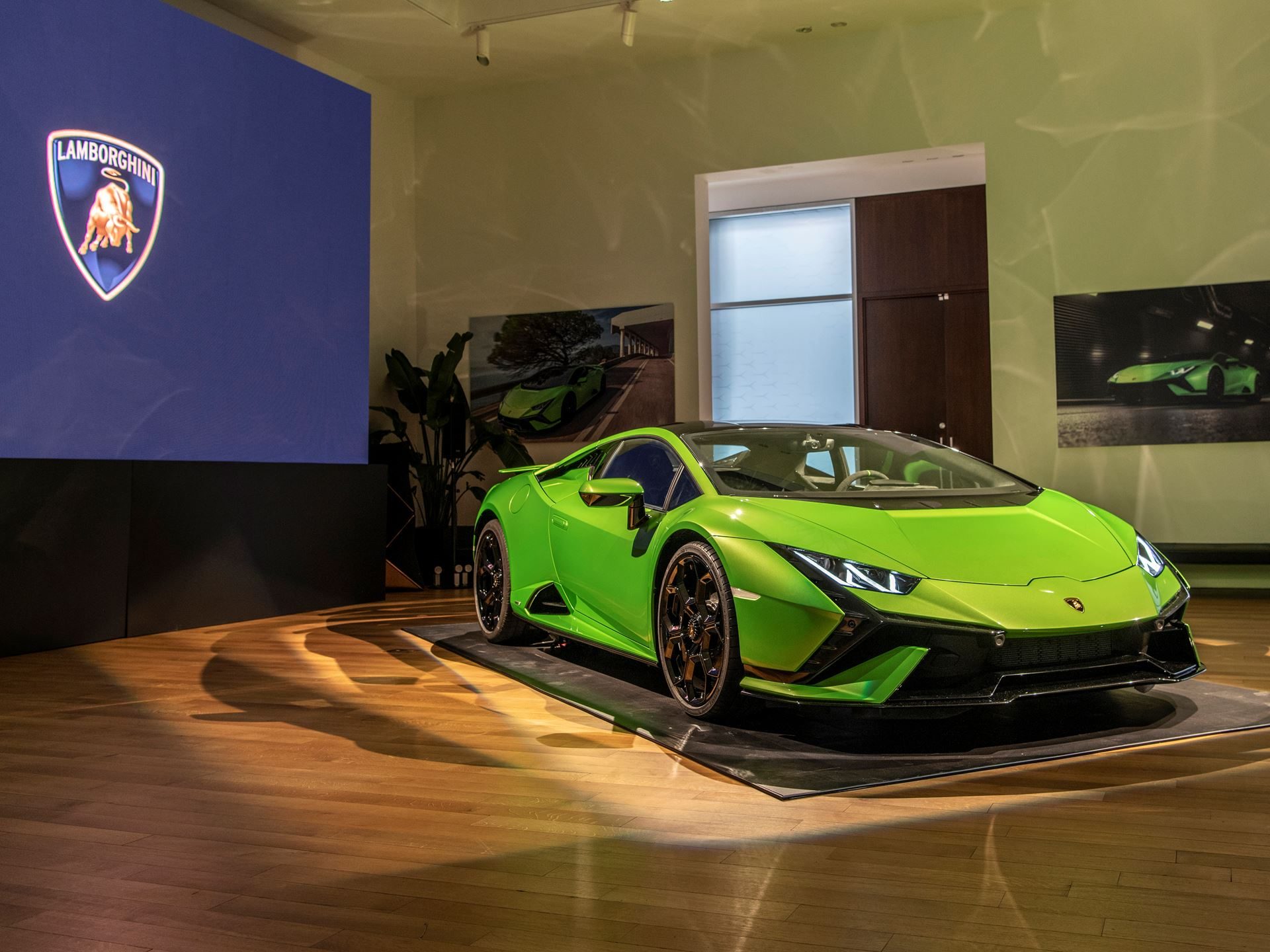
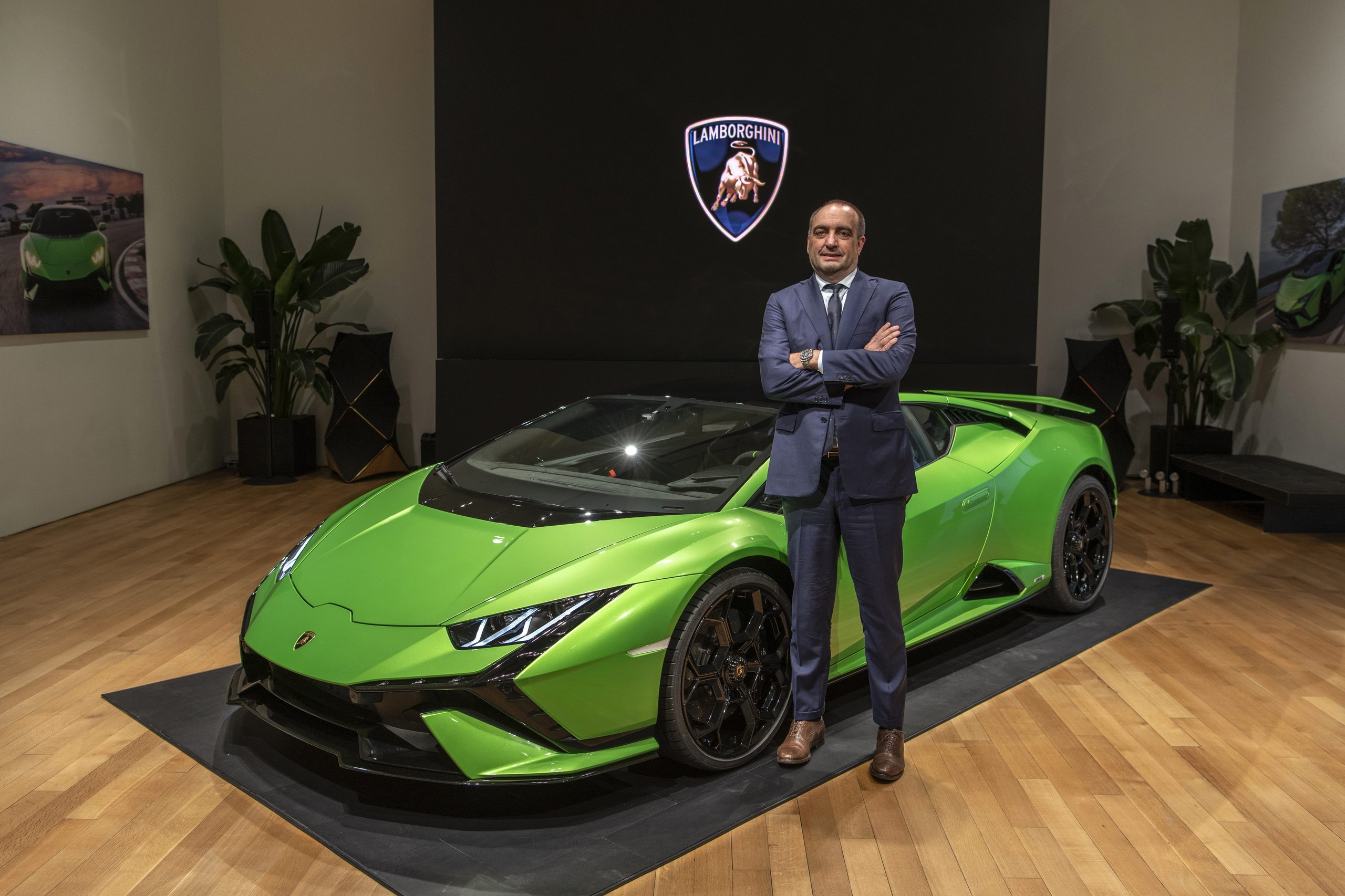
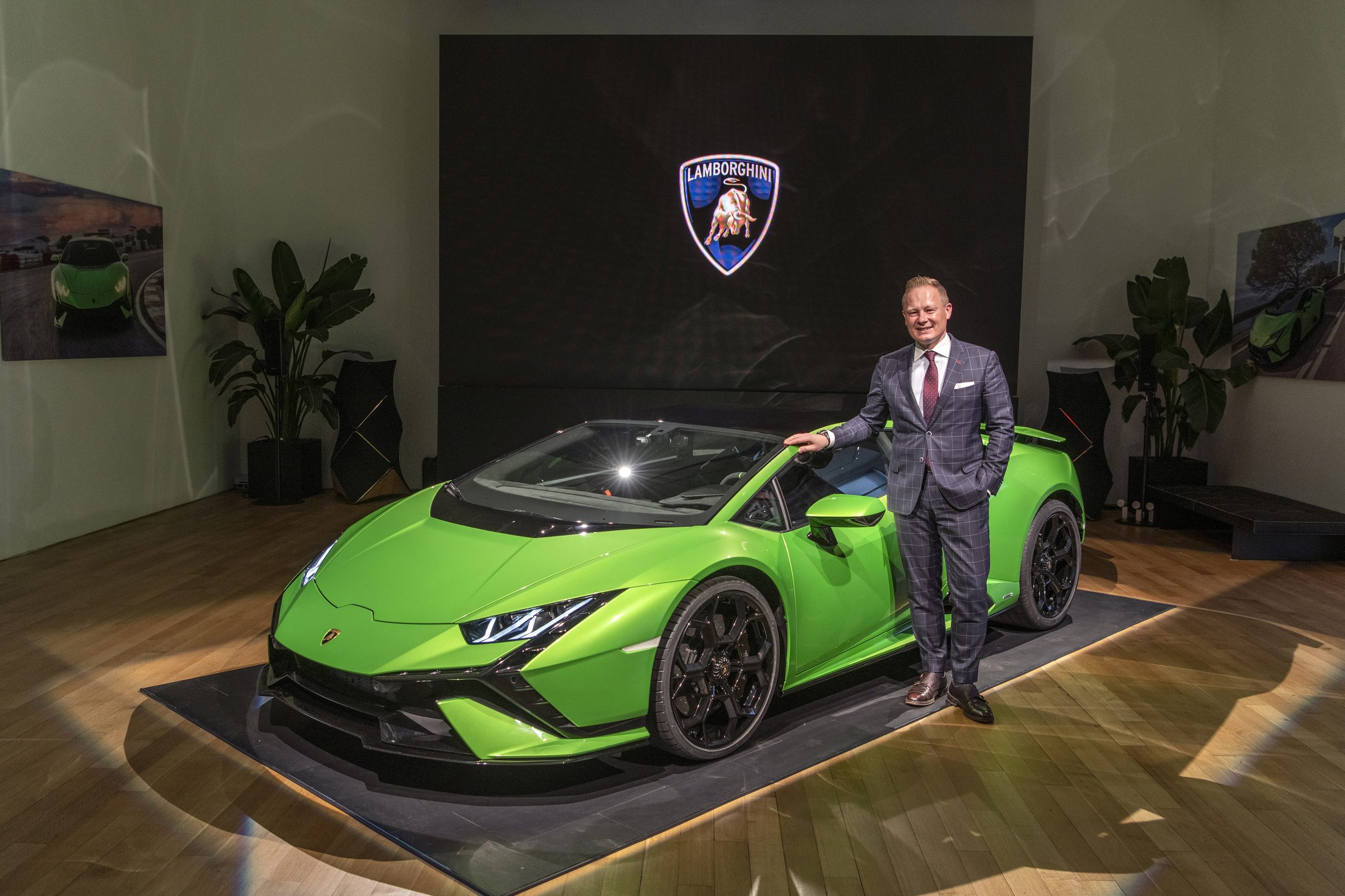
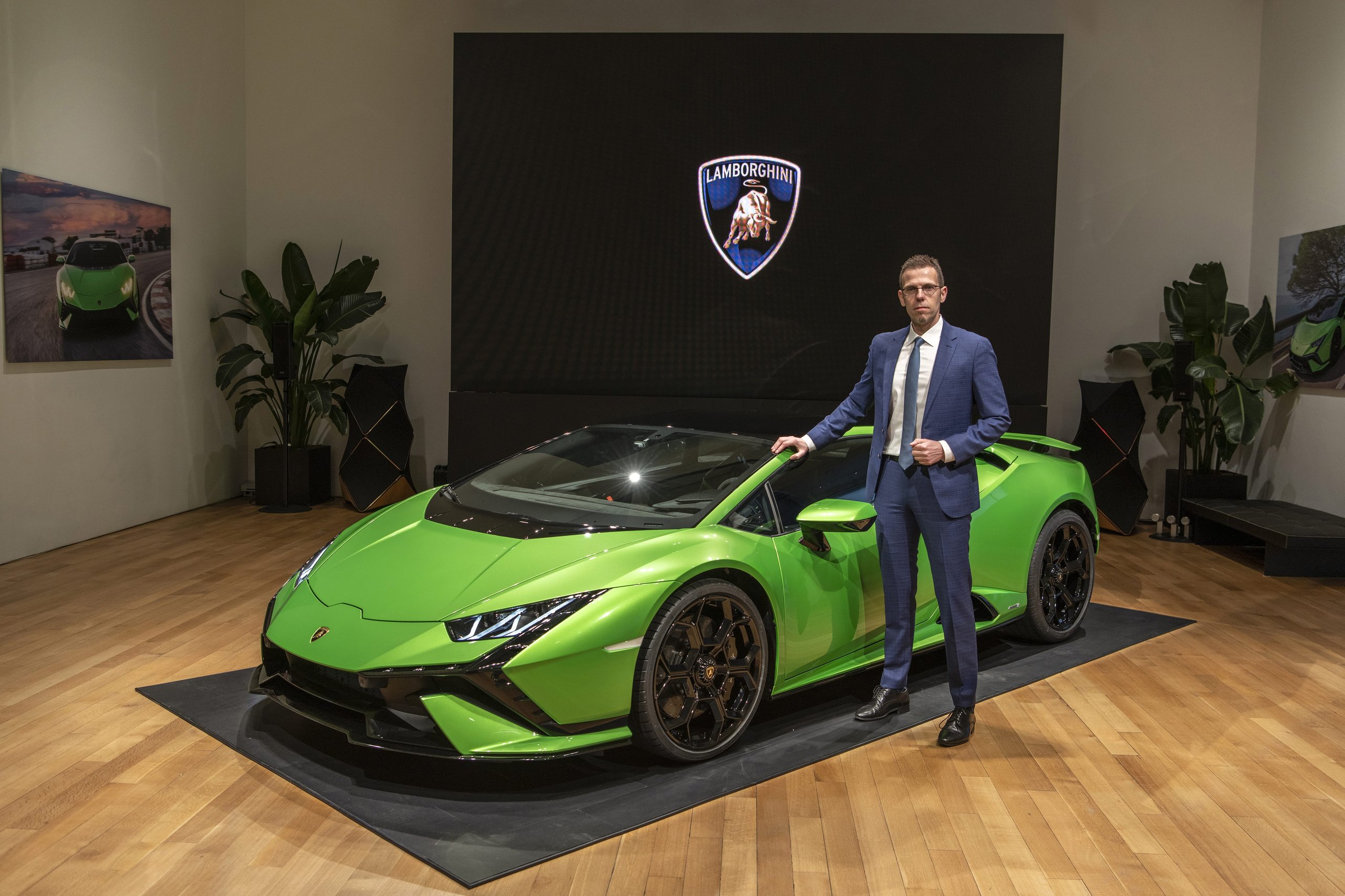
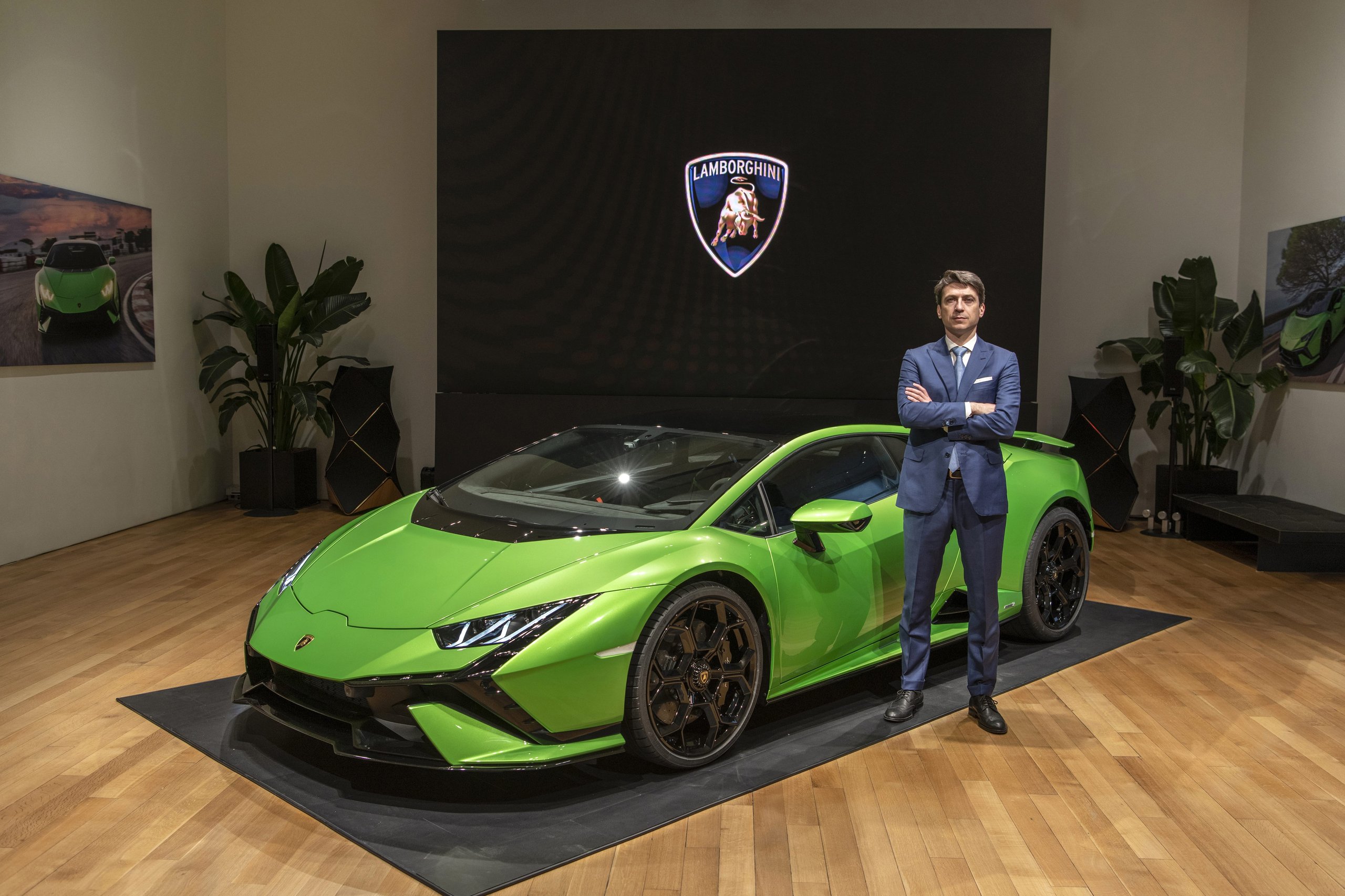
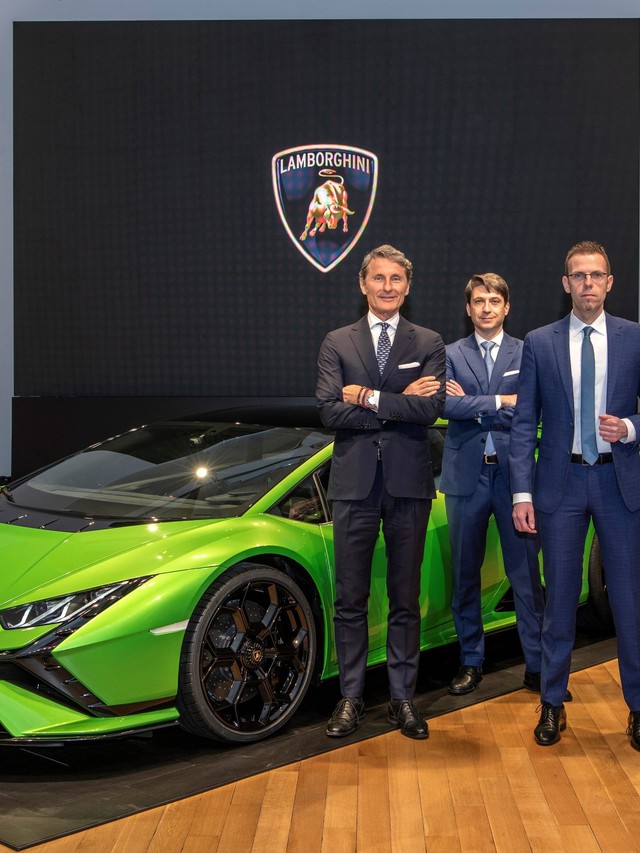
Lamborghini chose to premiere the Huracán Tecnica for North America not on the auto show floor at the Javits Center, but inside a private loft space in Manhattan’s Chelsea Arts District on April 12, 2022. The car sat under a dark cover on a black platform, the Lamborghini shield glowing on a screen behind it, while long-time customers, VIPs, and media waited for the pull. When the cover came off, a vivid green Tecnica stood beneath the lights, flanked by Chairman and CEO Stephan Winkelmann, CTO Rouven Mohr, Head of Design Mitja Borkert, and Chief Marketing and Sales Officer Federico Foschini.
That much executive firepower at a single-model reveal tells you something about what the Tecnica represents internally. This was not a facelift. The Huracán lineup had been carrying a tension for years: the EVO RWD is playful and comfortable but leaves track-day regulars wanting more grip and aero, while the STO is so committed to the circuit that its ride quality and road noise can test the patience of anyone who does not live next to a racetrack. The Tecnica, in Lamborghini’s framing, occupies the space between those two extremes, the sweet spot where a naturally aspirated V10 can serve both Saturday canyon runs and Tuesday track evenings without compromise. The car then moved to the New York International Auto Show for public display from April 15th through the 24th, but the real statement was the private event: Lamborghini wanted its most important buyers to understand this car’s purpose face to face.

Key figures from Lamborghini present the stunning new Huracán Tecnica in a vibrant green finish. Image: Automobili Lamborghini.
How the Tecnica Actually Bridges Road and Track
Delivering on that “sweet spot” promise required more than marketing language. Lamborghini says the Tecnica borrows the 5.2-liter naturally aspirated V10 from the STO, producing 640 CV and 565 Nm of torque at 6,500 rpm. That is 30 CV more than the EVO RWD, arriving through the same calibration philosophy that makes the STO feel so alive at high revs. The 0-100 km/h sprint drops to 3.2 seconds.
The more revealing engineering story sits underneath the skin. The Tecnica uses a recalibrated version of Lamborghini’s LDVI (Lamborghini Dinamica Veicolo Integrata) system, the central brain that coordinates traction control, torque vectoring, magnetorheological dampers, and rear-wheel steering into a single dynamic picture. Where the STO’s LDVI calibration assumes a driver who wants maximum track aggression, the Tecnica’s version widens the envelope. Its driving modes feature a specific suspension setup that does not punish you for choosing a bumpy back road, while rear-wheel direct steering sharpens turn-in without the nervous edge that makes the STO feel twitchy at parking-lot speeds.
Brake cooling, a detail that sounds minor until you spend twenty minutes on a hot track and feel the pedal go long, also received attention. The Tecnica’s improved brake cooling allows repeated hard stops without the thermal fade that plagues some road-biased supercars when owners push them on circuit days. For the buyer who wants one car that handles both environments, this combination of STO-level power with a more forgiving chassis and better thermal management is the core value proposition. The aerodynamic package provides 35% more rear downforce than the EVO RWD while simultaneously reducing drag by 20%, which explains why the Tecnica’s top speed of 325 km/h (202 mph) actually edges past the STO’s figure. Every engineering decision points the same direction: make the Tecnica genuinely capable on track without sacrificing the road manners that keep owners coming back to the Huracán.
Tecnica vs. STO vs. EVO RWD: Picking the Right Huracán
All three rear-wheel-drive Huracáns share the same naturally aspirated 5.2-liter V10 and seven-speed dual-clutch gearbox. The differences are in philosophy, and they matter more than the spec sheet suggests.
| EVO RWD | Tecnica | STO | |
|---|---|---|---|
| Power | 610 CV | 640 CV | 640 CV |
| 0-100 km/h | 3.3 s | 3.2 s | 3.0 s |
| Aero focus | Road-biased, minimal wing | Fixed rear wing, +35% downforce vs EVO RWD | Race-derived, manually adjustable wing |
| Character | Playful, tail-happy | Balanced road/track | Track-first, street-legal race car |
The EVO RWD weighs roughly 3,100 lbs and delivers the most traditional Huracán experience: light steering, a willingness to rotate the rear under throttle, and a cabin that feels livable over long distances. The STO strips weight aggressively, adds a massive adjustable rear wing, and calibrates everything for lap times. It generates 53% more downforce than the Performante it replaced, according to Lamborghini’s own figures, but the trade-off is a ride that multiple owners on enthusiast forums describe as brutal on anything but glass-smooth tarmac.
The Tecnica splits the difference with genuine precision. It matches the STO’s power output, adds meaningful downforce and brake cooling over the EVO RWD, yet keeps the suspension compliant enough for daily use. Forum discussion around the Tecnica consistently circles back to one phrase: “the Huracán sweet spot.” Owners who have driven both the STO and the Tecnica tend to describe the Tecnica as delivering STO-level performance without the physical punishment. One detail that surfaces repeatedly in ownership threads is the interior sound: the Tecnica is louder inside the cabin than the EVO, with a more direct connection to the V10’s intake note, which owners consistently praise.
The practical question for cross-shoppers is simple. If you track the car more than half the time, the STO remains the sharper tool. If you want a rear-drive V10 that flatters on the road and still embarrasses most sports cars at a track day, the Tecnica fills that gap cleanly.

A Pure V10 in an Electrifying Moment
The Tecnica’s sweet-spot positioning gains another dimension when you consider timing. Lamborghini framed the 2022 reveal explicitly as a celebration of the internal combustion engine, and that language was deliberate. By early 2022, the Revuelto’s hybrid V12 architecture was already confirmed as the Aventador’s successor, and the Temerario’s twin-turbo V8 hybrid was on the horizon as the Huracán’s eventual replacement. The Tecnica arrived knowing it would be one of the final chapters for a naturally aspirated V10 in a road car, a powertrain configuration that no direct competitor was still offering.
Ferrari’s 296 GTB, launched the year before, paired a twin-turbo V6 with an electric motor. McLaren’s Artura went hybrid with a twin-turbo V6 as well. Both cars are fast, both are impressive, and both sacrifice the linear throttle response and high-rpm scream that define a naturally aspirated engine. The Tecnica carries no electric motor, no battery pack, no regenerative braking logic. Its 5.2-liter V10 revs to 8,000 rpm with nothing between the driver’s right foot and the intake trumpets except air and fuel. In an era where electrification adds complexity, weight, and a layer of software abstraction between driver and powertrain, the Tecnica’s purity is its competitive argument, and the reason its sweet-spot character resonates so strongly with enthusiasts who know the window is closing.
Lamborghini has not confirmed whether the Tecnica was the final pure V10 variant (one report suggests another model followed later that year), but the broader direction is clear. For collectors and driving purists, the V10’s successor will almost certainly carry hybrid assistance, and no amount of clever engineering can replicate the mechanical directness of a naturally aspirated engine singing past 7,000 rpm with no turbo lag and no electric fill.
North America’s Appetite and What Comes Next
Premiering the Tecnica in New York rather than Geneva or Milan was a commercial statement as much as a logistical one. Lamborghini reported record-breaking results for 2021 in sales, turnover, and profitability. The United States remained the company’s largest single market globally, with 2,472 vehicles delivered that year, an 11% increase over 2020. This is where the buyers are, and the Tecnica’s road-and-track versatility speaks directly to the way American owners actually use their Lamborghinis.
Forum threads on Lamborghini-Talk reveal that early Tecnica allocations commanded modest premiums over MSRP, with discussion suggesting $10,000 to $15,000 above sticker at launch. That premium has softened as production ramped up, and used 2023 and 2024 examples now appear regularly on the secondary market. For prospective buyers today, the Tecnica offers an interesting value equation: it delivers the STO’s engine in a more livable package, and its status as one of the last naturally aspirated V10 Lamborghinis gives it a heritage argument that the EVO RWD cannot match.
Lamborghini’s design team, led by Mitja Borkert, gave the Tecnica subtle visual cues borrowed from the Sián, particularly around the front fascia. The Y-shaped daytime running lights and sharpened front splitter visible in the event photos reinforce the family resemblance without making the car look like a concept exercise. It reads as a mature, confident Huracán rather than a parts-bin special.
The takeaway for anyone considering a Tecnica is straightforward: this car occupies a specific and increasingly valuable position in Lamborghini’s history. It pairs the last naturally aspirated V10 with a chassis calibrated for real-world enjoyment, not just lap-time bragging rights. Whether that matters depends on whether you believe the sound and feel of a high-revving atmospheric engine is worth preserving. Most Lamborghini enthusiasts, based on the volume of forum activity around the Tecnica, seem to know exactly where they stand.

Anticipation builds as the new Lamborghini Huracán Tecnica remains concealed under a sleek car cover. Image: Automobili Lamborghini.
Gallery