Five Artworks, Five Space Keys, One Exploded Ultimae
Lamborghini’s inaugural NFT project, titled Space Time Memory, went to auction in February 2022 with a premise that sounded almost absurdly ambitious: Swiss artist Fabian Oefner would photograph more than 1,500 individual components of a Lamborghini Aventador Ultimae, arrange them into five images of the car deconstructing against Earth’s horizon, and pair each digital artwork with a physical “Space Key” containing carbon fiber that actually traveled to the International Space Station. Bidding ran on nft.lamborghini.com, managed by NFT PRO and RM Sotheby’s. The five lots collectively sold for $659,636.
Strip away the blockchain vocabulary and the project reduces to a question Lamborghini collectors already understand: what does it mean to own a piece of something irreplaceable? The Aventador Ultimae was the final expression of Lamborghini’s naturally aspirated V12 lineage. By the time Oefner was photographing pistons and connecting rods at the Sant’Agata Bolognese factory, the car’s production run was winding down. Turning the Ultimae into an art object, rather than simply selling the last units, was Lamborghini’s way of extending the car’s cultural shelf life into a medium that, at least in early 2022, felt like the future of luxury collectibles. Every element of the project, from the artist’s process to the ISS carbon fiber to the auction structure itself, was designed to answer that question of irreplaceable ownership by anchoring a digital asset to something physically, historically, and emotionally real.
Oefner’s Process: Engineering Plans, a Pop-Up Studio, and a Stratospheric Balloon
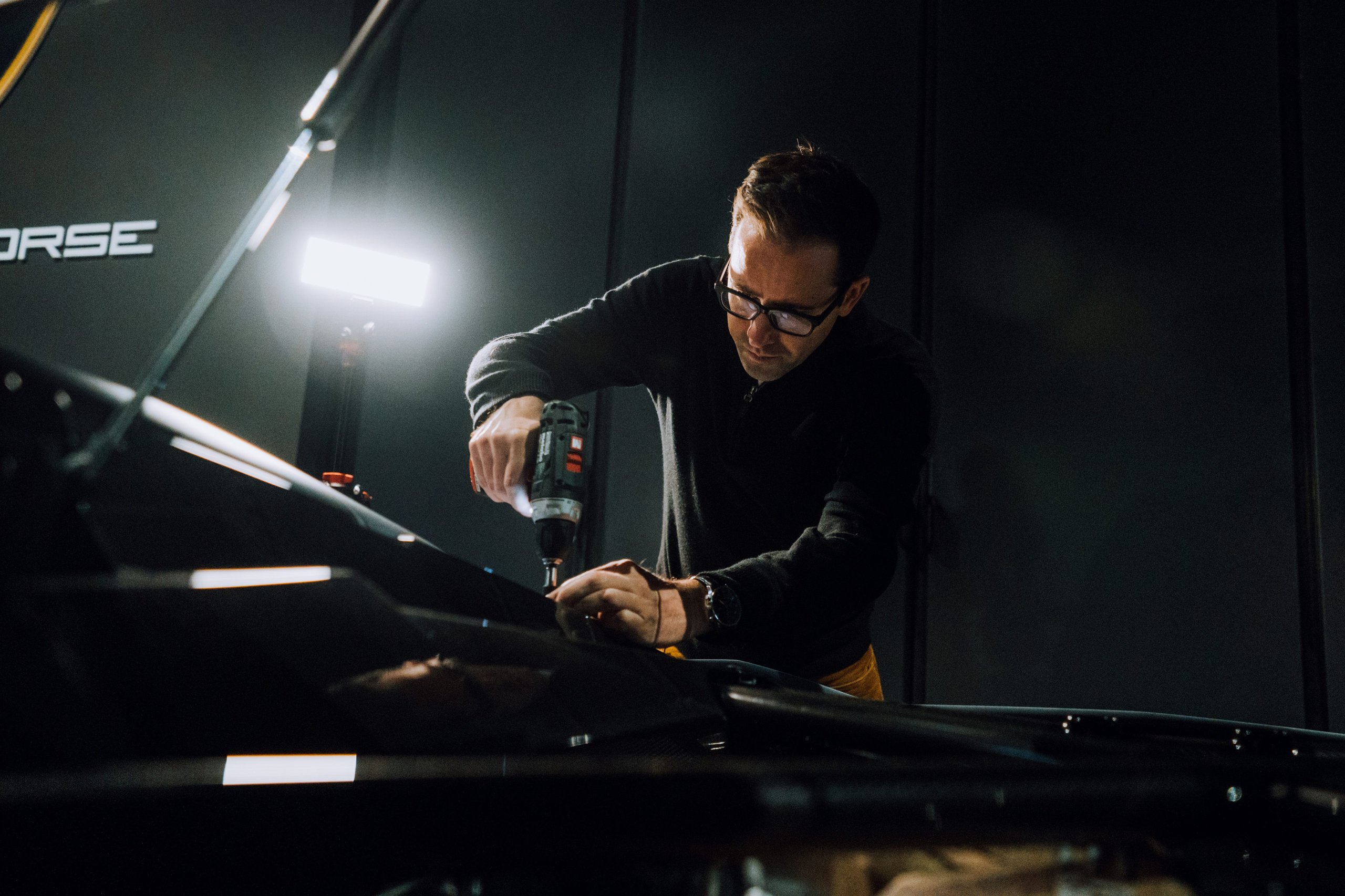
Fabian Oefner is best known for his “exploded view” photographic technique, which presents mechanical objects as frozen mid-disassembly, every bolt and bracket suspended in space. For Space Time Memory, he began by studying the engineering plans of the Aventador Ultimae to build an accurate blueprint of the car’s architecture. Actual production components were then transported to a temporary photo studio erected inside Lamborghini’s factory, where each part was individually photographed. The entire artistic process spanned two months.
The background is where the project gets genuinely eccentric. According to MotorTrend, the image of Earth’s curvature and horizon was captured by launching a weather balloon equipped with a camera into the stratosphere. The resulting photographs became the backdrop against which the Ultimae’s 1,500-plus components appear to scatter like a rocket breaking apart on ascent.
“This piece is not about a car. This piece is about memories… it really brings two worlds together, the digital and the physical worlds.”
Oefner describes the concept as an analogy for how humans form memories: experiences rooted in the physical world, stored in what he considers the digital realm of the brain. The five images each capture a different moment in the Ultimae’s imagined disintegration, and MotorTrend notes that the digital files offer interactive zoom capability, letting viewers examine details as granular as firing order markings and milling patterns on individual gears. That level of resolution distinguishes the work from the profile-picture NFTs that dominated the market at the time, and it reinforces the project’s central bet: that a digital collectible gains lasting value only when it rewards the same obsessive scrutiny collectors already bring to a V12 engine bay.

An engineer meticulously examines the intricate details within an open car engine bay, showcasing deep technical insight.
Why the Ultimae Was the Right Subject for a Digital Legacy
Oefner’s conceptual framework leans on a Latin pun that most coverage glossed over. Ultimae translates not only as “last” but also as “farthest.” The artist connected that second meaning to the Apollo missions and the moon, framing the Aventador’s final edition as a vehicle that had traveled as far as a naturally aspirated V12 supercar could go in an era of tightening emissions regulations and electrification mandates.
For Lamborghini enthusiasts, the subtext is hard to miss. The Ultimae produced 780 horsepower from its 6.5-liter V12, the most powerful version of the engine that defined the Murciélago and Aventador lineage. Its successor, the Revuelto, kept twelve cylinders but added three electric motors and a plug-in hybrid system. The Ultimae was the last car Lamborghini will build around an unassisted naturally aspirated V12, which gives the NFT project a commemorative weight that purely digital collectibles rarely carry.
Collectors who bought an Ultimae coupe or roadster already own a car whose significance grows with every year the Revuelto spends proving that hybridization is the new normal. Space Time Memory offered a parallel form of ownership: not the car itself, but a forensic artistic record of its components, frozen in a moment of symbolic departure. The physical-digital pairing only sharpens that parallel. Just as the Ultimae itself bridges Lamborghini’s analog past and its electrified future, each lot bridges a tangible artifact and a blockchain-authenticated image, insisting that the two halves need each other to tell the full story.
The Space Key: Carbon Fiber That Actually Left the Planet
Each of the five digital artworks came paired with a physical object Lamborghini calls a Space Key. These are small carbon fiber elements that the company sent to the International Space Station in 2020 as part of a joint research project. Each key is engraved with a unique QR code linking to its corresponding digital artwork, creating a physical bridge between the tangible object and the NFT.
The ISS connection is worth pausing on. Lamborghini’s carbon fiber research program with the ISS was a materials science initiative, not a marketing stunt conceived for the NFT launch. The company had already been studying how advanced composites behave in microgravity and extreme thermal cycling. Repurposing fragments from that research as the physical anchor for an art project gave Space Time Memory a provenance story that most NFTs, which exist only as entries on a blockchain, simply cannot match.
From a collector’s perspective, the Space Key is what separates this project from the avalanche of automotive NFTs that flooded the market in 2021 and 2022. A JPEG of a cartoon car requires faith in the blockchain’s permanence and the community’s continued interest. A piece of carbon fiber that orbited Earth at 17,500 mph carries its own intrinsic rarity regardless of what happens to the NFT market. That dual-asset structure, one foot in the physical world and one in the digital, was Lamborghini’s hedge against the volatility that would eventually gut the broader NFT ecosystem. It also made the project’s thesis tangible in the most literal sense: you could hold the proof of irreplaceability in your hand.

A man with glasses works diligently at a desk, illuminated by a single lamp, focusing on his creative task.
Lamborghini’s Position in the Luxury NFT Landscape
When Space Time Memory launched, it entered a crowded and chaotic digital collectibles market. Ferrari would later explore its own NFT initiatives, and several other luxury brands, from watchmakers to fashion houses, were racing to plant flags in the space. What distinguished Lamborghini’s approach was its restraint. Five lots, not 10,000. Physical objects with genuine provenance, not algorithmically generated variations. An established fine-art photographer, not a pseudonymous digital collective.
Even the auction’s duration was a curated detail: 75 hours and 50 minutes, a reference to the exact time Apollo 11 took to leave Earth and enter lunar orbit. Touches like that suggest Lamborghini treated the project as a brand exercise in storytelling rather than a revenue play. The total haul of $659,636 across five lots is meaningful but modest compared to what a single Aventador Ultimae commands on the secondary market.
Lamborghini has not publicly detailed plans for additional NFT collections, and the broader market’s collapse through late 2022 and 2023 cooled enthusiasm across the luxury sector. The more interesting question is whether the physical-digital pairing model survives as a template for future brand extensions, even if the NFT label itself falls out of fashion. Authenticated digital ownership tied to a physical artifact with real provenance is a concept that predates blockchain and will likely outlast the current hype cycle. Lamborghini, whether by design or fortunate timing, built its first digital collectible around that more durable idea.
For buyers who already collect limited-edition Lamborghinis, the Space Time Memory lots represent something genuinely novel in the brand’s history: an official Lamborghini collectible that contains no engine, no leather, and no paint, yet still draws its value from the same well of scarcity, engineering heritage, and emotional resonance that makes a Miura SV or a Countach LP400 worth millions.

An artist works diligently at his desk, illuminated by a single lamp in a dark, minimalist studio space.
Auction Results and What They Signal
The five Space Time Memory lots closed on February 4, 2022, with a combined total of $659,636. One report indicates the highest individual bid reached $203,636 for the T+0075S lot, while the lowest was $70,000 for T+0072S. The spread between top and bottom suggests buyers were differentiating between the five moments captured in Oefner’s sequence, assigning premium value to specific compositions rather than treating the set as interchangeable.
That price range puts each lot roughly in the territory of a well-optioned Huracán, which is an interesting psychological benchmark. Buyers were not spending Ultimae money, but they were spending real supercar money on art and carbon fiber rather than on a drivable vehicle. Whether those purchases look wise in hindsight depends entirely on how the owners value the physical Space Key relative to the digital component. The carbon fiber from the ISS retains its material rarity regardless of NFT market sentiment. The digital artwork’s value, like all NFTs, depends on continued platform access and collector interest.
Lamborghini’s practical takeaway from the project is probably less about revenue and more about proof of concept. The company demonstrated that its brand carries enough cultural weight to command six-figure bids for non-automotive objects, a validation that could inform future collaborations in art, fashion, or experiential luxury. For collectors watching from the sidelines, the lesson circles back to the project’s founding premise: when Lamborghini anchors a limited collectible to genuine engineering artifacts and irreplaceable provenance, the scarcity math tends to work in the buyer’s favor over time, whether the medium is steel, carbon fiber, or pixels on a blockchain.
Gallery