Six Hundred Guests, Six Decades of V12s, One New Address
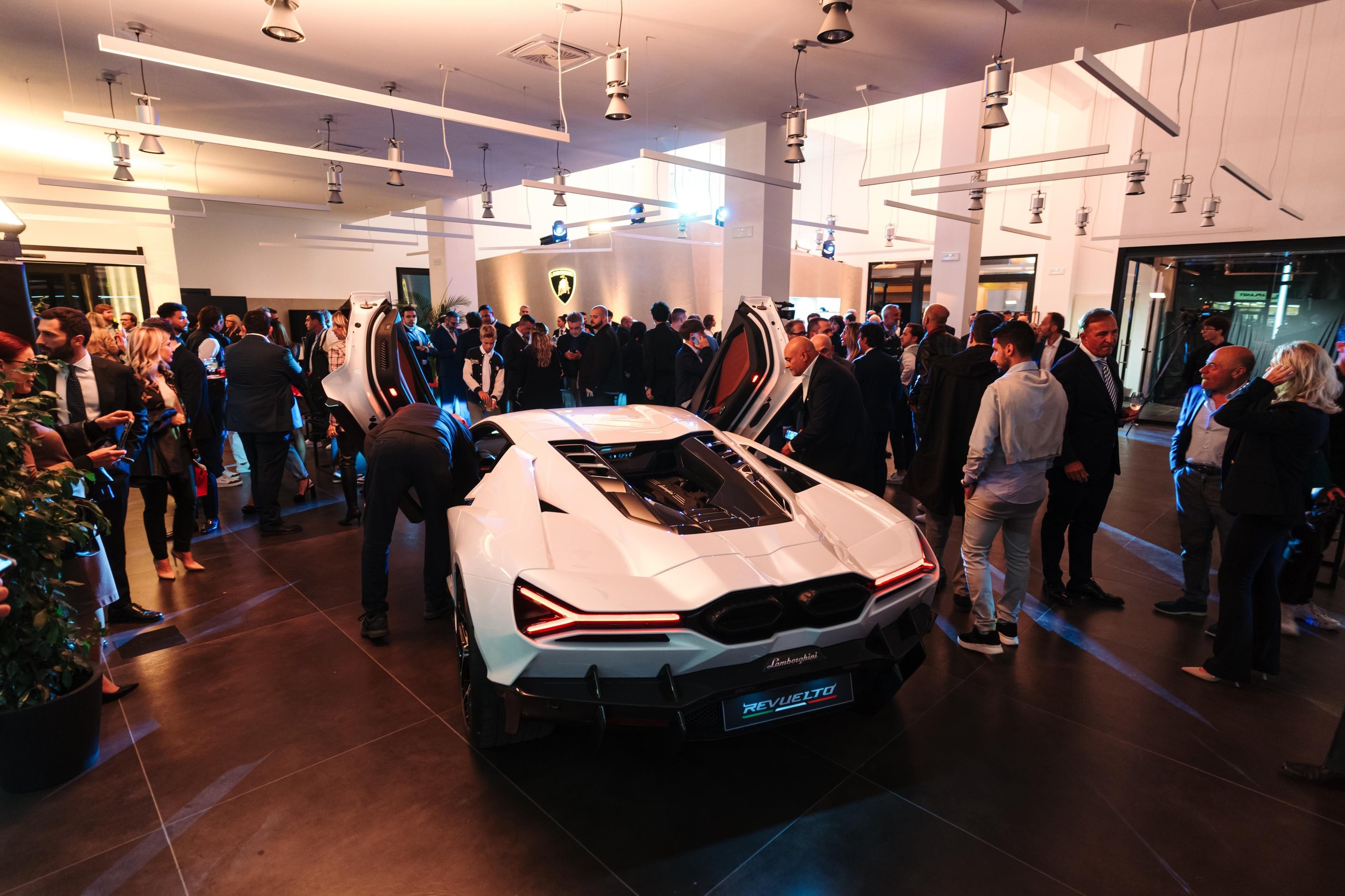
Lamborghini gathered 600 guests, its full board of directors, and a lineup stretching from the Miura to the Revuelto at a single location on Rome’s Via Tiburtina to inaugurate a substantially larger dealership for the Italian capital. The new facility at number 1100 replaces the brand’s previous Rome presence with over 1,000 square meters of showroom, workshop, dedicated pre-owned area, and a purpose-built Ad Personam customization studio. Stephan Winkelmann, Chairman and CEO of Automobili Lamborghini, framed the move in characteristically direct terms: “Italy is a key country for Lamborghini, and initiatives like this show how tangible our bond with the territory is.”
The timing matters as much as the square footage. Lamborghini opened the doors during its 60th anniversary year, a period in which the company achieved record sales of 10,112 cars globally and began delivering the Revuelto, its first plug-in hybrid V12. Choosing Rome for a flagship expansion rather than adding another showroom in the Middle East or China signals something specific about how Sant’Agata Bolognese views its domestic market. Italy’s ultra-luxury segment remains one of the most established in Europe, and Lamborghini now operates six dealerships across the country (Bari, Bergamo, Bologna, Milan, Verona, and Rome), supported by 79 points across the broader EMEA region and 182 worldwide.
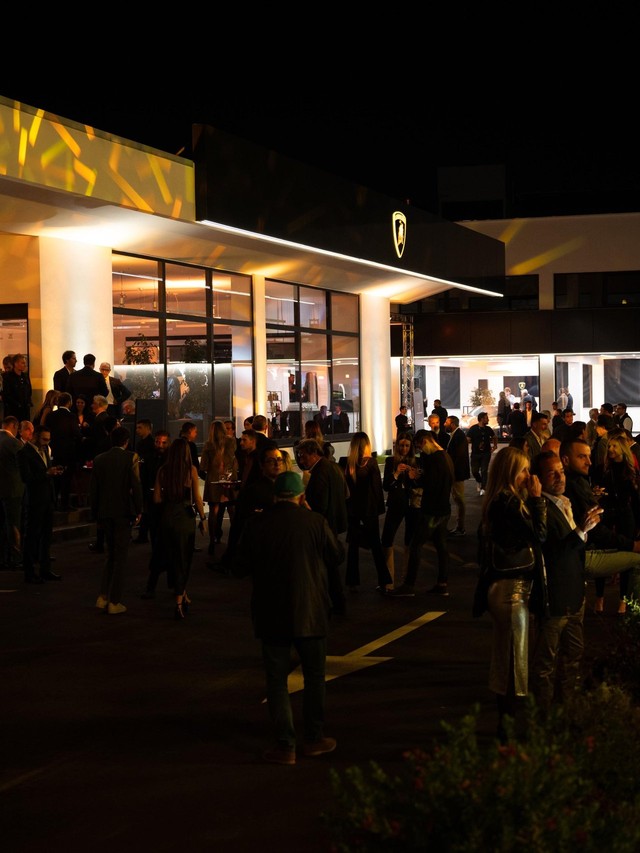
Dealership owners Fulvio Nobile and Rolando Cellitti, who have represented the brand in Rome for five years, oversaw the transition. The evening included performances by dancers and musicians, plus a commissioned artwork by Simon Berger: a glass painting of the Lamborghini bull emblem created over 240 hours using his signature “morphogenesis” cracking technique. Polished, theatrical, and calibrated to reinforce the notion that buying a Lamborghini in Rome should feel like a cultural event rather than a transaction.

Guests gather outside the newly opened Lamborghini dealership, illuminated by a warm glow during an evening event.
Ad Personam in the Capital: What the Customization Studio Actually Offers Buyers
For prospective owners, the most consequential addition to the Rome facility is the dedicated Ad Personam area. Lamborghini describes the program as offering an extensive range of paint finishes and interior configurations, including leather grades, contrast stitching patterns, carbon fiber trim elements, and various exclusive options that allow a buyer to build something genuinely distinct from the next Revuelto or Urus on the road.
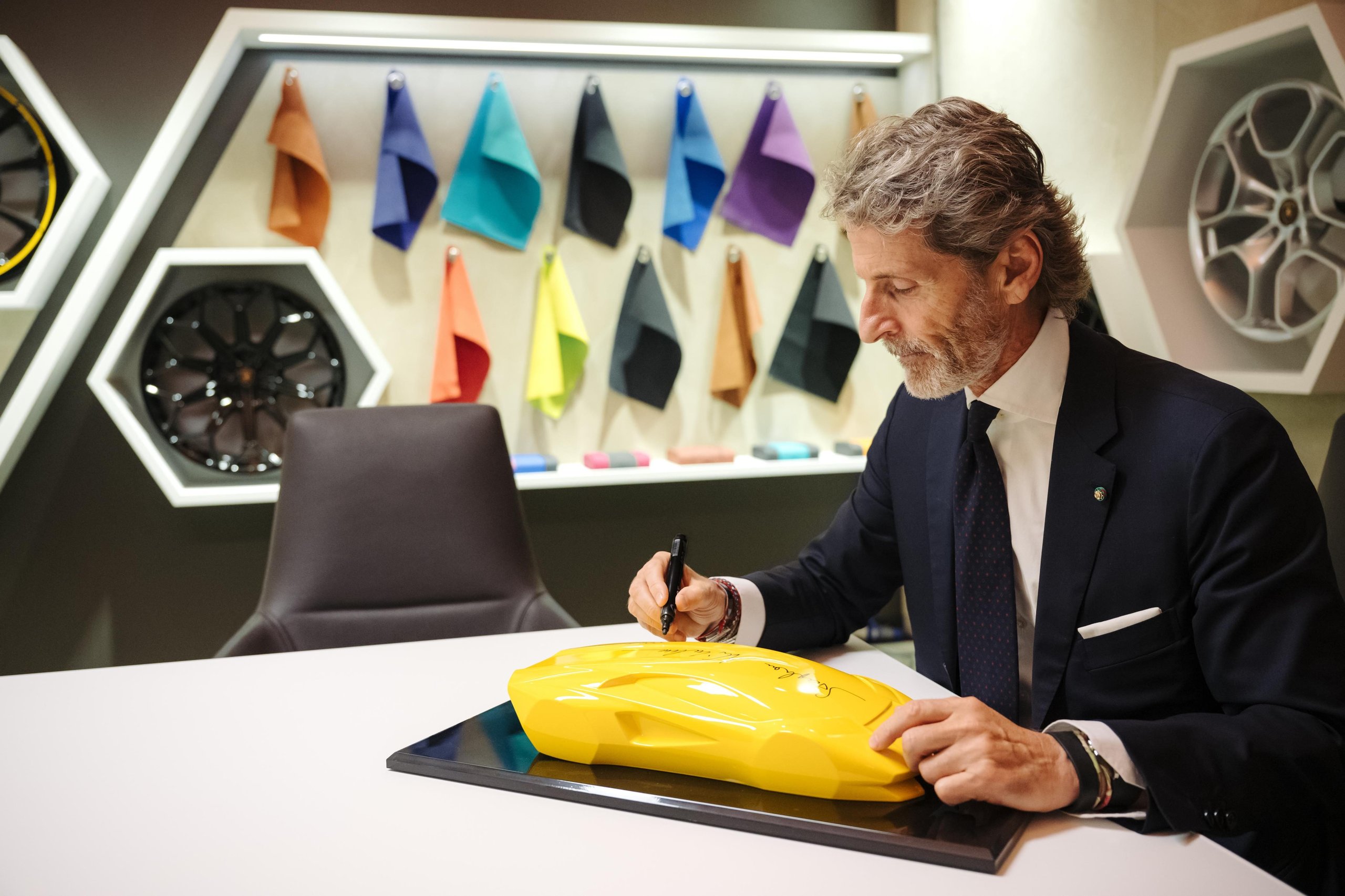
Beyond the obvious appeal of choosing your own shade of Verde Mantis, the two-tier structure Lamborghini operates deserves attention. The dealership-level Ad Personam consultation lets buyers explore and configure from the available palette with a specialist on hand. For clients who want to push further, the path leads to the Ad Personam Studio at the factory in Sant’Agata Bolognese, where bespoke color matching, one-off materials, and truly individualized details become possible. The Rome studio functions as the gateway: a physical space where buyers can touch samples, compare wheel finishes against body colors, and begin the process without booking a trip to Emilia-Romagna.
This distinction matters competitively. Ferrari’s Atelier program and Porsche’s Exclusive Manufaktur both offer extensive personalization, but the physical experience of configuring a car in a dedicated space, rather than scrolling through an online configurator, remains a differentiator that Lamborghini clearly wants to emphasize in its most prominent Italian locations. For buyers already on a Revuelto waiting list (Lamborghini reports two and a half years of production orders banked), the Rome studio offers a practical advantage: the ability to refine or finalize a specification locally, with physical material samples, rather than relying on digital renders alone.
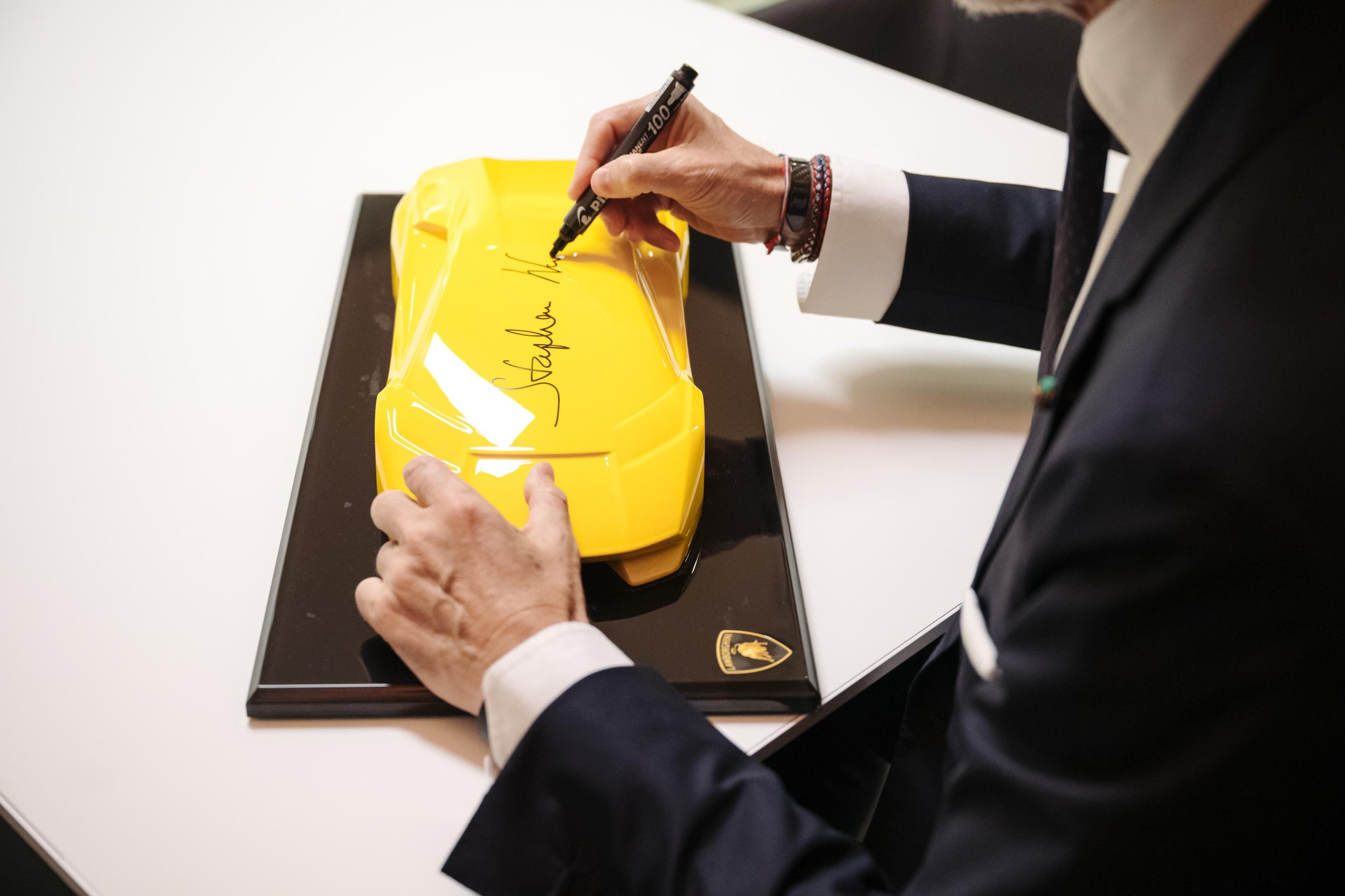
One detail worth noting for anyone who follows how these cars actually get specced: the Ad Personam studio walls visible in official imagery show a curated grid of leather swatches, wheel designs, and trim pieces arranged for side-by-side comparison. It looks more like a materials library in an architecture firm than a typical car dealership options wall, and that is precisely the point.

The elegant interior of a Lamborghini dealership features a client consultation area and extensive customization displays.
From the Miura to the Revuelto: Heritage as a Sales Argument
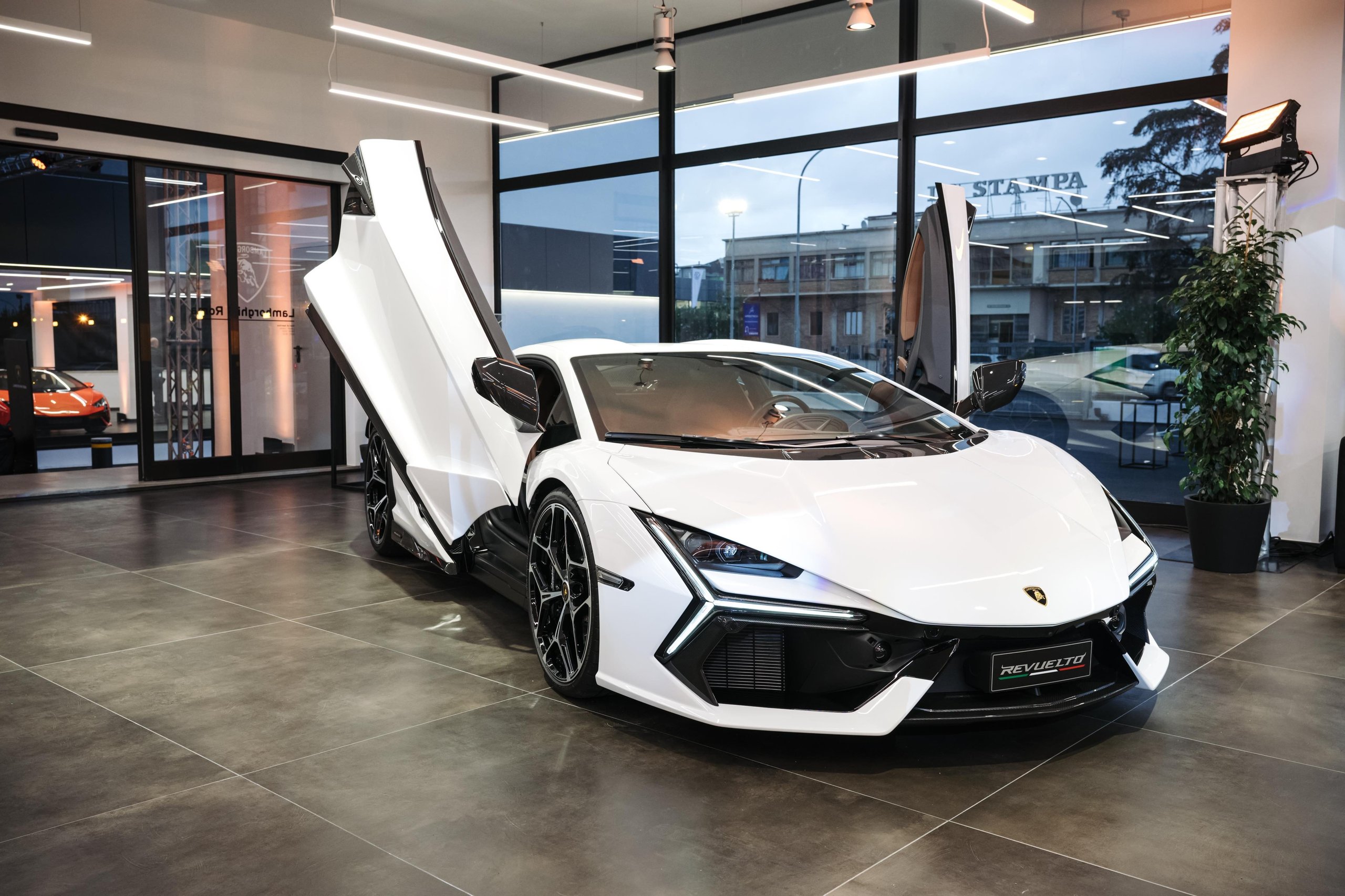
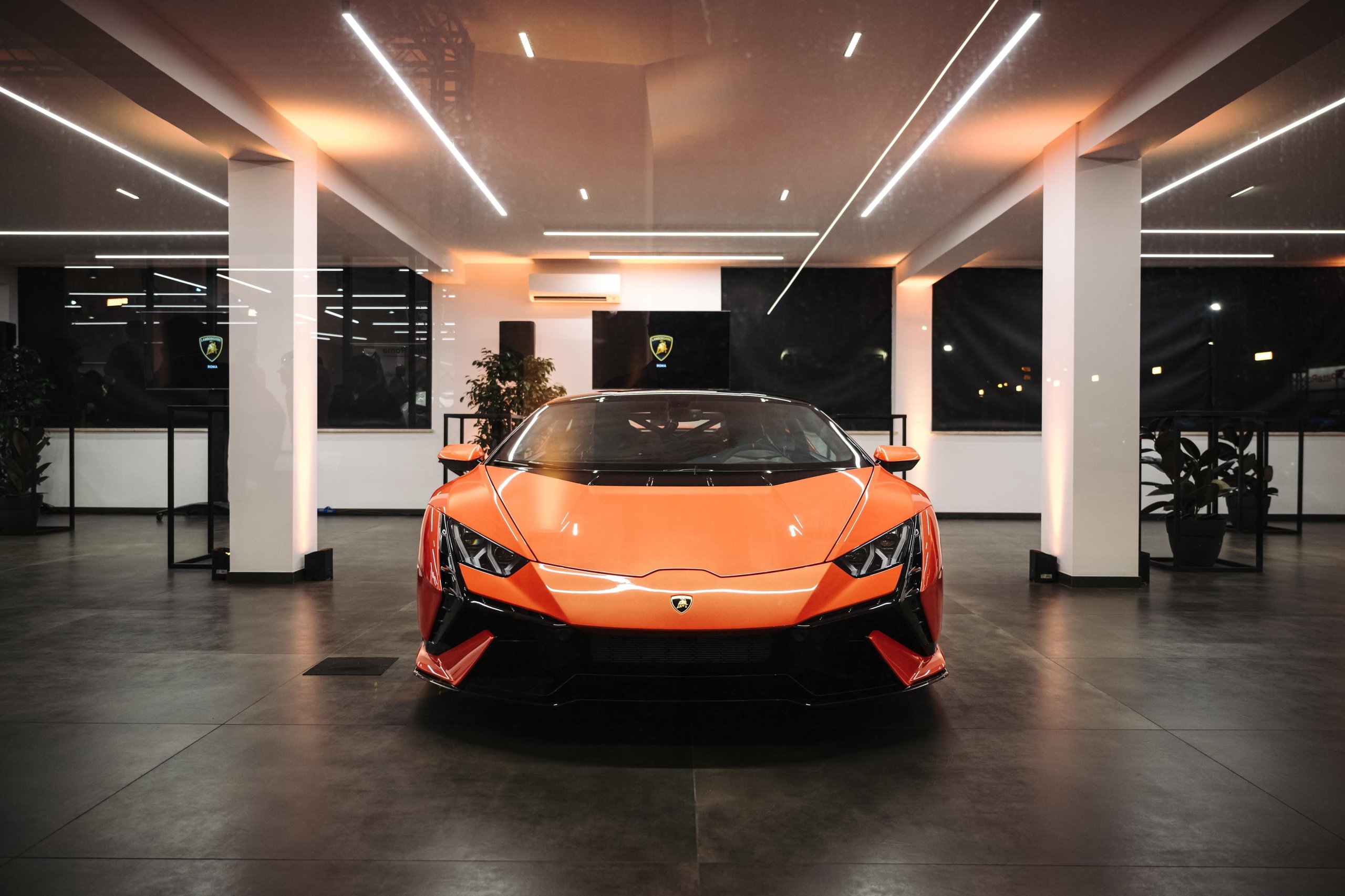
Lamborghini staged the inauguration as a deliberate visual conversation between its past and its electrified present. Parked outside or positioned throughout the facility were a yellow Miura, a Countach 25th Anniversary, a 400 GT Superleggera, a Diablo, a Murciélago, and an Aventador S. Inside, the white Revuelto stood with its scissor doors raised, flanked by three variants of the outgoing Huracán (Tecnica, STO, and Sterrato) and the Urus Performante.
The curatorial choice tells you exactly what Lamborghini wants visitors to feel. The Miura established the mid-engine supercar template. The Countach made it theatrical. The Diablo made it faster. The Murciélago refined it. The Aventador pushed it to the edge of naturally aspirated excess. And the Revuelto, Lamborghini argues, carries all of that DNA forward while adding three electric motors and a plug-in hybrid architecture. Placing these cars in a single room compresses six decades of engineering philosophy into one visual argument: electrification does not erase heritage; it extends it.
Whether buyers fully accept that argument remains one of the more interesting questions in the supercar world right now. The Revuelto keeps its V12 (a new 6.5-liter unit, not the Bizzarrini-derived architecture that served from the Miura through the Murciélago), and the hybrid system adds torque fill and electric-only capability rather than replacing combustion drama. For the Roman clientele walking through this showroom, the message is designed to be reassuring: the future sounds like a V12 with electric assistance, not a silent departure from everything that made the brand famous.

Two legendary Lamborghinis, a yellow Miura and a silver Countach, stand side-by-side, showcasing decades of iconic design.
Why Rome, and Why Now
Lamborghini positions Rome as both strategically and symbolically important. The Italian capital represents a buyer profile that differs meaningfully from Milan or Bologna. Rome’s luxury market skews toward clients who value spectacle, cultural weight, and public presence. A Lamborghini in Roman traffic is not commuting; it is performing. The new dealership, with its event-ready architecture and prominent glass facade, is designed to serve that audience.
The practical dimension is equally relevant. Over 6,000 Urus SUVs contributed to Lamborghini’s record 2023 sales, and the Super SUV has broadened the brand’s customer base to include buyers who want daily usability alongside supercar credentials. A larger workshop and dedicated pre-owned area in Rome suggest that Lamborghini expects its local ownership base to grow, and that servicing and resale will become increasingly important revenue streams for the dealer. The workshop area visible in official imagery shows a Huracán STO elevated on a lift in a clean, well-lit service bay, a deliberate contrast to the cramped independent shops that many Italian supercar owners have historically relied on.
Lamborghini is also reportedly offering a 10-year extended warranty on all new cars, with a five-year scheduled maintenance plan included and an eight-year high-voltage battery warranty for its HPEV models. That last detail is particularly significant for Revuelto buyers: the hybrid system introduces components that did not exist in the Aventador ownership equation, and a factory-backed battery warranty reduces one of the genuine unknowns of early hybrid supercar ownership. The extended warranty is an additional cost beyond the standard three-year coverage, but its availability signals that Lamborghini is thinking seriously about long-term ownership confidence as it transitions its entire lineup to electrified powertrains.

A grey Lamborghini Huracan STO is expertly positioned on a hydraulic lift within a pristine service bay.
The Full Lineup on Display: Huracán Variants, Urus Performante, and a Ducati
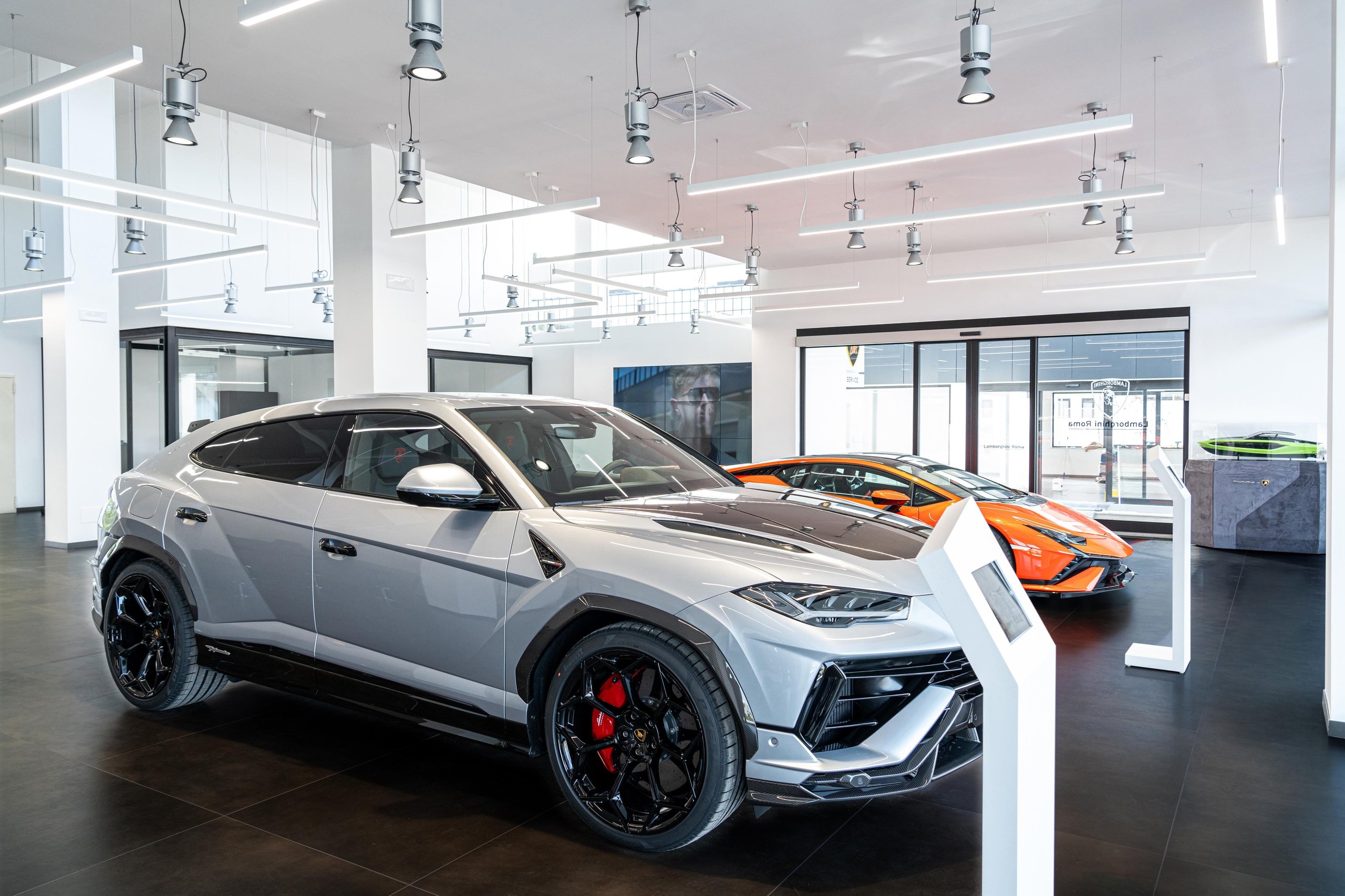
Beyond the heritage cars and the Revuelto, Lamborghini filled the showroom with models representing the full breadth of its current catalog. The Huracán Tecnica, STO, and Sterrato each occupy a distinct niche within the V10 range: the Tecnica as the rear-wheel-drive daily weapon, the STO as the track-focused homologation special, and the Sterrato as the genuinely eccentric off-road variant that proved Lamborghini could build a supercar with rally-style ground clearance and still sell every unit.
The Urus Performante anchored the SUV side of the display. For the Rome market specifically, the Urus remains the volume driver, the car that brings new clients into the Lamborghini ecosystem who might never have considered a mid-engine two-seater. Positioning it alongside the Huracán range and the Revuelto reinforces the idea that a Lamborghini dealership in 2023 serves a far wider audience than it did a decade ago, when the showroom floor might have held an Aventador and a Gallardo and little else.
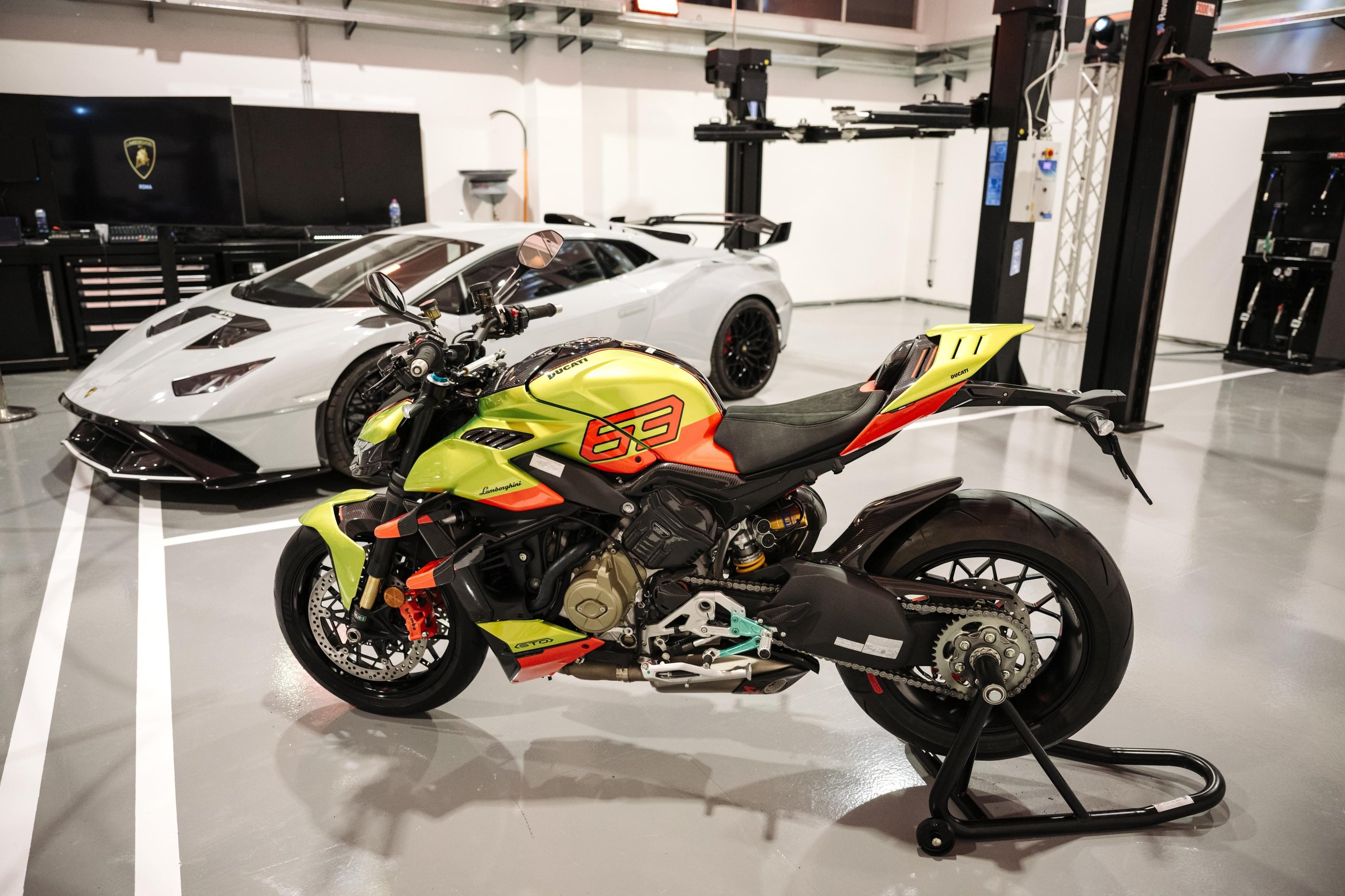
A Ducati Streetfighter V4 Lamborghini edition was also visible in the service area, a nod to the shared Volkswagen Group family and the kind of cross-brand lifestyle product that appeals to collectors who think in terms of garages rather than individual purchases. A small detail, but it speaks to how Lamborghini Rome intends to function: not as a place where you buy a single car, but as a destination where the brand’s entire world is accessible under one roof.

The vibrant orange Huracán Tecnica and the sleek silver Urus stand ready for admiration in the contemporary showroom.
A Template for Selling the Electrified Future
Dealership openings rarely qualify as genuinely interesting news. This one does, for a specific reason: it reveals how Lamborghini plans to sell its electrified future to the customers who care most about its combustion past.
The formula is legible. Place the Revuelto at the center of a room that also contains a Miura. Build an Ad Personam studio where buyers can touch the materials that will define their car. Invest in a workshop large enough to service hybrid powertrains alongside naturally aspirated V10s. And do all of this in Rome, where the audience expects drama, craftsmanship, and a sense of occasion that a website configurator cannot replicate.
For buyers currently on the Revuelto waiting list, the practical takeaway is straightforward: the Rome facility offers a physical Ad Personam consultation that can refine or finalize a specification without traveling to Sant’Agata Bolognese. For prospective buyers entering the brand through the Urus or a certified pre-owned Huracán, the dedicated pre-owned area and expanded service capacity lower the barrier to ownership in a city where independent supercar maintenance has historically been inconsistent.
Lamborghini has not disclosed the specific investment in the Rome facility, nor has it published sales targets for the location. What the company has made visible is a template: a dealership designed to function as a brand embassy, where heritage validates the present and customization turns a purchase into a personal project. As Lamborghini prepares to debut multiple new models (according to Road & Track, the company expects several debuts in the near term), Rome now has a stage large enough to receive them.

The modern Lamborghini dealership glows at dusk, displaying a grey Urus and an orange Huracan through its expansive windows.
Gallery