Championship Clinched at COTA: Michimi’s Title and Ferrucci’s Weekend Sweep
Shinya Michimi secured the Pro Driver Championship in the Lamborghini Blancpain Super Trofeo North America series at Circuit of the Americas in September 2016, wrapping up the title with three rounds still to run. He did it with a second-place finish in Round 10, the kind of result that tells you everything about the season he built: so commanding that he could let Santino Ferrucci take the checkered flag and still walk away with the crown.
Ferrucci, piloting the No. 77 Courtney Racing entry representing Lamborghini Broward, crossed the line 6.977 seconds ahead of Michimi to complete a weekend sweep of both COTA races. That margin represented genuine pace rather than a cautious field trailing behind. Michimi, driving the No. 1 Prestige Performance Huracán Super Trofeo LP 620-2 for Lamborghini Paramus, clearly managed his race with the championship math in mind. A runner-up result was all he needed, and he collected it with the composure of someone who understood the bigger picture.
Prestige Performance also took the Team Champions title, capping a year in which the outfit proved it could deliver both outright speed and the consistency required to win a championship across a full North American calendar. Together, the driver and team results painted a portrait of a season defined less by any single spectacular drive than by relentless, race-after-race execution.
A Season Dedicated to a Drag Racer’s Memory
What separates Michimi’s championship from a routine title clinch is the personal weight he carried through every round. Lamborghini says Michimi dedicated his entire 2016 campaign to his late grandfather, a drag racer who died of cancer two years prior.
“I lost my grandfather two years ago to cancer, and he was a drag racer. He was a lot of my inspiration. He used to tell me stories about what he did as a child and everything, so I’m dedicating this whole year to him.”
The generational thread matters. A grandson running Huracán Super Trofeo cars at COTA, channeling the memory of a man who raced in straight lines on different machinery, in a different era. Motorsport families understand this kind of continuity. It runs deeper than sponsorship logos and championship points, adding a human dimension to what could otherwise read as another line on a results sheet.
Michimi called his 2016 campaign “almost a dream season,” crediting his team’s preparation and the car’s consistent performance for making the dedication feel earned rather than symbolic. Six wins from ten races gave the tribute substance. The championship was not merely promised in his grandfather’s name; it was built, round by round, on results that left no room for doubt.
Super Trofeo as Lamborghini’s Competitive Proving Ground
Launched in 2009 with the Gallardo as its platform, the Lamborghini Super Trofeo series functions as the entry point to the brand’s customer racing pyramid. The North American arm arrived in 2013, and by 2016 it had matured into a genuinely competitive single-make environment where young professionals, gentleman drivers, and aspiring talent raced identical Huracán LP 620-2 machinery on world-class circuits.
One source indicates the series experienced substantial growth in its early years, with participation nearly doubling in two years and increasing eightfold since its 2009 inception. That trajectory reflects something real about the format’s appeal. Single-make racing strips away the variable of car advantage and forces outcomes to hinge on driver skill, team preparation, and racecraft. For Lamborghini, this creates a controlled environment to identify and develop talent while simultaneously giving dealers and customers a direct connection to the brand’s competition identity.
The Blancpain partnership, which gave the series its full title, reinforced the luxury positioning. According to one report, Blancpain’s CEO Marc Hayek owned and drove one of the inaugural Super Trofeo cars, a detail that underscores how closely the watchmaker’s brand identity aligned with the racing program. The partnership was never purely a title-sponsorship transaction; it connected two brands whose customers overlapped in meaningful ways.
The 2015 World Finals at Sebring brought the global competition to American soil, and by 2016 the North American series produced drivers like Michimi and Ferrucci whose results demanded attention beyond the single-make paddock. Their performances at COTA validated the premise that a well-structured one-make championship could generate competition intense enough to forge genuine talent.
The Huracán Super Trofeo: Purpose-Built for Close Racing
The Huracán LP 620-2 Super Trofeo shares its basic architecture with the road-going Huracán but diverges sharply in purpose. The LP 620-2 designation tells you the essentials: 620 horsepower from the naturally aspirated V10, sent exclusively to the rear wheels. That rear-drive configuration, distinct from the all-wheel-drive setup of most road Huracáns, rewards precision and punishes sloppiness, exactly the qualities a driver development series should test.
The car visible in official imagery from the COTA weekend wears aggressive aerodynamics including a prominent rear wing, an aerodynamic body kit, racing slicks, and exposed brake calipers, all wrapped in a grey camouflage livery with American flag accents. The visual identity is pure competition: sponsor decals, stripped interiors, and bodywork shaped for downforce rather than aesthetics. As Autoblog noted in a later feature on a road-titled Super Trofeo, the car represents a “hardcore, race-ready iteration” of the Huracán platform, one that exists at a level of commitment well beyond any Performante or STO.
What made the car effective as a championship tool was its combination of accessibility and challenge. Enough power to be genuinely fast, enough rear-drive sensitivity to separate the talented from the merely brave, and enough mechanical reliability across a season to let results be decided by the humans rather than the hardware. Michimi’s six wins from ten races in 2016 reflect exactly that formula working as intended: a car that revealed the driver rather than concealing him.

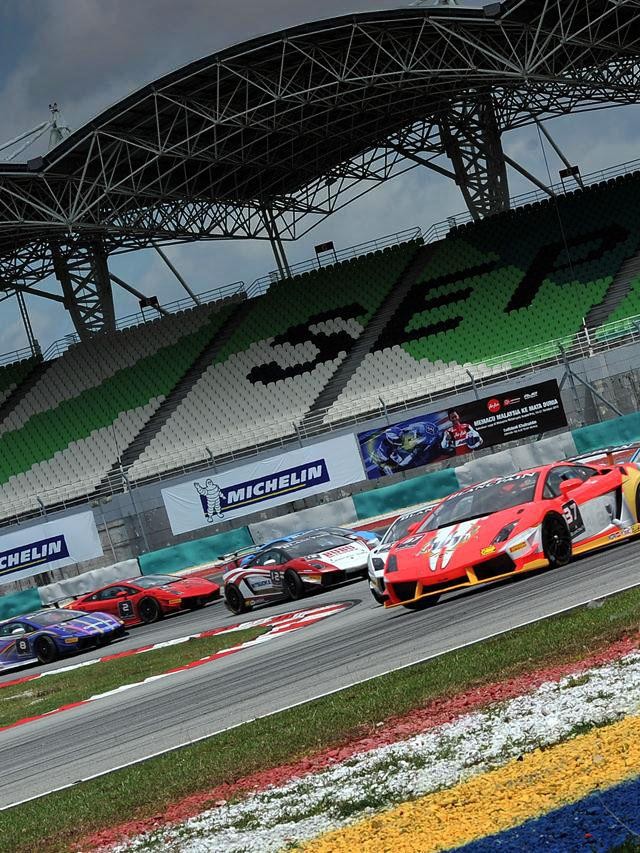
The camouflage-wrapped Lamborghini Huracan GT3 race car navigates a turn on the track during a Blancpain Super Trofeo event.
From COTA to Valencia: North American Results Feed Global Ambitions
Michimi’s championship was mathematically sealed at COTA, but the season was not finished. The final two rounds of the North American championship were scheduled for Valencia, Spain, on December 1-2, followed immediately by the Super Trofeo World Finals on December 3-4. For Michimi, those Valencia rounds offered the rare luxury of racing without championship pressure, a chance to focus purely on speed and preparation for the global showdown. For the remaining class titles still undecided, those rounds would carry enormous weight.
The World Finals format brings together champions and top finishers from the European, Asian, and North American Super Trofeo series, the logical culmination of Lamborghini’s regional racing strategy. Win your continental championship, then prove yourself against the best from every other market. The structure mirrors what other manufacturers attempt with their customer racing programs, but Lamborghini’s version benefits from single-make purity: every car on the grid runs the same Huracán specification, so the World Finals genuinely test drivers and teams rather than development budgets.
Ferrucci’s trajectory offers a useful illustration of what the series can produce. His dominant COTA weekend demonstrated the kind of raw pace and composure that professional racing teams look for. The Super Trofeo grid functions, in practical terms, as a talent identification system wrapped in a customer racing experience. Lamborghini benefits twice: the series generates revenue and dealer engagement at the customer level, while simultaneously producing a stream of proven competitors who can represent the brand in higher-profile championships.
Looking at where Lamborghini’s motorsport ambitions have traveled since 2016 makes the Super Trofeo’s role even clearer. The recently unveiled Temerario GT3 marks Lamborghini’s first competition car to be fully designed, developed, and built in-house, a significant evolution from the era when external partners handled much of the race car engineering. The pipeline from Super Trofeo customer racing through GT3 competition and, more recently, into the LMDh prototype category with the SC63 represents a deliberate escalation. Drivers who prove themselves in the controlled environment of Super Trofeo earn attention for programs further up the ladder.
The championship will transition to the Temerario platform in the coming years, bringing turbocharged hybrid power to a series built on naturally aspirated V10 purity. That shift will redefine the driving challenge, the sound, and the skills required to win. Michimi’s 2016 title belongs to a specific chapter in that story: the era when 620 naturally aspirated horsepower, rear-wheel drive, and a driver’s nerve were the only variables that mattered.


