A Singular Show Car Comes Home to Sant’Agata
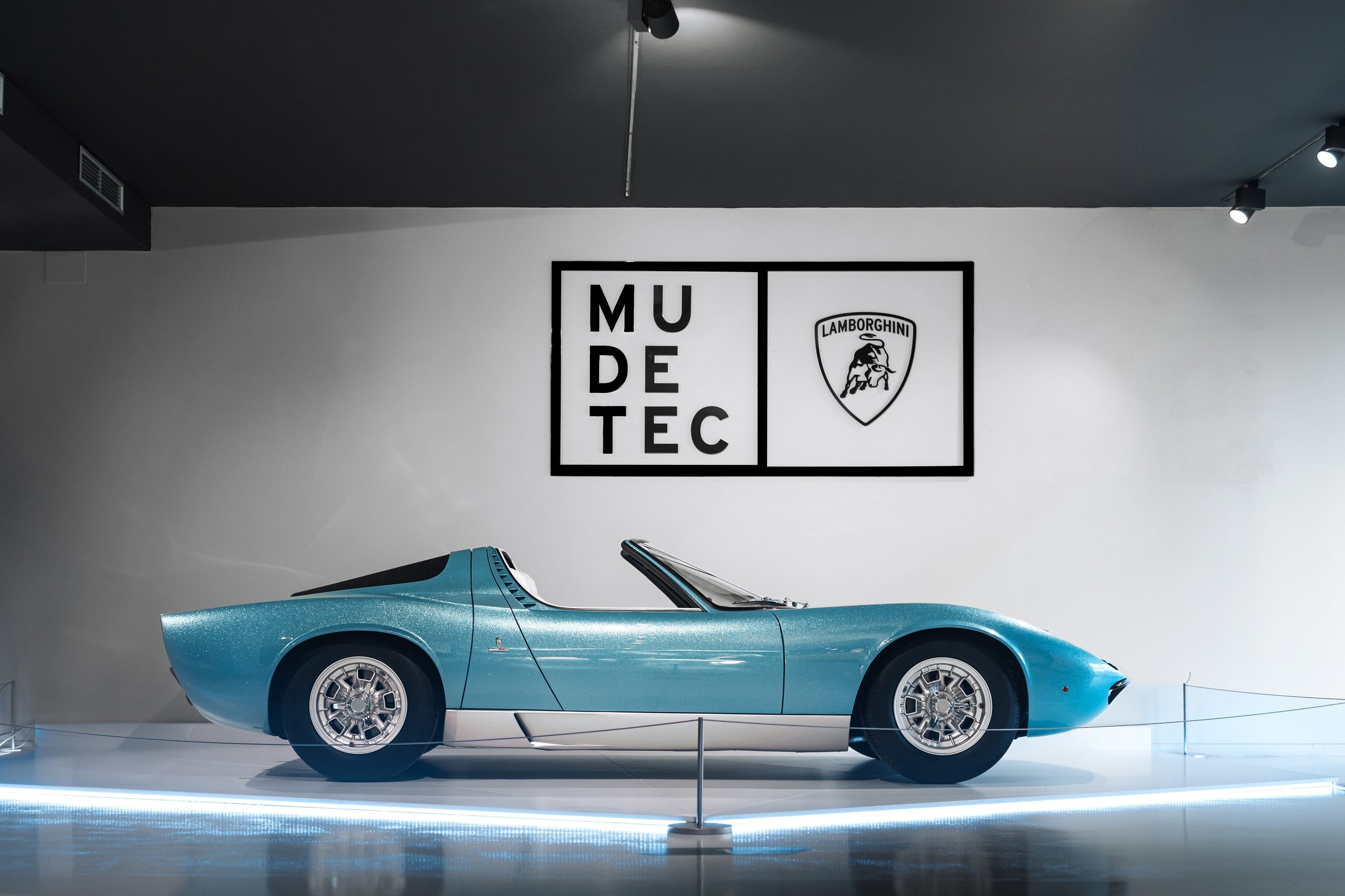
Lamborghini’s MUDETEC museum in Sant’Agata Bolognese is hosting the sole surviving 1968 Miura Roadster through October and November, placing it alongside the production Miura coupe in a pairing that makes the company’s design argument in the most direct way possible. This is not just a heritage display. Lamborghini says the Miura Roadster served as the direct design inspiration for the configuration of the Aventador Ultimae Roadster, the final V12 Aventador ever built. That claim turns a museum visit into something more pointed: a chance to stand in front of the 54-year-old source material and trace its influence forward to the car that closed the Aventador chapter.
The approach is unusually literal for a supercar manufacturer. Rather than invoking heritage through mood boards or press-release rhetoric, Lamborghini brought the actual car back to the factory and put it under lights, inviting visitors to make the visual connection themselves. For anyone who can reach northern Italy before December, the opportunity to examine a one-off show car that shaped a modern V12 supercar’s farewell form is worth the detour.
Bertone’s Boldest Miura: What Made the Roadster Different
The Miura Roadster debuted at the Carrozzeria Bertone stand during the 1968 Brussels Motor Show, and it was never a simple exercise in removing the coupe’s roof. Marcello Gandini and the Bertone team redesigned the rear section entirely, eliminating the coupe’s characteristic engine cover slats to leave the transverse V12 fully exposed. The result was a more sculptural, more theatrical presentation of the powertrain, turning the engine bay into a visual centerpiece rather than something hidden behind louvers.
Designed without side windows or any roof closure system, the Roadster allowed Bertone’s stylists to maintain what Lamborghini describes as a pure, uninterrupted line from windshield header to tail. Inside the cabin, secondary control switches that normally sat on the ceiling of the coupe were relocated, a small but telling detail that reveals how thoroughly the interior was reconsidered for the open-air format. The original color specification reinforced the show-car intent: Lamè Sky Blu paintwork over a white leather interior with red carpeting, a combination calibrated to stop traffic on a motor show floor.
The Roadster also received larger air intakes on the sides of the rollover hoop to feed more cooling air to the engine, along with a lower rollover hoop for cleaner airflow. Bertone reportedly strengthened the structure to compensate for the absent roof. These were not cosmetic tweaks layered onto an existing body. The Roadster was a ground-up rethink of the Miura’s visual and aerodynamic identity, which is precisely why its influence persisted long enough to reach the Aventador program decades later.

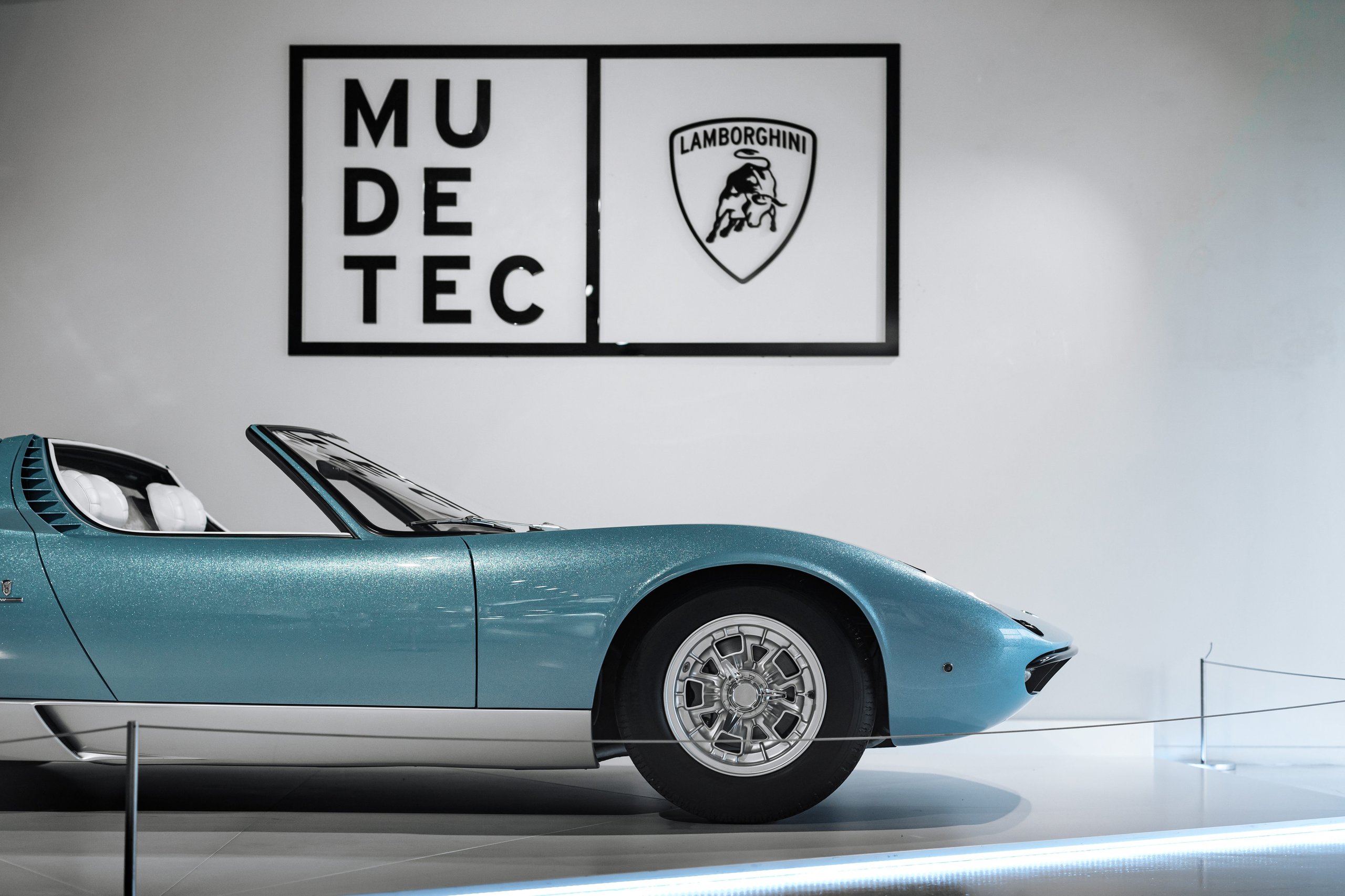
The rare light blue metallic Lamborghini Miura Roadster is presented in a dynamic front three-quarter view at MUDETEC.
From Miura Roadster to Aventador Ultimae: Tracing the Design Thread
Lamborghini’s claim that the Miura Roadster inspired the Aventador Ultimae’s configuration is not vague brand poetry. Specific design cues carried forward to a special Ad Personam Ultimae Roadster project: a specially created “Azzurro Flake” body color interpreted the Miura Roadster’s original Lamè Sky Blu with an updated metallic flake element, the roof and rear engine cover used shiny black-painted carbon fiber as a nod to the Roadster’s roofless architecture, and the air intake treatment referenced the original Bertone design.
The logic becomes easy to follow once you see both cars side by side at MUDETEC. The Miura Roadster’s defining gesture was exposing the engine and stripping away visual barriers between the occupants and the mechanical heart of the car. The Aventador Ultimae Roadster, with its removable roof panels and transparent or darkened engine cover treatments, pursued the same idea through modern materials and engineering. Carbon fiber replaced hand-formed aluminum. Active aerodynamics replaced Gandini’s fixed intakes. But the philosophical impulse, letting the buyer see and feel the powertrain’s presence, remained constant across five decades.
By anchoring the Ultimae’s identity in a specific, traceable design lineage rather than pure performance escalation or materials innovation, Lamborghini gave its final naturally aspirated V12 Aventador a narrative depth that spec sheets alone cannot replicate. The MUDETEC exhibit exists to let visitors verify that narrative with their own eyes.

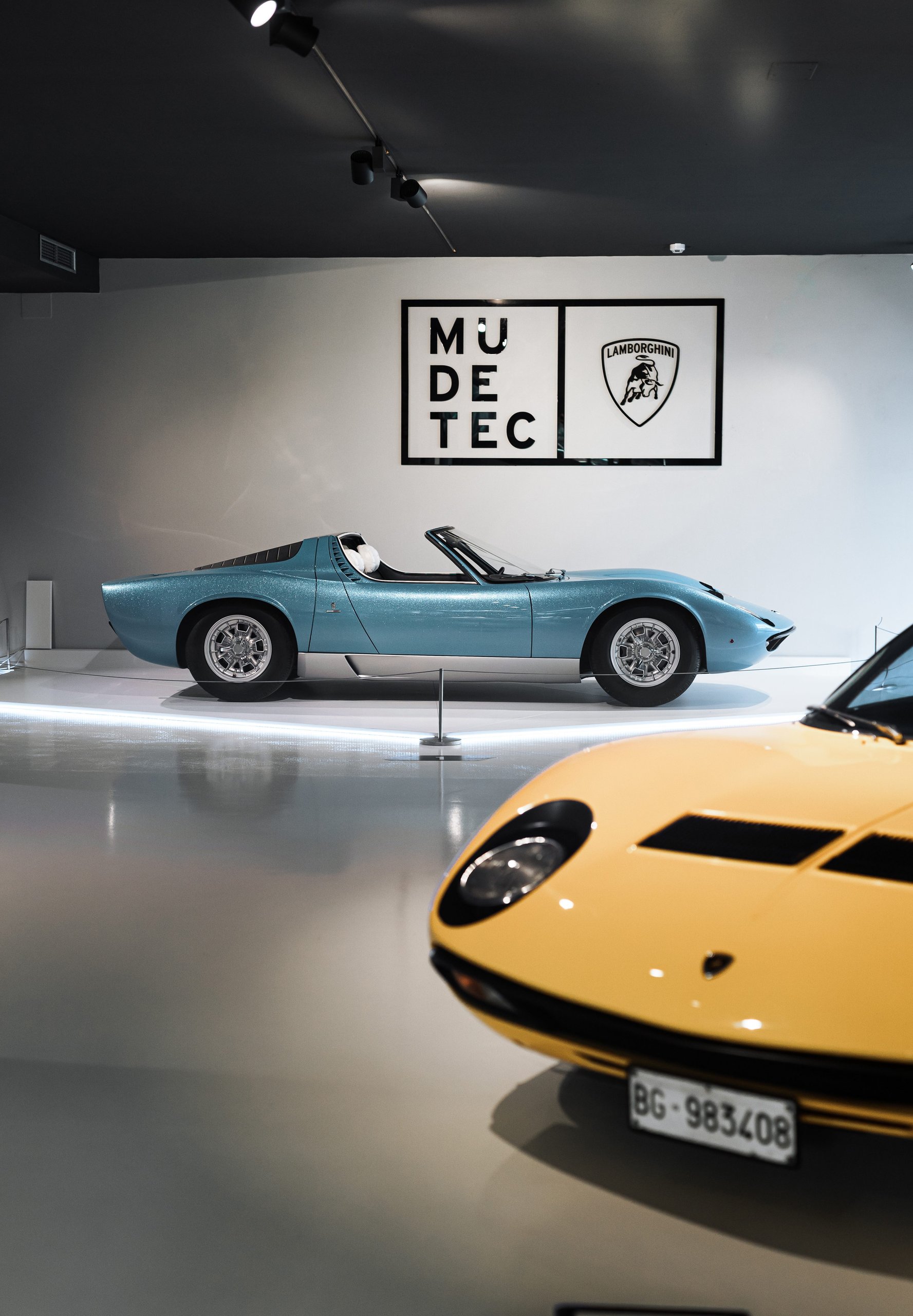
Two iconic Lamborghini Miura models, a rare Roadster and a classic coupe, are showcased side-by-side at MUDETEC.
Zinc Alloys, Olive Green Paint, and a Long Road Back to Sky Blue
The Miura Roadster’s journey from Brussels show stand to MUDETEC museum case involved one of the stranger detours in Lamborghini history. After appearing at both the Brussels and Geneva Motor Shows in 1968, the car returned to Sant’Agata Bolognese, where legendary Lamborghini test driver Bob Wallace conducted road tests. The specifics of those sessions remain frustratingly undocumented. Lamborghini has not published mileage figures or test reports, and no independent source has surfaced Wallace’s notes. What we know is that the car was driven on real roads by the man who also developed the Miura Jota, which tells you the Roadster was evaluated seriously, not just paraded.
The car then went back to Bertone, which sold it to the International Lead and Zinc Research Association (ILZRO). The organization’s interest was not in Lamborghini heritage. ILZRO extensively modified the car, repainted it dark olive green with a matching green interior, and renamed it ZN 75 to showcase the potential of zinc alloys in automotive applications. For decades, one of the most significant show cars in Italian automotive history existed as an industrial demonstrator, its original identity buried under institutional paint and zinc-plated components.
Between 2007 and 2008, the Roadster underwent a comprehensive restoration that returned it to its original Brussels Motor Show specification. Following that work, the car appeared at the Pebble Beach Concours d’Elegance in August 2008, where it secured second place in the class dedicated to Lamborghini models. Second place at Pebble Beach, for a car that spent years as a zinc-alloy billboard, speaks to the quality of the restoration and the enduring regard the concours world holds for this particular machine.
That restoration is what makes the MUDETEC exhibit possible and, more importantly, what makes the Aventador Ultimae connection legible. Without the return to Lamè Sky Blu, the design thread linking 1968 Brussels to the Ultimae’s Azzurro Flake would be invisible. Lamborghini treats its most significant historical cars as active brand assets, not static museum pieces, and the Miura Roadster’s second life as the Ultimae’s design ancestor is the clearest proof of that philosophy.

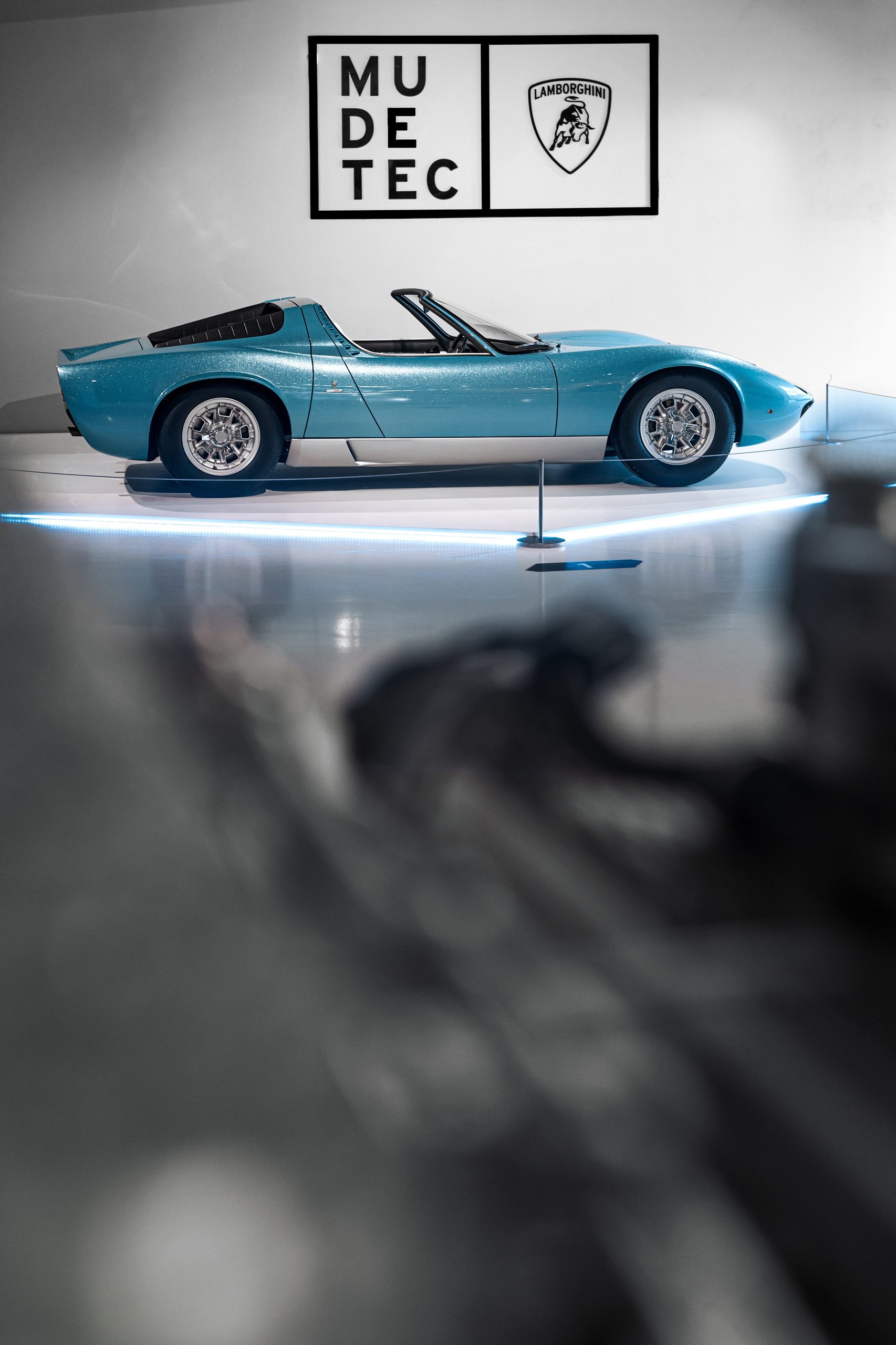
An overhead perspective highlights the open cockpit and sleek lines of the rare Lamborghini Miura Roadster at MUDETEC.
What the Exhibit Signals About Lamborghini’s V12 Identity
Placing the Miura Roadster at MUDETEC alongside the production Miura coupe and other early Lamborghini models is a curatorial choice with commercial implications. The original Miura, introduced in 1966, was Lamborghini’s first mid-engined car and is broadly recognized for initiating the trend of high-performance mid-engined sports cars. Every V12 flagship that followed, from the Countach through the Diablo, Murciélago, and Aventador, built on the template the Miura established. By anchoring the Aventador Ultimae’s farewell in the Miura Roadster’s design language, Lamborghini is arguing that its V12 lineage is a single, continuous thread rather than a series of disconnected products.
That argument carries particular weight now. The Aventador’s successor, the Revuelto, pairs its V12 with a hybrid system and three electric motors. Enthusiast forums reflect genuine anxiety about whether hybridization will dilute the visceral character that defined the naturally aspirated V12 era. Lamborghini’s response, at least in part, is to keep reinforcing the design and emotional continuity of the lineage. If the Revuelto’s engineering represents a break from the Aventador’s mechanical purity, the company wants buyers to see the aesthetic and philosophical DNA as unbroken.
For anyone weighing an Ultimae purchase on the secondary market, the Miura Roadster connection adds a layer of provenance that few modern supercars can claim. The Ultimae was already the final naturally aspirated V12 Aventador. Knowing that its specific design configuration traces to a car Marcello Gandini built for the 1968 Brussels Motor Show gives it a collector narrative that should age well. Whether Lamborghini planned it that way from the start or recognized the connection after the fact is almost beside the point. The story holds together, and in the collector market, a coherent story is worth real money.

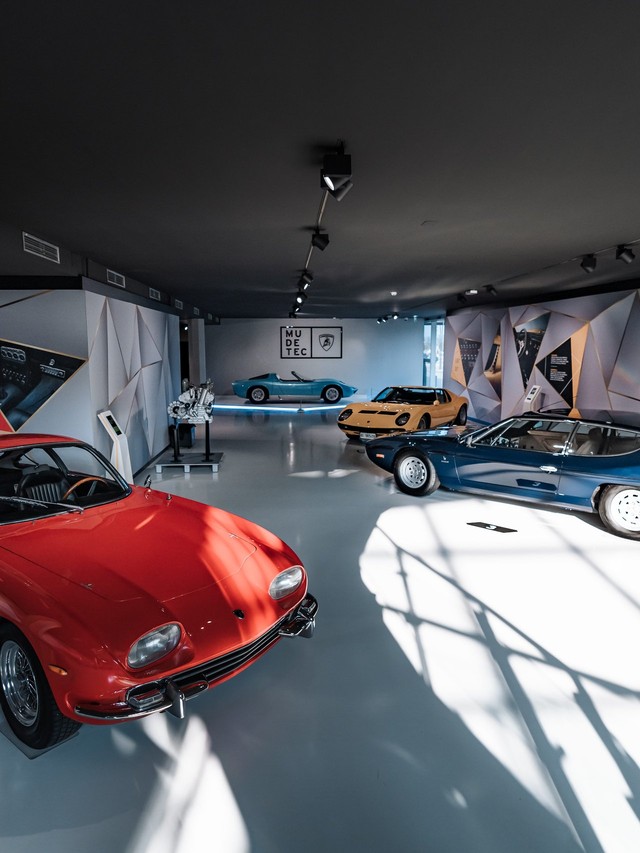
A panoramic view of the MUDETEC museum reveals a stunning collection of classic Lamborghini models, including the rare Miura Roadster.
Visiting MUDETEC: Practical Details
The Miura Roadster display runs through October and November at the MUDETEC (Museo delle Tecnologie) on the Lamborghini campus in Sant’Agata Bolognese. Lamborghini has not published specific ticketing details or extended-hours information for this particular exhibit, so checking directly with the museum before traveling is the practical move. The wider MUDETEC collection, visible in official images, includes a yellow Miura coupe, a red 400 GT, and a blue Islero among other models, making the visit worthwhile even beyond the Roadster itself.
For those who cannot make the trip, the exhibit reinforces a pattern worth watching. Lamborghini increasingly uses MUDETEC as a rotating stage for heritage storytelling tied to current product launches. The Countach LPI 800-4 received similar treatment, and the Revuelto’s debut was accompanied by historical context displays. If you are tracking Lamborghini’s brand direction, the museum’s programming is becoming as informative as the press conferences.
Gallery