Three Continents, One Circuit, Six Races
On a single Friday in late October 2019, the Circuito de Jerez de la Frontera settled all three regional Lamborghini Super Trofeo championships, and not one title fight followed the script. Bonaldi Motorsport’s Danny Kroes and Sergei Afanasiev clinched the European crown. Gama Racing’s Chris van der Drift and Evan Chen took the Asian title. Change Racing’s Richard Antinucci and Corey Lewis emerged from a three-way scrap to win in North America. Each result arrived through a different cocktail of misfortune, composure, and opportunism, and together they made the case that the Super Trofeo’s spec format is precisely what forces this kind of drama.
Concentrating the finales of three continental series into one weekend, on one circuit, turns Jerez into a pressure cooker. Drivers who spent months accumulating points across Asia, Europe, and North America suddenly share a paddock, a pit lane, and the same strip of Andalusian asphalt. The format rewards consistency over heroics, but the drama that unfolded suggested the cars and their drivers did not read the memo. When every entrant races an identical Huracán Super Trofeo Evo, the margins between championship glory and a broken weekend shrink to almost nothing: a punctured tire, a pit-stop miscalculation, a stalled engine on the installation lap.
Europe: A Puncture Hands the Title to Kroes and Afanasiev
The European title fight between Kroes/Afanasiev and Imperiale Racing’s Kikko Galbiati and Vito Postiglione came down to a left-rear tire. Lamborghini confirms that the #44 car, in Galbiati’s hands, suffered a puncture just before the pit window opened in Race 2, destroying any chance Postiglione and Galbiati had of claiming a maiden series triumph. For Postiglione, it marked yet another final-round title defeat, a pattern that stings regardless of how philosophical one tries to be about racing luck.
Kroes and Afanasiev did not need to win. They finished sixth in the opener and lost points to their rivals, but kept composure in Race 2. After following teammates Stuart Middleton and Jack Bartholomew past the pole-sitting #98 Huracán of Gerhard van der Horst in the closing laps, a second-place finish was enough. The title went to the pairing that absorbed pressure rather than the one that generated the most outright speed.
Jonathan Cecotto and Frederik Schandorff dominated Race 1 from pole, winning by eight seconds, a margin that underlines how the Huracán Super Trofeo Evo rewards clean air and rhythm. Target Racing teammates Alberto di Folco and Davide Venditti inherited second after a post-race penalty for Middleton and Bartholomew. In a one-make format where every car runs the same naturally aspirated V10, a gap like eight seconds is built on racecraft and setup, not horsepower advantages. That reality is what makes the spec formula so revealing.
North America: A Pit-Stop Penalty and a Stalled Engine Scramble the Order
Antinucci and Lewis arrived at Jerez leading the North American standings but nearly threw it away in Race 1. Lamborghini says the Change Racing pairing received a drivethrough penalty for being under the minimum pit-stop time, dropping them to fourth in the Pro category. The win went to the Prestige Performance/Wayne Taylor Racing entry of Sandy Mitchell and Andrea Amici in the #101 Huracán.
That result compressed the standings: Mitchell and Amici were suddenly tied on points with third-place finisher Brandon Gdovic, and both crews sat just four points behind Antinucci and Lewis heading into Race 2. Then the racing gods intervened again. Mitchell and Amici were due to start from pole, but their #1 car ground to a halt with a suspected engine issue on the installation lap, forcing a start from the back of the field. They recovered to fourth in Pro, a remarkable salvage job, but Antinucci and Lewis only needed their third-place finish to seal the championship. Gdovic and his co-driver Daly could not take the Pro win they required.
The North American finale illustrated a practical reality of customer racing that the spec format amplifies rather than eliminates: mechanical reliability matters as much as driver talent. When every car shares the same 620-horsepower V10 architecture, the margin between a title and a broken weekend can come down to a single installation lap.
Asia: Van der Drift’s Switchback Clinches It at Turn 9
The Asian series produced the most visually compelling title-deciding moment. Gama Racing’s van der Drift and Chen entered the finale locked in battle with FFF Racing’s Juuso Puhakka and Takashi Kasai. The VS Racing Pro-Am entry of Yuki Nemoto claimed pole and led the opening stint before handing over to Alex Au, who slipped behind both Chen and Puhakka after the mandatory stops. Puhakka carried more pace in the closing stages, but Chen defended well enough to edge the win by two-tenths of a second, leaving both crews tied on 144 points before Race 2.
The decider was similarly tense. Puhakka led from pole and handed over to Kasai, who defended robustly from van der Drift as the pair disputed the lead exiting the Dry Sack hairpin. Lamborghini says van der Drift eventually made it into the lead after a superb switchback manoeuvre on Kasai at Turn 9, clinching the title with a second victory of the weekend for the #268 Huracán. Two-tenths in Race 1, a switchback in Race 2. The Asian championship delivered the kind of wheel-to-wheel narrative that one-make series are designed to produce but rarely execute this cleanly. Identical cars, identical tires, and the outcome still came down to a single corner.

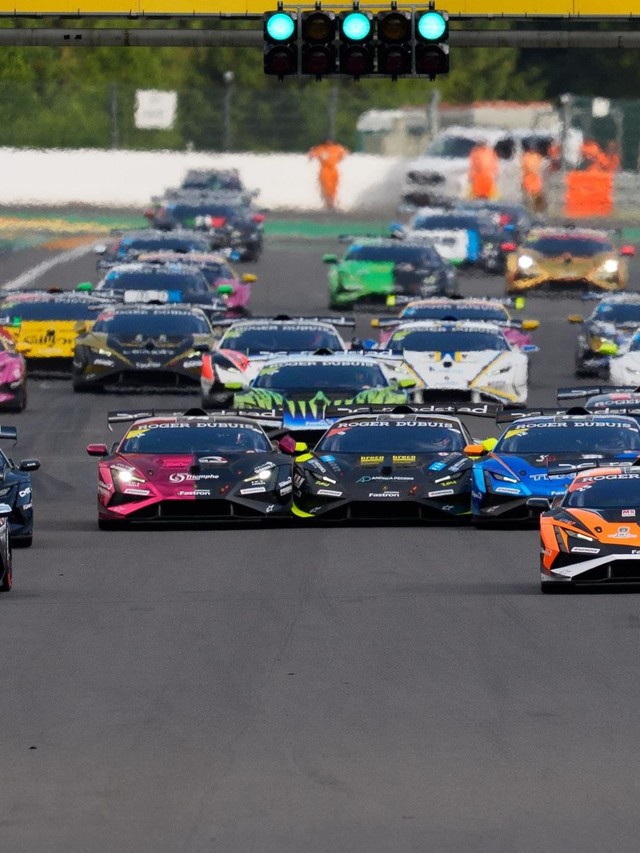
Lamborghini Huracán Super Trofeo Evo cars compete fiercely on the track during the 2019 World Final at Jerez.
Why the Super Trofeo Matters Beyond the Podium
The Lamborghini Super Trofeo is an international one-make motor racing series that operates across Europe, Asia, and North America, with the European championship running since 2009. Its structure, where every entrant races an identical Huracán Super Trofeo Evo on Hankook tires, strips away the engineering arms race that defines prototype and GT3 competition. Driver skill and team preparation become the primary differentiators, which is exactly why the 2019 finales played out the way they did. No team could buy its way out of a puncture or a stalled engine; no crew could engineer around a pit-stop penalty.
For Lamborghini, the program serves a dual purpose. It functions as a talent pipeline: drivers who prove themselves in Super Trofeo often progress into GT3 and endurance racing, carrying Lamborghini experience with them. It also keeps privateer teams invested in the brand’s ecosystem. A team that buys, maintains, and races a Huracán Super Trofeo Evo for several seasons develops a relationship with Squadra Corse that extends well beyond a single car purchase. The cost of entry and season participation remains something Lamborghini does not publicly detail, but the series positions itself as accessible relative to GT3, where budgets escalate quickly.
The Temerario GT3, widely reported as Lamborghini’s first competition car to be fully designed, developed, and built in-house, represents the next chapter. The Huracán road car was replaced by the plug-in hybrid Temerario, and the racing ladder will eventually follow. For teams and drivers who built their programs around the Huracán’s naturally aspirated V10 characteristics, this transition means adapting to an entirely new powerband and different engineering philosophy. The Super Trofeo’s current chapter, still running on that screaming V10, feels like both a celebration and a farewell.
World Finals and What Comes Next at Jerez
With the regional titles settled on Friday, the rest of the Jerez weekend shifted to the World Finals, where drivers from all three continental championships compete for a global crown. Qualifying sessions for the Pro/Pro-Am and Am/LB Cup classes were scheduled for Saturday morning, with races running through Sunday afternoon.
The entry list carried some notable names beyond the regional champions. Lamborghini says nine-time motocross World Champion Tony Cairoli and five-time 24 Hours of Le Mans winner Emanuele Pirro would take the start in the Pro-Am class. Cairoli’s presence is a reminder that the Super Trofeo draws competitors from outside traditional single-seater or GT pipelines, a cross-pollination strategy that keeps the series visible to audiences who might not otherwise follow customer GT racing. All World Finals races were set to be live streamed on the Squadra Corse YouTube channel and Facebook pages.
The 2019 Jerez finales made the argument more vividly than any brochure could: the Super Trofeo remains one of the more compelling customer racing programs in the supercar segment precisely because the spec format forces drama. A puncture rewrote the European championship. A stalled engine on the installation lap scrambled the North American fight. A switchback at Turn 9 decided Asia. The Huracán Super Trofeo Evo’s naturally aspirated V10 will eventually give way to whatever Squadra Corse develops next, but these results demonstrated that the format itself, not just the car, is what makes this series worth following.


