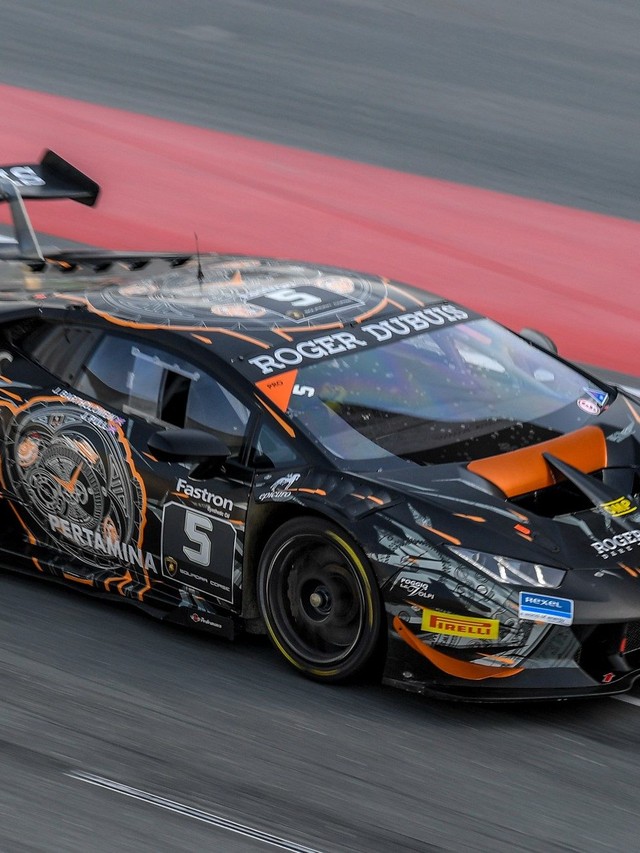
A Dubai Double: How Race 2 Unfolded at the Autodrome
Jack Bartholomew and James Pull made it look routine, and that is precisely what made it impressive. The FFF Racing by ACM pairing swept both races during the second round of the Lamborghini Super Trofeo Middle East on February 16-17 at the Dubai Autodrome, turning a weekend that started with a second-row grid position into a commanding double victory. Yet the way they won told a deeper story about what this series is designed to reveal: which drivers can adapt when a race falls apart around them.
Giacomo Altoé, driving the #78 Antonelli Motorsport Huracán Super Trofeo, grabbed the lead from pole and set the fastest lap of the race at 1’37.752. Altoé, Taylor Proto, and Christopher Zoechling held the top three through the opening stint, running a pace that looked sustainable enough to keep Bartholomew and Pull at arm’s length. Then the race broke open. Proto lost time in a spin on lap nine, dropping from a podium position to fifth and reshuffling the order right before the mandatory driver change. When the pit window closed, Glauco Solieri inherited the lead in the Antonelli car but could not sustain it. Bartholomew, now behind the wheel of the #5 FFF entry, needed roughly ten laps to climb from third to first. Once he got there, he stayed. The gap at the flag made the second consecutive win look comfortable, but the mid-race sequence told a different story: this was a field where small errors carried large consequences, and the drivers who kept their composure were the ones who climbed.
Jefferies and Proto: The Battles That Revealed More Than the Win
The more revealing contest played out further down the order, and it spoke directly to the series’ purpose as a proving ground. Axcil Jefferies, competing as a Lamborghini Young Driver alongside Carrie Schreiner in the #11 Konrad Motorsport entry, inherited a modest position after Schreiner’s opening stint. What followed was a sustained charge through the field that brought Jefferies onto the tail of Proto’s FFF car in the closing laps. The two young drivers ran wheel-to-wheel before Jefferies forced his way past on the final tour, claiming second overall and first in the Pro-Am category. That result, combined with his recovery drive, pushed Jefferies and Schreiner into first position in the Pro-Am standings for Konrad Motorsport.
Proto, despite the earlier spin, recovered to finish third overall and first in AM. For a young American driver building a racing resume, the ability to regroup after losing time and still hold off a stacked field counts for more than a clean, uneventful podium. In the Lamborghini Cup, Mark Proto continued his own winning streak with a second consecutive class victory, and the Pro-Am podium was completed by the Altoé-Solieri pairing in second and the Lefterov-Jasper duo in third. Across every category, the weekend rewarded adaptability over raw speed, which is exactly the quality Lamborghini’s motorsport division looks for when deciding who deserves a longer look.
Why the Super Trofeo Exists: Lamborghini’s Motorsport Ladder
Strip away the individual results and the Super Trofeo’s architecture comes into focus as something more deliberate than a customer racing series. Launched in 2009 with the Gallardo and positioned from the start as the fastest one-make championship in the world, the concept was straightforward: give customer teams and developing drivers identical machinery, remove the variable of car performance, and let talent sort itself out.
The series now operates across three continental championships (Europe, North America, and Asia), plus the Middle East regional series, all feeding into an annual World Final where drivers from every region compete for an overall title. The driver categories (Pro, Pro-Am, Am, and Lamborghini Cup) create a structured environment where gentlemen racers and aspiring professionals share the same grid, and crucially, the same car. That car is the Huracán Super Trofeo, a rear-wheel-drive, purpose-built racer that shares its naturally aspirated 5.2-liter V10 DNA with the road car but strips away all-wheel drive and most creature comforts in favor of a carbon-and-aluminum chassis optimized for circuit work.
The Super Trofeo is recognized as a crucial talent pipeline for drivers aspiring to GT3 competition. Ferrari runs the Challenge series with a similar philosophy, and Porsche fields the Carrera Cup. Lamborghini’s version occupies a specific niche: it sits below GT3 in terms of outright pace and technical complexity, which makes it both more accessible for newcomers and more revealing of raw driver skill. When everyone drives the same car, the stopwatch measures the person, not the budget. Races like the one Jefferies drove in Dubai are precisely the kind of audition the system is built to produce.
From Dubai Grid to Factory Program: The Talent Pipeline in Action
Jefferies’ drive in Race 2 illustrates exactly how this pipeline works in practice. Competing under the Lamborghini Young Driver banner, he occupied a seat specifically reserved for emerging talent that Squadra Corse wants to evaluate under race conditions. The Young Driver designation is not honorary. It signals that Lamborghini’s motorsport division considers a driver worth investing in, monitoring, and potentially promoting to higher-tier factory programs.
The progression is deliberate. A driver proves consistency and racecraft in the Super Trofeo, builds relationships with established customer teams like Konrad Motorsport or FFF Racing, and eventually earns consideration for GT3 endurance programs where the stakes, the budgets, and the competition are all significantly higher. Bartholomew’s dominance in the Pro class during this Middle East season, three consecutive wins according to available reporting on the 2018 campaign, represents the kind of sustained performance that catches the attention of factory decision-makers.
For prospective entrants watching from the sidelines, the practical question is always cost. Lamborghini does not publicly disclose a standard entry fee for the Super Trofeo, and the total outlay depends heavily on the team, the number of rounds, and the level of factory support. Forum discussion among enthusiasts and prospective racers tends to describe the series as expensive but competitive for its category, though specific figures remain difficult to pin down without direct team quotes. What the series does offer is a structured environment with factory-backed technical support, equal machinery, and a direct line of sight to Lamborghini’s broader racing ecosystem.
Connecting the Grid to Lamborghini’s GT3 Future
Every one-make series eventually faces a generational question: what happens when the car changes? The Huracán Super Trofeo replaced the Gallardo version, and the next chapter will inevitably involve the Temerario platform. According to Autoblog, the Temerario GT3 debuted at the 2025 Goodwood Festival of Speed as Lamborghini’s first competition car fully designed, developed, and built in-house. That shift from outsourced development to internal engineering control represents a significant change in how Squadra Corse approaches racing.
The Super Trofeo’s role in this transition is straightforward. It provides the proving ground where Lamborghini can evaluate both drivers and operational processes before committing them to the higher-profile GT3 stage. Drivers who cut their teeth on the naturally aspirated V10 in Dubai or Monza will eventually need to adapt to the Temerario’s twin-turbo V8 architecture, a fundamentally different powerband that demands different driving techniques and racecraft. For teams and drivers who built their programs around the Huracán’s characteristics, that transition means adapting to new weight distribution, turbo management in wheel-to-wheel racing, and an entirely different throttle response profile.
The Middle East series plays a specific role in this broader picture. Running a compact three-round calendar at circuits like Yas Marina and the Dubai Autodrome, it provides a lower-barrier entry point for regional talent and teams who may not commit to a full European or North American season. It also keeps Lamborghini’s motorsport brand visible in a region where supercar culture runs deep and customer relationships matter enormously to the road-car business.
Looking Ahead: The Season Finale at Dubai Autodrome
The third and final round of the Super Trofeo Middle East is scheduled for March 1-3 at the Dubai Autodrome, this time using a different track layout. With Bartholomew and Pull holding a commanding points advantage in the Pro class, the real drama will likely center on the Pro-Am and Lamborghini Cup battles, where the margins remain tight.
That finale feeds into a season that culminates in the World Final, where regional champions from every Super Trofeo series converge for a single weekend. The drivers who prove themselves in Dubai will carry that momentum forward, and some will use it as a springboard to GT3 programs. Bartholomew’s consistency and Jefferies’ raw pace both suggest drivers worth following beyond this particular weekend in the desert. Whether either name surfaces in a factory GT3 cockpit down the line, the system that gave them the chance to show what they can do is working exactly as Lamborghini designed it.
Gallery


