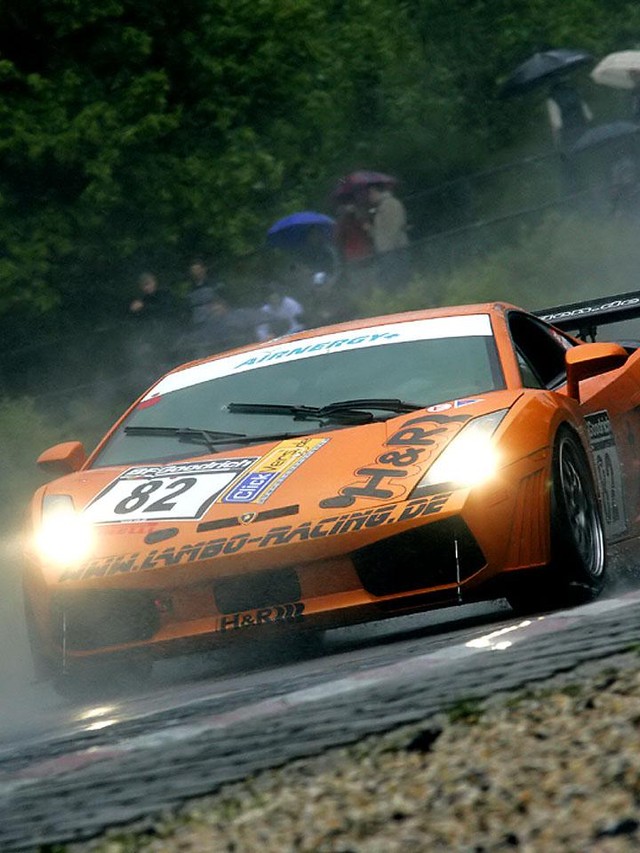
A Tropical Downpour and the Gallardo’s Final Competitive Chapter
Sepang International Circuit in November 2014 delivered exactly the kind of send-off the Gallardo Super Trofeo deserved: chaotic, dramatic, and soaking wet. The sixth and final round of the Lamborghini Blancpain Super Trofeo Asia doubled as the regional component of the 2014 World Final, cramming two 50-minute races into a single day and forcing Asian and European competitors onto the same patch of tarmac. The first race ran under relatively normal conditions. The second did not. A tropical thunderstorm rolled across the circuit before the start, delaying proceedings and leaving standing water across the racing line.
The pace car led the field for two laps under yellow flags, with Gallardo Super Trofeos kicking up walls of spray as they circulated on a surface that offered about as much grip as polished marble. By lap three, the safety car peeled off and the real racing began. For a series built around amateur and semi-professional competitors, the conditions were genuinely punishing. These were all-wheel-drive Gallardos built to GT3 specifications, running 562 horsepower through reworked chassis clothed almost entirely in carbon fiber, but no amount of engineering can fully compensate for a flooded apex and a gentleman driver’s adrenaline.
The significance of the weekend extended well beyond the results sheet. This was the Gallardo’s curtain call as a racing platform. The series launched in Europe in 2009 and expanded to Asia in 2012, built entirely around the Gallardo LP 560-4 Super Trofeo. Every lap at Sepang that weekend carried the weight of finality, because the car that defined Lamborghini’s first one-make series was about to be retired, and the machine waiting in the wings would demand something entirely different from its drivers.
Ochiai, Wiser, and the Art of the Comeback
Two drivers defined the weekend’s narrative arc, and both illustrated why the Lamborghini Blancpain Super Trofeo has always been more than a vanity exercise for wealthy hobbyists. Toshiyuki Ochiai, running solo in the #212 car, started the first race from seventh on the grid and methodically picked his way through the field to finish in the top three. In the second race, under those treacherous wet conditions, he repeated the trick with another come-from-behind drive to win the AM category outright. For a gentleman driver competing without a co-driver, that consistency across wildly different conditions spoke to genuine skill.
Max Wiser and Jiang Xin in the #209 car told a different story. Their first race ended abruptly after lap 12 with a retirement. Rather than letting that setback define their weekend, the pair came back for the second race and dominated the PRO AM category, seizing the lead at lap 12 and holding it to the flag. Lamborghini says the duo had already clinched the Super Trofeo Asia series championship after the Shanghai round, making their Sepang victory a statement of intent ahead of the World Final on Sunday.
Other results added texture. Hironori Takeuchi and Masami Kageyama (#211) won the PRO AM category in the opening race. Solo racer Andrea Garbagnati (#206) earned a podium finish with a late charge. The Japanese pairing of Yasuyuki Uchida and Tomonobu Fujii (#223) led the second race for most of its duration before being overtaken on the very last lap, a gut-punch finish that underscored how competitive the series had become even among its amateur ranks. These were not professionals trading tenths; they were enthusiasts trading paint, and the racing was better for it.
The Gentleman Driver Model and What It Reveals About Lamborghini’s Racing DNA
The Super Trofeo series occupies a specific and strategically important niche in Lamborghini’s world. It exists for wealthy enthusiasts who want real wheel-to-wheel racing in identical, factory-prepared cars, without requiring a professional racing license or a lifetime of karting experience. Drivers compete individually or in teams of two, with categories (PRO AM and AM) structured to keep competition meaningful across different skill levels. Each round follows a consistent rhythm: 50 minutes of practice, 35 minutes of qualifying, and two 50-minute races.
The inaugural Asian series in 2012 drew 18 teams from seven countries, including China, Malaysia, Singapore, Thailand, Taiwan, Hong Kong, and Japan. By 2014, the grid had matured into a genuinely competitive field. The Gallardo Super Trofeo was the only one-make series car at the time to use all-wheel drive, giving its gentleman drivers a slightly more forgiving platform in conditions like Sepang’s monsoon-soaked second race.
The cars themselves were serious machines. Beyond the 562-horsepower V10, the Gallardo Super Trofeo featured an FIA FT-3 fuel cell, a full roll cage, Brembo Racing brakes, HANS device compatibility, and Makrolon polycarbonate replacing all glass. The interior was stripped to essentials: Alcantara trim and a low-mounted racing bucket seat built from Kevlar and carbon fiber. The adjustable rear wing could be repositioned for different circuits. For anyone considering what these cars represent as collectibles today, it is worth noting that the road-going Gallardo Super Trofeo Stradale, introduced at Frankfurt in 2011 and sharing many of these racing components, carried a price that one source placed at just under $300,000. That the gentleman driver program demanded machinery this serious tells you everything about how Lamborghini viewed the endeavor: not as a marketing sideshow, but as a proving ground.
The Huracán LP 620-2 Super Trofeo: A New Platform, a New Philosophy
Lamborghini used the 2014 World Final weekend to preview the car that would replace the Gallardo in its one-make series: the Huracán LP 620-2 Super Trofeo. Attendees could test-drive the new machine at Sepang, making the weekend both a farewell and an introduction.
The shift to the Huracán platform brought a fundamental change in philosophy. Where the Gallardo Super Trofeo retained all-wheel drive, the Huracán LP 620-2 moved to rear-wheel drive, a configuration that demands more precision from the driver but rewards it with sharper rotation and more adjustable handling at the limit. Lamborghini described the car as built specifically for the rigors of the track, suggesting a more dedicated, less road-car-derived approach than its predecessor. The new car was slated to debut across all three continental series (Europe, Asia, and North America) for the 2015 season.
For the gentleman racers who had spent years learning the Gallardo’s forgiving all-wheel-drive character, the transition meant starting over. The safety net was gone, replaced by a platform that would reward clean technique and punish lazy inputs. Whether that shift attracted or intimidated potential entrants is a question the subsequent seasons answered, but the ambition was clear: Lamborghini wanted its customer racing program to produce better drivers, not just faster lap times. The rain-soaked Gallardo farewell at Sepang, then, was not merely an ending. It was the moment Lamborghini signaled that its gentleman racers would need to grow alongside the cars.
From Customer Racing to In-House GT3: The Thread That Connects Sepang to Today
Viewed from a decade’s distance, the 2014 Sepang weekend looks like a hinge point in Lamborghini’s motorsport trajectory. The Super Trofeo series proved that the company could organize, support, and sustain a global customer racing program, building infrastructure and expertise that would serve larger ambitions. The Huracán Super Trofeo evolved through EVO and EVO2 iterations over the following years, and the platform’s naturally aspirated V10 became a collector magnet in its own right. Autoblog reported that one Huracán Super Trofeo was even sold by a Michigan dealer titled for road use, a testament to the desirability of these machines beyond the paddock.
The larger strategic payoff arrived with the Temerario GT3, which multiple outlets report as Lamborghini’s first competition car to be fully designed, developed, and built in-house. The organizational muscle required to run three continental one-make series and a World Final, season after season, laid the groundwork for Squadra Corse to take that step. Without the Super Trofeo program proving that Lamborghini could build and support race cars at scale, the leap to a fully in-house GT3 effort would have been far more difficult to justify.
For buyers and collectors watching the market, the Gallardo Super Trofeo cars from this era occupy an interesting position. They represent the origin of Lamborghini’s modern customer racing identity, built in limited numbers and raced hard. The ones that survived in good condition are becoming increasingly scarce. Whether that translates into collectible premiums depends on the usual variables, but the historical significance of these cars within Lamborghini’s story is not in question. What started with gentleman racers wrestling all-wheel-drive Gallardos through Sepang’s rain now connects directly to Lamborghini’s most ambitious competition programs. The thread runs unbroken from that stormy Malaysian afternoon to the factory floor in Sant’Agata.
Gallery


