Lamborghini Hands the Temerario Polizia to Italy’s Finest
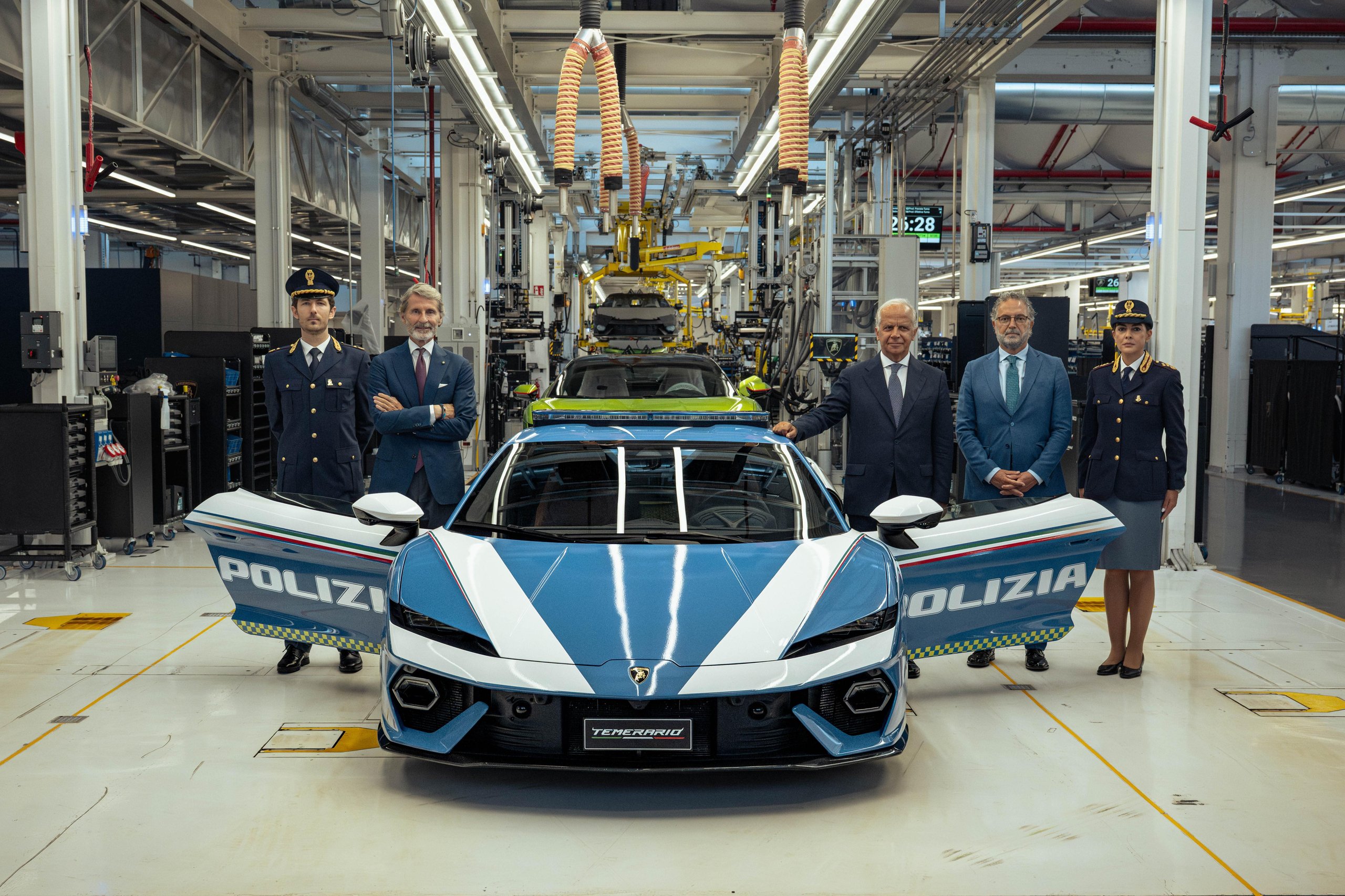
At Lamborghini’s Sant’Agata Bolognese headquarters, the company formally presented a new Temerario in full Polizia specification to the Italian State Police, with Minister of the Interior Matteo Piantedosi and Lamborghini Chairman and CEO Stephan Winkelmann both in attendance. The car wears the familiar blue and white livery with “Polizia” branding and a roof-mounted light bar, but the real story is what it will do once it leaves the factory floor: join a fleet of Lamborghini supercars dedicated primarily to the emergency transport of organs and medical supplies across Italy.
This is not a publicity stunt dressed up as law enforcement. The partnership between Lamborghini and Italy’s State Police dates back to 2004, when the first Gallardo entered service and completed its inaugural organ transport mission that same September. In the 22 years since, six Lamborghini vehicles have rotated through the fleet. The Temerario is the latest, and the first to carry Lamborghini’s new hybrid powertrain architecture into active duty.
The Italian State Police reportedly do not intend to use the Temerario for high-speed pursuits. Its mission is more specific and more consequential: getting a viable organ from one hospital to another before the transplant window closes. That singular purpose is what elevates the Polizia program from corporate goodwill into something genuinely rare among supercar manufacturers, a sustained commitment where performance engineering directly serves human life.
Twenty-Two Years of Gallardos, Huracáns, and Lives Saved
The lineage reads like a compressed history of Lamborghini’s mid-engine evolution. The original Gallardo gave way to the Gallardo LP 560-4, which was followed by the Huracán. The Urus Performante joined in 2023, giving the police a high-riding option for different operational needs. Each car was donated by Lamborghini and modified for service.
The cumulative impact is tangible. These vehicles have participated in over 200 organ transport missions across Italy. One widely reported instance involved a Huracán covering roughly 300 miles from Rome to Padua in approximately two hours, delivering a donor kidney at an average speed that would make most Autostrada drivers nervous. That journey normally takes about five hours. Lamborghini states the police cars have also taken part in over 1,500 road safety education events, a softer but still meaningful use of the brand’s visibility.
A book titled I motori della Polizia, tracing the history of vehicles that have served the Italian State Police, was also presented during the ceremony. It is a niche publication, but it underscores something important: this collaboration is old enough and deep enough to warrant its own archival record. Twenty-two years of continuous service, with each successive Lamborghini generation stepping into the same role, has turned what began as a single donated Gallardo into an institutional tradition.

The new Lamborghini Temerario Polizia is presented to a large gathering of officials and executives. Image: Automobili Lamborghini.
Why 920 CV of Hybrid Power Matters for Organ Transport
The Temerario’s powertrain represents a generational leap from the naturally aspirated V10 that powered the Huracán Polizia. An all-new 4.0-liter twin-turbo V8 pairs with three electric motors for a total output of 920 CV. Reports indicate the hybrid system includes a 3.8 kWh battery pack and an eight-speed dual-clutch transmission.
For organ transport, the advantages of electrification go beyond raw speed. The electric motors provide instant torque at low speeds, which matters when accelerating out of toll plazas and merging onto motorways under emergency conditions. The plug-in hybrid architecture also means the car can operate in electric-only mode at low speeds around hospital complexes, where noise and emissions are genuine concerns. Improved fuel efficiency, relative to a pure combustion supercar, extends the effective range between fuel stops on cross-country sprints where every minute counts.
One source describes a specialized refrigerated compartment, typically located in the front trunk, designed to safely store organs and temperature-sensitive medical supplies like blood plasma. This compartment reportedly includes a display and data logger for continuous temperature monitoring. Lamborghini’s official material does not detail the Temerario Polizia’s specific interior modifications beyond the livery and light bar, but previous cars in the fleet have carried similar equipment, and the Temerario’s mid-engine layout preserves a usable front storage area.
For context on what the standard Temerario can do: according to Car and Driver, the car carries a base price of $440,367 and produced a Lightning Lap time of 2:41.7 at Virginia International Raceway. That kind of dynamic capability, calibrated for a police role, gives the Italian State Police a tool with performance headroom that no conventional emergency vehicle can match.
The Brand Value of Blue and White
Lamborghini donates these cars. That fact is easy to overlook, but it shapes the entire relationship. The company absorbs the cost of a fully built, specially configured supercar and hands it to a government institution. In return, Lamborghini gets something no advertising budget can replicate: its cars photographed in service on Italian motorways, performing missions that are unambiguously good. Every time a Huracán Polizia appeared in international media carrying a kidney across the peninsula, Lamborghini’s brand equity grew in a way that a Monaco yacht party or a celebrity Instagram post simply cannot achieve.
No other supercar manufacturer maintains this kind of active, operational partnership with a national police force for humanitarian logistics. Ferrari lends its name to plenty of Italian institutions, but it does not donate 920 CV supercars for organ runs. Porsche supplies vehicles to various European police forces, primarily for patrol and pursuit roles. Lamborghini’s niche is narrower and, arguably, more powerful as a brand statement: its fastest cars exist to save lives.
For enthusiasts who follow the brand closely, the Polizia cars occupy a special place in Lamborghini’s identity. They reinforce the “Made in Italy” narrative at its most literal. A supercar built in Sant’Agata Bolognese, donated to the national police, deployed on Italian highways to deliver organs to Italian hospitals. Every link in that chain is domestic. In an era when luxury brands increasingly chase global scale, this partnership is a reminder that Lamborghini’s roots remain stubbornly, productively local.
What Comes Next for the Fleet
Lamborghini confirmed the Temerario Polizia will join the cars already in service, which currently includes the Urus Performante. The company did not announce whether additional Temerario units will follow, or whether the existing Huracán will be retired from active duty.
Practical questions remain. Over 200 missions across 22 years averages out to roughly nine per year, though the pace may have increased as the fleet expanded and hospital networks learned to rely on the service. What happens to these cars after their operational life ends? Previous Polizia Lamborghinis have occasionally appeared at events and in museums, but Lamborghini does not publicly detail their disposition.
For buyers waiting on their own Temerario deliveries, the Polizia version serves as an inadvertent durability endorsement. These cars accumulate real motorway miles under demanding conditions, driven hard by trained police drivers who are not babying the clutch. If the hybrid powertrain proves reliable in that context, it speaks well for the thousands of customer cars now entering service. Road & Track described the standard Temerario as a car that “revs to 10,000 and loves to slide,” which is a fine quality in a supercar and a useful one when an officer needs to close a 300-mile gap in two hours.
The Temerario Polizia is the sixth chapter in a collaboration that most automakers would envy and none have replicated at this scale. Lamborghini builds the car, Italy’s police put it to work, and the organ recipient on the other end of the motorway gets a few more decades of life. The engineering is impressive. The purpose is better.
Gallery