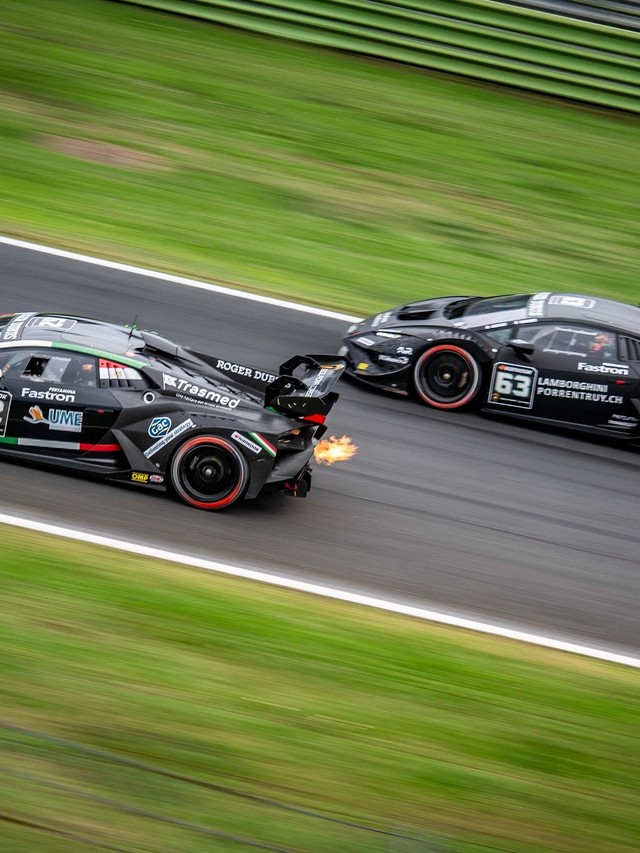
The 2019 Jerez World Final: Where Lamborghini’s Racing Ladder Produced Its Most Diverse Class of Champions
Circuito de Jerez in southern Spain served as the stage for the 2019 Lamborghini Super Trofeo World Final, the annual event that pits regional champions from North America, Europe, and Asia against one another in a winner-take-all weekend. Two 50-minute races across Pro, Pro Am, Am, and LB Cup classes, with points from both rounds determining who leaves with a world title. For the drivers, it represents an entire season’s work compressed into roughly 100 minutes of wheel-to-wheel combat on an unfamiliar circuit.
The racing delivered plenty of drama, but the real story was the cast of characters who emerged with hardware. A sixteen-year-old from Southern California who dominated a field of adults. A Supercross legend with multiple two-wheeled championships making the improbable transition to four wheels. And a woman who, after finishing second six times across the North American season, finally stood on the top step at the most consequential round of the year. Together, they did more to illustrate what Lamborghini’s customer racing program actually produces than any brochure or spec sheet ever could. Each of their stories traces back to the same underlying truth: the Super Trofeo, built around identical rear-wheel-drive Huracans, strips away the usual advantages of budget and pedigree and compresses competition down to skill, adaptability, and nerve.
Steven Aghakhani: Sixteen Years Old and Already a World Champion
Steven Aghakhani was sixteen when he arrived at Jerez representing US RaceTronics and Lamborghini Beverly Hills. He had already won five of ten Am Class races in the North American season, plus both rounds at the series finale on Friday in Jerez. The World Final weekend only extended that streak. Aghakhani took both Am Class races, leaving no ambiguity about who owned the class.
A teenager beating experienced gentleman drivers in identical machinery deserves a moment of consideration. The Huracán Super Trofeo EVO is a track-only, rear-wheel-drive race car that punishes overconfidence and rewards precision. In a one-make series where every car runs the same engine and the same aerodynamic package, the margin between competitors shrinks to driver skill, racecraft, and team execution. For a sixteen-year-old to dominate that environment suggests something beyond precocious talent. It points to the kind of driver development pathway that Lamborghini’s Squadra Corse operation is specifically designed to foster.
Aghakhani became the ninth North American entrant to claim a class world title, and his age at the time of the victory remains one of the more striking statistics in the series’ history. Customer racing programs live or die on their ability to attract and develop new talent, and Aghakhani’s 2019 campaign provided Lamborghini with a compelling proof point.
Ashton Harrison Makes History at the Final Round
Ashton Harrison’s season told a story of persistent near-misses before a breakthrough at the moment that mattered most. Driving the No. 143 Prestige Performance / Wayne Taylor Racing entry under the Lamborghini Paramus banner, Harrison finished second six times across the twelve rounds of the North American LB Cup season. Six runner-up finishes in twelve starts is the kind of consistency that builds frustration as much as confidence.
At Jerez, she led the LB Cup race from start to finish, claiming her first victory of the year. More than a personal milestone, Lamborghini confirmed it was the first time a female driver won a World Final race in the history of the series. In a motorsport landscape where representation milestones still carry weight, the achievement resonated beyond the paddock.
The context matters. The Super Trofeo series operates as a gateway into Lamborghini’s broader motorsport ecosystem. Drivers who prove themselves here can move toward GT3 competition, and Lamborghini’s stated ambition with the upcoming Temerario GT3, which the company describes as its first competition car fully designed, developed, and built in-house, suggests the ladder will only grow more relevant. Harrison’s breakthrough underscored the Super Trofeo’s role as a platform where talent from varied backgrounds can compete on equal terms, and where persistence through a season of near-misses can be rewarded at the highest-stakes moment.
From Supercross to Super Trofeo: Chad Reed’s Four-Wheeled Reinvention
Chad Reed’s presence on the 2019 Super Trofeo grid was the kind of crossover story that motorsport rarely produces cleanly. Reed built his reputation as one of the most decorated Supercross riders of his generation, a career spent managing violent machines on dirt at triple-digit heart rates. The transition to circuit racing in a Lamborghini is not a natural one. The physics are different, the inputs are different, and the competitive dynamics of a one-make car series bear little resemblance to motocross.
Running the No. 122 Dream Racing entry under Lamborghini Atlanta’s banner, Reed did not compete in the full North American season but won four of the final eight races before arriving at Jerez. Saturday’s opening race yielded another victory. Sunday’s second-place finish was enough to clinch the LB Cup world title.
The appeal of Reed’s story for Lamborghini extends beyond the obvious celebrity angle. One-make series across the supercar world, from Ferrari’s Challenge to Porsche’s various cup programs, depend on attracting participants who bring attention, budgets, and competitive spirit. Reed brought all three. His ability to adapt from two wheels to four and perform at a championship level validated the Super Trofeo as a series where genuine racers, regardless of their background discipline, can find a competitive home. For prospective entrants watching from the sidelines, that message carries real weight, and it reinforces the same thesis that Aghakhani’s and Harrison’s results wrote in different ink: the playing field the Huracan creates is genuinely open.
The Pro Class Tie-Breaker and the Drama of Equal Machinery
The Pro class produced the weekend’s most arcane drama. Andrea Amici and Sandy Mitchell, driving the No. 101 Prestige Performance / Wayne Taylor Racing entry, won Sunday’s race over the No. 31 car from Europe. Because the same two cars had finished first and second in reverse order on Saturday, the championship came down to a tie-breaker.
Lamborghini’s procedure first compares finishing positions across the World Final weekend. With each car holding one win and one second place, that metric was also deadlocked. The next criterion: total wins across all global Lamborghini series during the season. The No. 31 entry held the advantage on that count and was named Pro Class World Final champion. Amici’s post-race comments captured the frustration of a team that won the race but lost the title on an obscure statistical measure. Few competitors in any racing series encounter a tie-breaker that reaches back across an entire global calendar to determine a single weekend’s champion.
This scenario exists precisely because one-make championships, where the cars are mechanically identical, produce results this close. When the machinery is equalized, the margins compress to a degree that demands elaborate contingency procedures. It is the strongest possible endorsement of the competitive environment the Huracan Super Trofeo EVO creates.
The Pro Am class offered its own cautionary tale. Damon Ockey and Jacob Eidson, who had won eleven of twelve North American Pro Am races in the No. 109 US RaceTronics entry, received a drive-through penalty for a pit stop violation and briefly left the circuit. They finished fifth, off the podium for the first time all season. Dominance across a regional calendar means nothing if the World Final weekend goes wrong.
The Huracán Super Trofeo EVO: The Equalizer Behind Every Result
Every result from Jerez was produced by the same car: the Huracán Super Trofeo EVO, a track-only, rear-wheel-drive variant of Lamborghini’s V10 platform. The Huracán LP 620-2 Super Trofeo debuted at the 2014 Monterey Car Week, and its evolution through the EVO specification refined the aerodynamics, cooling, and driver ergonomics while preserving the naturally aspirated 5.2-liter V10 that defined the platform.
The rear-wheel-drive layout is a deliberate choice. Road-going Huracáns predominantly use all-wheel drive, but the Super Trofeo car sends power exclusively to the rear axle, placing a greater premium on throttle management and car control. In a series designed to develop driver skill, that engineering decision matters. It rewards sensitivity and punishes aggression, which is exactly the kind of environment that produces better racers over time, and exactly the reason a teenager, a motocross convert, and a driver with six second-place finishes could all find their way to the top step on the same weekend.
Track-only Huracán Super Trofeo cars occasionally appear for sale on the secondary market, though they are not street-legal. According to Autoblog, at least one Michigan dealer attempted to title a Super Trofeo for road use, a quirk that generated considerable attention. For most buyers, these cars exist exclusively as track tools or collector pieces. The Huracán ST EVO2 continues to serve as the current race car for the series, extending the platform’s competitive life even as the road car has been succeeded by the Temerario.
Lamborghini’s Customer Racing Strategy and What Comes Next
The Super Trofeo series, which began with the Gallardo and marked Lamborghini’s re-entry into one-make racing, functions as the entry point of a broader motorsport ecosystem. The North American series runs as a regular support category alongside IMSA events, giving participants exposure to professional-grade circuits and organizational infrastructure. The European series similarly supports the GT World Challenge Europe, according to one report. For drivers with ambition beyond the one-make format, these affiliations create natural stepping stones toward GT3 and endurance competition.
Lamborghini’s next chapter in customer racing centers on the Temerario GT3, which the company says represents its first competition car fully designed, developed, and built in-house. Previous GT3 efforts relied on external partners for significant portions of the development and construction process. Bringing that work entirely within Squadra Corse signals a deeper organizational commitment to motorsport, and it suggests the Super Trofeo series will eventually transition to a Temerario-based platform as well. Lamborghini has not confirmed that timeline, but the pattern from Gallardo to Huracán makes the direction clear enough.
For anyone considering entry into the Super Trofeo, the practical questions remain only partially answered. Lamborghini does not publicly disclose a standard entry cost, and the expenses involved, including car purchase or lease, team fees, travel, consumables, and insurance, vary significantly depending on the regional series and team arrangement. What the 2019 World Final demonstrated is that the competitive return on that investment can be substantial. A world title, a historic first, a career-defining crossover moment: these are the outcomes that justify the cost of participation for drivers who take the series seriously.
The World Final itself continues to rotate through prominent circuits. The 2020 edition was announced for Misano in Italy. The 2025 Super Trofeo World Finals are confirmed for the Misano World Circuit Marco Simoncelli from November 6 through 9, and Monza will host the event in 2026 from October 21 through 23. One source indicates that the 2026 edition will be the 13th running of the annual World Finals, a number that reflects how embedded this event is in Lamborghini’s calendar.
Viewed in that longer arc, the 2019 Jerez weekend stands as a particularly vivid snapshot of what the program can produce. The winners that year were not established GT professionals or well-funded veterans coasting through a gentleman’s series. They were a teenager, a motocross champion learning a new discipline, and a driver who refused to let six second-place finishes define her season. That diversity of background and achievement is precisely the argument Lamborghini makes for the Super Trofeo’s existence, and at Jerez, the results made the argument for them.
Gallery


