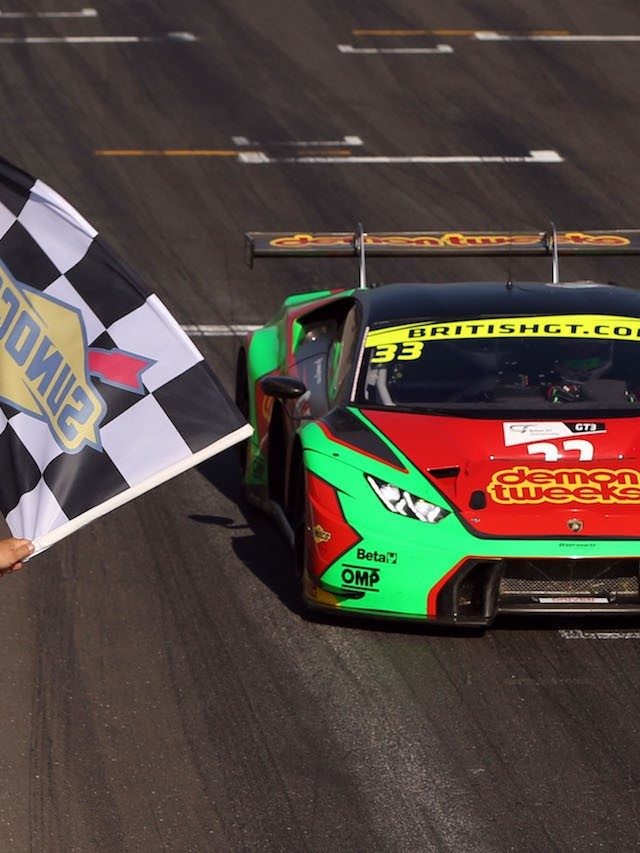
A Weekend Sweep No Crew Had Managed Since 2010
Jon Minshaw and Phil Keen did something at Snetterton that no British GT Championship pairing had accomplished in six years: they won both races on the same weekend. Driving Barwell Motorsport’s Lamborghini Huracán GT3, the duo qualified on pole on Saturday, then converted that advantage into back-to-back victories over TF Sport’s Aston Martin Vantage GT3. The result brought their season tally to four wins, vaulted them into the championship lead with an 11.5-point cushion, and set up a Donington Park finale they could control rather than chase.
Lamborghini described the result as the product of “perfect strategy and a fast and solid race pace.” The language is predictably tidy, but the underlying performance supports it. Pole position, two lights-to-flag wins against a strong Aston Martin factory-supported entry, and a statistical milestone reaching back to 2010. For a car barely a year old at the time, the Snetterton weekend was the moment the Huracán GT3 stopped looking like a promising newcomer and started looking like the car to beat in British GT.
Why the Huracán GT3 Clicked So Quickly for Barwell
Unveiled in January 2015 and developed in collaboration with Dallara, the Huracán GT3 retained the road car’s aluminum and carbon fiber hybrid construction while adding the wider bodywork, substantial rear wing, and aerodynamic package required for FIA GT3 competition. At its core sat a naturally aspirated 5.2-liter V10 whose linear delivery and high-rpm character gave it a distinct personality against the turbocharged opposition from McLaren, Audi, and Bentley that populated the 2016 British GT grid.
Barwell’s relationship with Lamborghini Squadra Corse began that same season, and the partnership clicked almost immediately. Running two Huracán GT3 entries, the team found a car whose rear-drive layout and V10 power delivery rewarded the kind of precise setup work and driver sensitivity that gentleman-driver categories demand. Minshaw, a Pro-Am competitor, benefited from a car that communicated its grip limits clearly; Keen, one of the UK’s most accomplished GT professionals, could extract maximum qualifying pace from a chassis that responded predictably to aggressive driving.
The Snetterton double was the clearest evidence yet that Barwell had unlocked the Huracán GT3’s potential in a championship context, not just in isolated race results. Pole position through two race wins to a championship lead is the kind of weekend that binds a team’s identity to a specific platform.
What the Championship Lead Meant Going to Donington
With the season finale at Donington Park scheduled for September 10 and 11, Minshaw and Keen carried an 11.5-point advantage over their nearest rivals. In GT racing, where Balance of Performance adjustments can shift competitiveness between rounds, arriving at the final event with a double-digit lead is a genuine luxury.
The timing mattered beyond the trophy count. The Huracán GT3 was still proving itself in customer hands globally, and a British GT title in its debut full season with Barwell would validate Squadra Corse’s customer racing model. That model depended on privateer teams buying the car, running it competitively, and winning, which in turn attracted more customers. Barwell’s results at Snetterton were, in practical terms, a sales argument for every prospective GT3 customer team watching from the paddock.
Barwell also arrived at Snetterton fresh from a Pro-Am podium at the 24 Hours of Spa-Francorchamps, meaning the team was running the Huracán GT3 competitively across two very different formats: sprint races and endurance. That versatility is exactly what customer teams need from a GT3 platform, and it distinguished the Huracán from cars that excelled in one format but struggled in another.
A Foundation That Lasted a Decade
Viewed from a longer perspective, the 2016 season turned out to be the beginning of one of the most durable team-manufacturer partnerships in British GT history. One report indicates Barwell has since accumulated over 30 British GT victories with Lamborghini machinery, progressing through the Huracán GT3 EVO and EVO2 iterations as Squadra Corse refined the platform. The team expanded to a three-car entry in subsequent seasons, and the basic competitive formula established at Snetterton, combining a naturally aspirated V10 with meticulous Barwell preparation, proved remarkably consistent across regulation changes and Balance of Performance cycles.
The Huracán GT3 platform itself ran for a full decade in global competition before Lamborghini confirmed the Temerario GT3 as its successor. As Road & Track noted, the Huracán GT3 brought a “historically racing-averse brand into some of the world’s most competitive racing series,” and the car’s longevity speaks to how well the original design held up against newer rivals from Porsche, Ferrari, and Mercedes-AMG.
For anyone tracking Lamborghini’s motorsport trajectory, the Snetterton weekend in August 2016 was a turning point. It established Barwell as Lamborghini’s anchor team in British GT, proved the Huracán GT3 could dominate rather than merely compete, and set the pattern for a partnership that continues to define the brand’s presence in UK customer racing. The Temerario GT3 will eventually inherit that role, but the foundation was poured at a Norfolk circuit on a summer weekend when Minshaw and Keen simply could not be beaten.
Gallery


