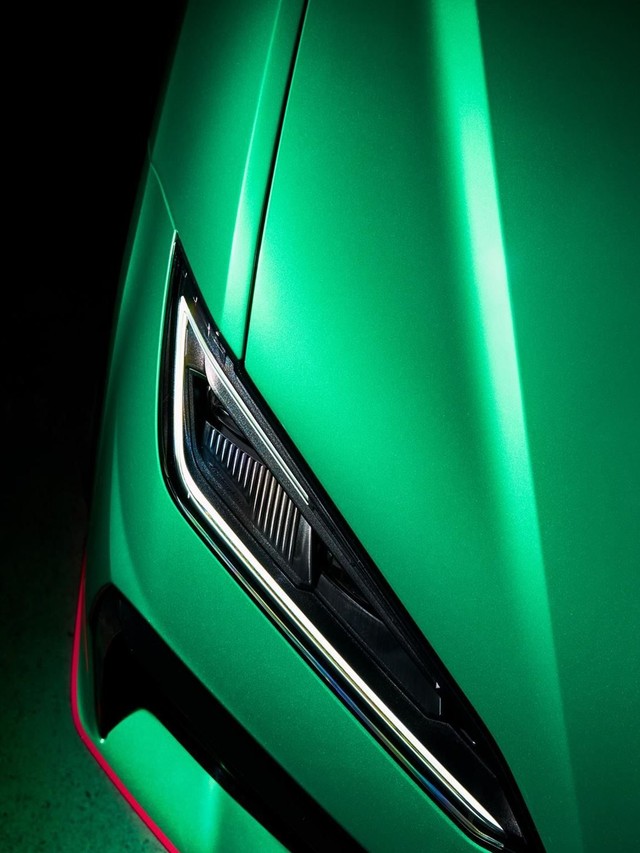
630 Buyers, 70+ Combinations: What the Tettonero Actually Is
- Lamborghini caps the Urus SE “Tettonero” Capsule at 630 units worldwide, with over 70 exterior configurations and extensive interior personalization.
- The 800 CV (approximately 789 hp) plug-in hybrid powertrain carries over from the standard Urus SE, paired with over 60 km of electric-only range.
- Two new-to-Urus colors, Giallo Tenerife and Verde Mercurius, debut alongside a carbon fiber logo plate marking the tenth anniversary of Lamborghini’s Ad Personam Studio.
The name gives it away if you know a little Italian. “Tettonero” combines tetto (roof) and nero (black), and the defining visual move on this limited-run Urus SE is exactly that: a gloss-black “Nero Shiny” treatment that wraps the roof, pillars, rear spoiler profile, and exhaust tips, contrasting against whichever of six body colors the buyer selects. Lamborghini presented the capsule at the 2026 Milano Design Week, photographing the first examples at the Pirelli HangarBicocca, a converted industrial plant in Milan that now operates as a contemporary art foundation.

But the real product here is the configurator, not the car. The Urus SE underneath is mechanically identical to the standard model: same 4.0-liter twin-turbo V8 hybrid powertrain, same 25.9 kWh battery, same electronically controlled torque splitter. Lamborghini says the Tettonero offers the widest range of color combinations ever achieved on a Lamborghini Capsule, and the math backs that up. Six body paints multiplied by six livery accent colors, then layered with brake caliper finishes, wheel sizes spanning 21 to 23 inches, and carbon fiber exterior elements like the rear diffuser, side mirror caps, and front splitter. The combinatorial result exceeds 70 distinct exterior configurations before you even open the door.

For a production run of 630 units, that ratio matters. It means, statistically, fewer than nine buyers worldwide will share the same exterior spec. Whether that constitutes genuine exclusivity or a clever illusion of it depends on your definition, but the effect on the showroom floor is the same: your Tettonero looks like yours.
Ad Personam’s Tenth Anniversary Showcase
The Tettonero arrives as the Ad Personam Studio, Lamborghini’s in-house bespoke personalization program, turns ten. Ad Personam (the name translates roughly to “made for the individual”) is the department where buyers who want more than a standard color palette go to spec their cars. Think of it as Lamborghini’s answer to Porsche’s Paint to Sample or Ferrari’s Tailor Made, except the Tettonero Capsule bakes an unusual amount of Ad Personam depth into a production-run special edition rather than reserving it for one-off commissions.
The liveries were developed through a collaboration between the Lamborghini Centro Stile, the company’s design studio led by head of design Mitja Borkert, and the Ad Personam team. Centro Stile is responsible for the visual language across every Lamborghini model, from the Revuelto hypercar down to the Urus. For the Tettonero, they created six livery accent colors (Arancio Borealis, Bianco Monocerus, Giallo Auge, Grigio Nimbus, Rosso Mars, and Verde Mantis) that overlay the body paint in pinstripe and graphic treatments visible in the press images.

A special carbon fiber logo plate inside the cabin commemorates Ad Personam’s decade of operation and over 20 years since Lamborghini first launched its broader personalization program. The passenger-side dashboard carries a carbon fiber trim with a silk-screened Urus logo, and buyers can extend carbon fiber into the central tunnel, instrument cluster, and door panels. These pair with Dinamica leather and Corsa-Tex microfiber fabric, a synthetic suede-like material that shows up across the Lamborghini range.

The interior color strategy follows a simple logic: Nero Ade (a deep black) serves as the base, with six contrast tones (Viola Acutus, Bianco Leda, Giallo Quercus, Arancio Dryope, Verde Viper, and Grigio Octans) available to match the exterior livery. On top of that, 12 embroidery colors cover the seats, headrests, and upholstery stitching. An optional “63” logo on the lower front doors references 1963, the year Ferruccio Lamborghini founded the company in Sant’Agata Bolognese. It is a small detail, but the kind of thing that separates a buyer who knows the brand’s history from one who picked a color they liked on the configurator screen.

Inside the 800 CV Hybrid: What the Driver Actually Feels
The powertrain is the part that doesn’t change between a Tettonero and a standard Urus SE, and it deserves a proper explanation because Lamborghini’s first plug-in hybrid SUV works differently from most PHEVs on the road.
The 4.0-liter twin-turbo V8, engineered under Lamborghini CTO Rouven Mohr‘s technical leadership, pairs with a permanent-magnet synchronous electric motor integrated ahead of a new 8-speed automatic transmission. Car and Driver reports the V8 alone produces 611 hp and 590 lb-ft of torque, while the electric motor contributes an additional 189 hp and 356 lb-ft. Combined, the system produces 800 CV (588 kW) at 6,000 rpm with 950 Nm of torque available from just 1,750 rpm all the way to 5,750 rpm.
That torque split has a precise mechanical consequence: the electric motor fills the dead zone below the point where the V8’s twin turbochargers reach full boost. Off the line, the Tettonero launches with the instant shove of an EV. As the turbos spool, the V8 takes over with a character shift the driver feels through the throttle pedal — two distinct power deliveries inside a single acceleration event. The 25.9 kWh lithium-ion battery sits beneath the load floor and above the electronically controlled rear differential, keeping the center of gravity as low as the packaging allows in a vehicle this tall.
Lamborghini says the Tettonero can cover over 60 km on electric power alone. In the real world, that translates to roughly 37 miles of silent, zero-emission driving, enough for most daily commutes in cities where these cars actually live. The Urus SE can start up and drive entirely on electric power, which means early-morning departures from residential neighborhoods no longer announce themselves with a V8 bark. For a vehicle that Lamborghini claims accelerates from 0 to 100 km/h in 3.4 seconds and reaches 312 km/h (194 mph), the ability to creep through a school zone on battery power alone is a genuinely useful contradiction. The dossier adds another number worth noting: 0 to 200 km/h arrives in 11.2 seconds, and combined fuel consumption comes in at 2.08 l/100km — a figure that would have seemed impossible for an 800 CV SUV five years ago and reflects how aggressively the hybrid architecture reshapes what an emissions certificate looks like for a vehicle this powerful.
The development program ran through both Sant’Agata Bolognese, Lamborghini’s headquarters, and the Nardò Technical Center in southern Italy, where the company conducts high-speed and dynamics testing on the facility’s 12.6 km oval and handling circuits. A third location also factored into the program: the Military Academy of Modena, where Lamborghini has conducted specialized chassis and dynamics work — a partnership that rarely surfaces in press materials but reflects the breadth of testing infrastructure the company draws on when validating a platform as dynamically demanding as the Urus SE.

Oversteer on Demand and the Drive Mode Matrix
Lamborghini’s marketing describes the Tettonero as delivering “oversteer on demand,” which sounds like brochure language until you look at the hardware. The system uses a centrally mounted, electronically controlled torque splitter with an electro-hydraulically actuated multi-plate clutch. A computer-controlled clutch pack sits between the front and rear axles, continuously varying how much torque goes where. Unlike a conventional all-wheel-drive system that reacts to wheel slip after it happens, this splitter can preemptively shift torque rearward before the driver even feels the front tires begin to wash out. The result, when paired with the new electronically controlled limited-slip rear differential, is a 2,500-plus-kilogram SUV that can rotate its rear end on throttle input, something that would feel deeply unnatural in most vehicles this heavy.
Based on available reporting, the tamburo drive selector (Lamborghini’s term for the rotary mode dial on the center console) retains the familiar Strada, Sport, Corsa, Neve (snow), Sabbia (sand), and Terra (off-road) modes. Layered on top are four new Electric Performance Strategies: EV Drive, Hybrid, Performance, and Recharge. The combination means the driver is choosing both a chassis behavior and an energy management philosophy simultaneously. In EV Drive plus Strada, the Tettonero is a quiet luxury SUV. In Performance plus Corsa, the battery and V8 work together at maximum output with the sharpest throttle mapping and the most aggressive torque-rear bias.
The rear-wheel steering system deserves its own explanation because it does something counterintuitive with the same hardware at different speeds. Below 70 km/h, the rear axle steers up to 4 degrees opposite the front wheels, shrinking the wheelbase so a vehicle measuring over five meters turns with the agility of something considerably smaller — the geometry that lets a heavy platform thread a tight urban corner. Above 70 km/h, the rear wheels steer in phase with the fronts, lengthening the effective wheelbase for motorway stability. The driver experiences two fundamentally different handling characters from the same chassis, depending entirely on how fast they are traveling.
Pirelli P Zero tires come standard across all wheel sizes, developed specifically for the Urus SE platform using Pirelli Elect technology, which optimizes rolling resistance and noise for electrified powertrains. Scorpion Winter 2 tires are available for colder climates. Given that a meaningful percentage of Urus buyers use their cars year-round, including ski trips and mountain driving, the winter tire option is less an accessory and more a practical necessity for the ownership pattern these vehicles actually see.

The Competitive Calculus: Purosangue, Bentayga, and the Price of Being Different
Lamborghini positions the Urus SE as the performance apex of the super-SUV segment, and the numbers support the claim. A 3.4-second sprint to 100 km/h and a 312 km/h top speed put it ahead of the Ferrari Purosangue (3.3 seconds to 100, but a naturally aspirated V12 with no electric range and a significantly higher price floor), the Bentley Bentayga Speed (3.5 seconds, no hybrid option in the current generation), and the Aston Martin DBX707 (3.3 seconds, twin-turbo V8 only). The Urus SE’s over-60-km electric range is a capability none of those direct rivals currently offer, which matters both for daily livability and for European regulatory compliance.
CarBuzz’s test drive review of the standard Urus SE noted something worth flagging for prospective Tettonero buyers: the SE’s 0-to-60 time of 3.4 seconds is actually 0.2 seconds slower than the outgoing non-hybrid Urus, and 0.3 seconds behind the discontinued Urus Performante. The added weight of the battery and electric motor costs a fraction of a second in the initial launch, even as the total system output climbs to 800 CV. For most owners, that tenth-of-a-second difference is invisible outside of instrumented testing. But for the enthusiast who specifically valued the Performante’s rawer character, the Tettonero (and the entire Urus SE platform) represents a philosophical shift toward hybrid refinement over analog aggression.
Lamborghini has not disclosed the specific price premium for the Tettonero Capsule over the standard Urus SE, which carries a base price in the range of $252,000 to $281,000 depending on model year and market, according to one report. Given the depth of the personalization program and the 630-unit cap, expect the Tettonero to command a meaningful upcharge, with the carbon fiber options and livery work adding further to the final invoice. For buyers weighing this against a Purosangue (which Ferrari famously restricts through allocation rather than configurator depth) or a fully loaded Bentayga, the Tettonero’s value proposition is clear: Lamborghini gives you the tools to make the car visually yours, at a production scale that keeps delivery timelines reasonable.
Seventy configurations across 630 units is choice. Six hundred and thirty buyers worldwide is scarcity. The math says most owners will end up with something no other Tettonero on the road matches exactly, and nobody will end up with something truly rare. That tension between individuality and volume is not a flaw in the configurator. It is the entire product.


