A Grand Tourer Pilgrimage Through Umbria, Tuscany, and Emilia-Romagna
On September 7th, twenty classic Lamborghinis, a mix of Espadas and Isleros, gathered in Perugia for a curated multi-day driving tour organized by Lamborghini Polo Storico to mark the 50th anniversary of both models. The route spanned nearly 800 km through Umbria, Tuscany, and Emilia-Romagna, threading through Orvieto and Assisi before concluding at Lamborghini’s headquarters in Sant’Agata Bolognese, where participants reportedly received a tour of the assembly line and Polo Storico’s own workshop.
Lamborghini did not park these cars in a museum hall or rope them off at a concours. The company put them on challenging roads, across regions where elevation changes, narrow medieval town centers, and summer heat would test any car, let alone one built in 1968. Every participant arrived in excellent condition, a statement about the engineering and the owners’ dedication that no spec sheet could match.
For anyone who associates Lamborghini exclusively with scissor doors and mid-engine theatrics, this tour served as a pointed reminder that the company’s roots run through front-engine grand tourers powered by the same family of V12 engines that made the Miura famous. Polo Storico’s role in making that possible, from parts supply to factory-backed restoration, is the thread connecting every car on the route and every story its owners brought with them.
The Espada and Islero: Two Sides of Lamborghini’s Grand Touring Ambition
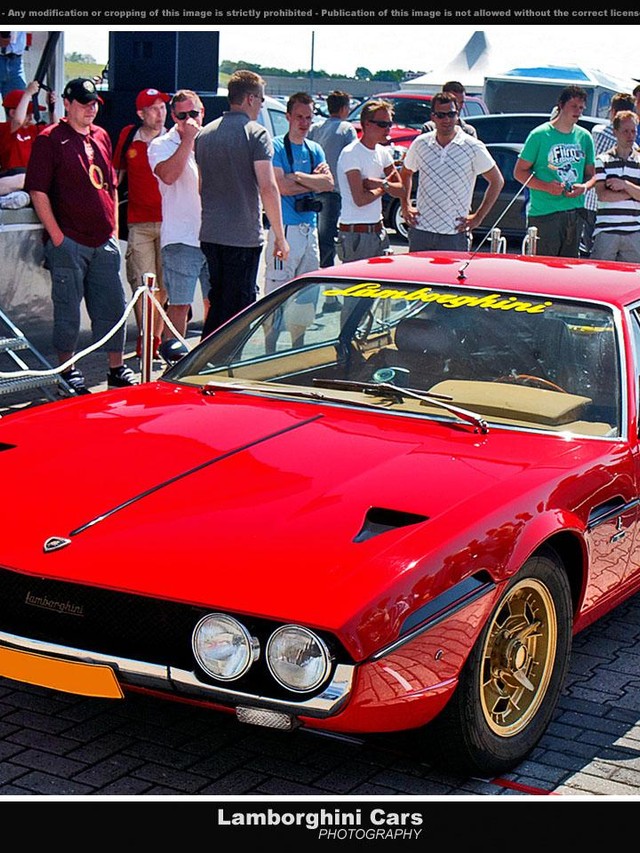
Both the Espada and Islero debuted at the 1968 Geneva Motor Show, sharing a 4.0-liter V12 engine but offering fundamentally different propositions. The Espada was Lamborghini’s first true four-seater and also the first model to offer an optional automatic transmission, a genuinely radical idea from a company whose founder believed comfortable, refined GT cars could outclass anything from Maranello. Penned by Marcello Gandini at Bertone and drawing inspiration from the Marzal and Jaguar Pirana concepts, the Espada took its name from the Spanish word for sword. It enjoyed a 10-year production run with over 1,200 units built across three series. Lamborghini says the 4.0-liter DOHC V12 initially produced 325 horsepower, with Series II cars bumping output to 350 hp before US emissions regulations clawed some of that back in Series III.
The Islero, by contrast, was the quieter successor to the 400 GT. Designed by Mario Marazzi rather than Gandini, it wore straighter, more angular lines and a 2+2 layout. Only 225 were built, including just 70 examples of the more powerful Islero S. Ferruccio Lamborghini reportedly drove an Islero himself, which tells you something about which car the founder considered the better daily companion. The model also appeared in the 1970 Roger Moore film The Man Who Haunted Himself, though its screen time did little to rescue it from commercial obscurity.
The Islero remains one of the rarest and least understood cars in Lamborghini’s catalog. Where the Espada was flamboyant enough to attract attention on its own terms, the Islero asked buyers to appreciate subtlety from a brand that would soon become synonymous with the opposite. That both models survived fifty years and could still be driven hard across Italy speaks to the durability Polo Storico works to preserve.
The Owners Who Keep Lamborghini History on the Road
The tour’s most telling details come from the individual cars and the people who brought them. A 1973 Espada Series 3 (chassis 9300) received an award for the longest continuous single ownership. Purchased used in January 1977 by two English owners, this Espada served as the family’s sole car for years, used daily for commuting and school runs. Recently restored and registered for the tour to coincide with the owners’ golden wedding anniversary, it embodied a kind of loyalty that is difficult to manufacture through marketing: fifty years of marriage, forty-one years with the same Lamborghini.
The award for farthest distance traveled went to a rare Espada Series 2 (chassis 8386), one of only 12 examples produced with a VIP fit-out. Its Norwegian crew drove a 6,000 km round trip from Oslo across Scandinavian highways and Alpine passes, without a support truck or a factory chase car, in a car designed when Richard Nixon was running for president.
A 1968 Islero S (chassis 6435) won recognition for being most faithful to Sant’Agata Bolognese. One of the very few right-hand drive examples among the 70 Islero S models produced, it was purchased new in 1969, passed to the owner’s son in 1993, and driven from England to Sant’Agata Bolognese every year for servicing. That annual pilgrimage, repeated over decades, is the kind of owner relationship most brands can only dream about.
The Lamborghini Museum also contributed two vehicles: a 1976 Espada Series 3 in Blu Notte and a 1968 Islero in Rosso Amaranto. Stefano Domenicali, then Lamborghini’s Chairman and CEO, personally presented the awards at the tour’s conclusion. These stories matter because they illustrate what Polo Storico ultimately exists to support: not static museum pieces, but cars that accumulate miles and memories.
Polo Storico: Keeping Classic V12s Alive, One Part at a Time
None of these ownership stories would be sustainable without a factory willing to back them up. Lamborghini Polo Storico is the dedicated division for the restoration and certification of classic models, covering everything from the 350 GT to the Diablo. Based at the company’s headquarters in Sant’Agata Bolognese, the division maintains historical archives, manages the supply of original spare parts, and undertakes full restorations. Lamborghini states its parts coverage now extends to over 65% of the classic fleet, with 200 new items added to catalogs in 2017 alone.
The division’s philosophy distinguishes it from typical dealer restorations. Polo Storico aims to return cars to their original factory condition, including minor imperfections that were present at the time of production, rather than chasing modern concours perfection. Each restoration includes a one-year warranty. One source reports that a full Polo Storico restoration can cost around €300,000 and take approximately 18 months to complete, positioning this as a serious financial commitment rather than a casual weekend project.
For prospective classic Lamborghini buyers, the practical takeaway is significant. Polo Storico’s expanding parts catalog and factory-backed restoration service mean that owning an Espada or Islero in 2018 is a more viable proposition than it was even a decade ago. Parts availability, the perennial anxiety of vintage Italian car ownership, is being addressed systematically rather than left to the aftermarket. Ferrari operates a comparable program through Ferrari Classiche, offering authentication and restoration for its heritage models. The difference in emphasis is notable: Ferrari Classiche tends to spotlight the most valuable competition and road cars in its back catalog, while Polo Storico’s willingness to organize a dedicated tour for the Espada and Islero, models that rarely headline auction results, suggests a broader commitment to the entire production history rather than just the trophy pieces.
What This Tour Proves About Lamborghini’s Heritage
Lamborghini’s modern identity is built almost entirely around mid-engine supercars. The Countach, Diablo, Murciélago, Aventador, and now the Revuelto form the spine of the brand’s public image. The Espada and Islero belong to a different chapter, one where Ferruccio Lamborghini’s original ambition was to build refined, fast grand tourers that could cross continents without drama.
By celebrating these front-engine V12 GTs, Lamborghini reinforces the idea that its heritage is deeper and more varied than the wedge-shaped poster cars suggest. For collectors, factory attention of this kind can quietly support values: a model that the manufacturer actively restores, certifies, and celebrates is a model the market takes more seriously. Lamborghini confirmed no pricing details or market valuations for these models as part of the tour.
What the event did confirm is that the company views its classic grand tourers as a living part of the brand, not a footnote. When twenty V12 Lamborghinis can cross 800 km of Italian roads and arrive in excellent condition, with Polo Storico standing behind every restored seal and remanufactured part, the engineering argument makes itself. The Espada and Islero were built to be driven. Fifty years later, they still are.
Gallery


