Introducing Sanna: Lamborghini’s Unsung Architect of Performance
Supercar manufacturers love to invoke “racing DNA” in their marketing. The phrase appears so often it risks becoming meaningless. Giorgio Sanna‘s career is the rare case where it describes something concrete.
Born in Rome, Sanna joined Lamborghini’s R&D department in 2001 as a test driver. Over the next decade and more, he contributed to the development of every production model and special version the company released, from the Murciélago through the Huracán. He also held FIA world speed records and won an Italian GT Championship title. That both résumés belong to the same person tells you something important about how Lamborghini builds its cars: the man calibrating suspension dampers and validating aerodynamic packages during the week was the same man racing at national championship level on weekends. The feedback loop between track and road ran through a single pair of hands, and that tight connection shaped the tactile character of every modern Lamborghini in ways no spec sheet can capture.
From R&D to Race Track: Sanna’s Dual Role Shaping Lamborghini’s Identity
Sanna’s dual role crystallized in 2009, when Lamborghini re-entered competitive motorsport after decades on the sidelines. As chief R&D test driver, he took on responsibility for developing the company’s racing cars alongside his ongoing production-car work. The timing was significant. Lamborghini’s Super Trofeo one-make series launched that same year, and the company needed someone who understood both the tolerances of a road car platform and the demands of a racing environment.
Before that transition, Sanna competed in the Italian “Superstars” and GT3 championships from 2006 to 2009, driving for Audi Italia. The Volkswagen Group connection is worth noting: his experience with Audi’s motorsport operation gave him exposure to a different engineering culture, one obsessed with data-driven chassis development and endurance reliability. When he returned to race under the Lamborghini banner, competing in the Italian GT Cup and GT3 championships as an official test driver through 2013, he brought that cross-pollinated perspective with him.
The 2011 Italian GT Championship title confirmed what the R&D department already knew. Sanna could extract the maximum from a car, and more importantly, he could articulate why the car behaved the way it did. For a test driver, that second skill matters more than outright pace. Engineers design systems; a great test driver translates those systems into subjective feel, bridging the gap between simulation data and the sensations a driver actually experiences at the limit.
The Murciélago and Huracán: Sanna’s Influence on Iconic Road Cars
Lamborghini’s official account credits Sanna with contributing to every production model and special version released during his tenure, spanning the Murciélago through the Huracán. The company does not itemize which calibration changes or dynamic improvements came directly from his input, and that is typical of how OEMs discuss test-driver contributions.
What can be said is that both platforms evolved significantly during his years in R&D. The Murciélago went from a slightly unruly V12 grand tourer to the razor-edged LP 670-4 SV, a car whose steering precision and high-speed stability represented a genuine leap over the original. The Huracán’s progression was even more dramatic, moving from the LP 610-4 through the Performante and eventually the STO, each iteration sharpening turn-in response and rear-axle composure in ways that track-day owners noticed immediately.
A chief test driver’s value in this process is difficult to overstate. Sanna occupied that role for over a decade, meaning the tactile character of modern Lamborghinis passed through his assessment before reaching production. The progressive buildup of steering effort in a Murciélago SV, the way a Huracán Performante loads its outside rear tire through a fast sweeper: these qualities reflect the judgment of someone who raced the cars as well as developed them, and who understood what a driver needs to feel at the edge of adhesion.
Record Breaker: The Nardò Feats and Championship Victories
Sanna’s speed records at the Nardò Ring add a different dimension to his profile. In 2002, he was part of the driving team that achieved the FIA world speed record over 24 hours in the Volkswagen W12 prototype on the high-speed oval in southern Italy. On the same circuit, he set the FIA world record for production cars over the distance of one hour at the wheel of a Murciélago. According to Lamborghini, that one-hour record still stands.
Nardò’s 12.6-kilometer circular track is a brutal proving ground. Sustained high-speed running tests mechanical endurance, tire integrity, cooling efficiency, and aerodynamic stability in ways that a short sprint never can. Pushing a production Murciélago to record-setting speeds over a full hour requires absolute confidence in the car’s engineering margins. The fact that Sanna was willing to do it, and that the Murciélago survived the attempt without mechanical failure, says something concrete about both the driver and the machine.
For enthusiasts, the Nardò records serve as a useful counterpoint to the Nürburgring lap times that dominate modern supercar marketing. A sustained-speed record over distance tests a fundamentally different set of engineering qualities: thermal management, drivetrain durability, and aerodynamic drag at continuous high velocity. Lamborghini rarely emphasizes these records in its current marketing, but they remain part of the brand’s verified performance history, and they underscore the depth of trust between Sanna and the cars he helped develop.
Competitive Edge: How Sanna’s Expertise Elevates Lamborghini Against Rivals
The idea of a chief test driver bridging R&D and racing is not unique to Lamborghini, but the specific structure of Sanna’s career highlights a philosophical difference in how Sant’Agata approaches performance development. Ferrari’s motorsport identity flows primarily from Formula 1, where technology transfer to road cars is real but filtered through layers of regulation and abstraction. Porsche emphasizes its “track to road” philosophy through programs like the 911 GT3 RS and Manthey partnership, but its test-driver culture operates within a much larger engineering bureaucracy.
Lamborghini’s operation is smaller and more concentrated. A single test driver contributing to both the Murciélago and the Huracán Super Trofeo race car means the feedback loop between road and track is shorter, more personal, and arguably more direct. When Sanna identified a handling characteristic during a GT3 race weekend, that observation could reach the same R&D team he worked with on production cars without passing through multiple departmental layers.
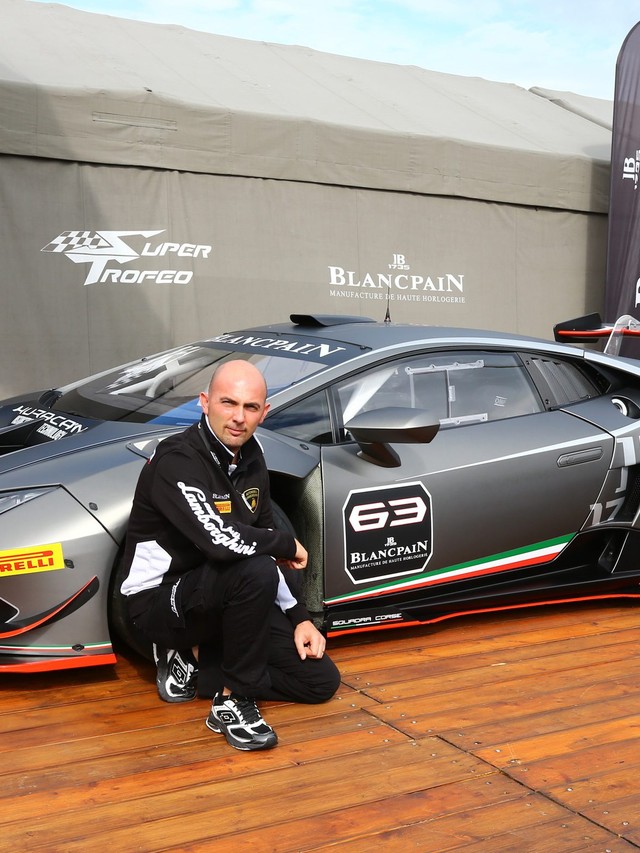
The Huracán Super Trofeo itself illustrates this tight integration. Built on the LP 610-4 platform, the race car produces 620 horsepower from its naturally aspirated 5.2-liter V10 and uses a rear-wheel-drive layout with a six-speed sequential gearbox. According to one source, it weighs 335 pounds less than the street car, achieving a reported dry weight of 1,270 kg. Racing ABS with 12 positions, traction control with nine positions, and adjustable brake bias give drivers granular control over the car’s behavior. One source indicates the car was designed by Squadra Corse in collaboration with chassis specialist Dallara. Every one of those specifications represents a decision that Sanna, as chief R&D test driver, would have validated on track.

A man in a racing suit kneels next to a grey Lamborghini Huracán Super Trofeo at an outdoor event.
The Human Element: What Sanna’s Legacy Means for Lamborghini Owners and Enthusiasts
Lamborghini owners and prospective buyers rarely think about who validated the car they are driving. The appeal of a Huracán STO or a Murciélago SV is visceral: the sound, the acceleration, the way the car changes direction. But every one of those sensations was calibrated by a human being, and in Lamborghini’s case, that human being spent his career simultaneously racing and developing the cars.
For anyone who has driven a late-model Huracán on a track day, the practical implication is worth considering. The progressive way the car communicates grip levels through its steering, the confidence-inspiring stability under hard braking, the predictability of its rear-axle behavior at the limit: these are not accidents of engineering. They are the product of thousands of test laps by someone who understood what a racing driver needs from a car, because he was one.
As Lamborghini transitions into a new era with the hybrid Temerario and its forthcoming GT3 racing variant, the question becomes whether the next generation of development drivers can maintain this kind of continuity. Sanna’s career represents something increasingly rare in the automotive industry: a single individual whose expertise spans an entire model generation, connecting the analog feel of a Murciélago to the digital sophistication of a Huracán. The cars that follow will carry forward the engineering principles he helped establish, even as the powertrains and electronic architectures change beneath them.
Specifications can be matched. Horsepower figures can be exceeded. The subjective quality of a car’s dynamic character, the thing that makes a Lamborghini feel like a Lamborghini, requires someone who understands it deeply enough to protect it through every engineering revision. That was Sanna’s job for more than two decades, and the cars on the road today reflect his work.
Gallery


