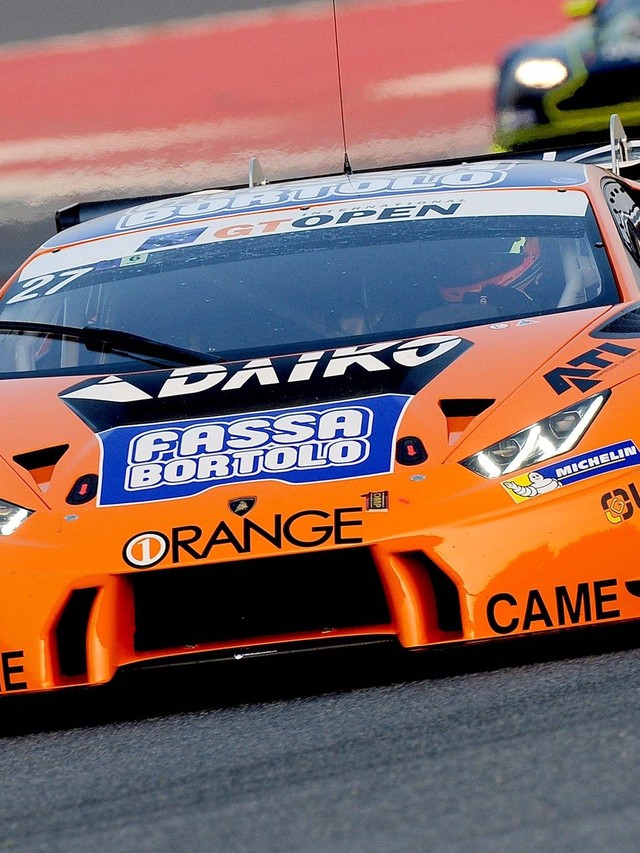
A Championship Clinched Before the Final Flag
Thomas Biagi and Fabrizio Crestani brought the Orange 1 Team Lazarus Huracán GT3 home in second place during Race 1 at Barcelona on November 6, 2016, and the math was already done. The International GT Open championship belonged to Lamborghini, sealed with a race still left on the schedule. For a car competing in its first full season, that kind of margin tells you something beyond raw speed: it points to consistency, preparation, and a program that arrived ready to fight rather than learn.
The final points tally underlined the dominance. Lamborghini says the Italian pairing accumulated 167 points against 129 for the BMW M6 GT3 of Yacaman and Monje, a 38-point cushion built across seven double-header weekends spanning Estoril, Paul Ricard, Silverstone, the Red Bull Ring, Monza, and Barcelona. Less than a month earlier, the FFF Racing by ACM team, fielding GT3 Junior Program drivers Andrea Amici and Edoardo Liberati, had wrapped up the GT Asia Series title in Shanghai. Two major championships in year one. For a brand whose motorsport credibility once rested almost entirely on one-make trophies and gentleman-driver events, the 2016 season marked a genuine inflection point.
Why a Debut Title Rewrites the Conversation
Winning a GT3 championship on debut is rare enough that it demands context. GT3 racing is a Balance of Performance regulated category, meaning organizers adjust power, weight, and aero restrictions to keep the field competitive. In theory, no single car should dominate on engineering alone. In practice, a well-sorted chassis with good tire behavior and a team that understands the package can still extract a meaningful advantage within those rules.
The Huracán GT3 replaced the aging Gallardo FL2, a car that served Lamborghini respectably but never quite punched at the level of the best Porsche or Ferrari GT3 entries of its era. Squadra Corse needed the Huracán platform to prove that the company could build a race car competitive enough to attract serious customer teams, not just loyal privateers. A debut championship answered that question emphatically.
Giorgio Sanna, head of Motorsport at Automobili Lamborghini, framed the result in terms of teamwork rather than pure machinery. Lamborghini’s official account quotes Sanna: “The preparation of Orange 1 Team Lazarus, the mix of experience and speed offered by the drivers Thomas and Fabrizio best represent the views of Lamborghini Squadra Corse in teamwork.” That phrasing is deliberate. Sanna positioned the win as validation of the entire ecosystem: car, team, driver pairing, and factory support.
Engineering the Edge: V10 Muscle in a BoP World
At the heart of the Huracán GT3 sits a 5.2-liter naturally aspirated V10, derived from the road car but extensively reworked for endurance racing. The engine uses a 90-degree V angle, gasoline direct injection, and dry sump lubrication, a combination that delivers a linear torque curve and the kind of throttle response that makes mid-corner adjustments predictable for drivers. In a BoP-regulated series, peak power matters less than how that power arrives, and a naturally aspirated engine with a broad, progressive torque band gives drivers confidence that turbocharged competitors sometimes struggle to match.
The chassis blends aluminum and carbon fiber, a hybrid structure designed to balance rigidity with weight savings. Squadra Corse developed the aerodynamic package in collaboration with Dallara, and the results at Barcelona illustrated the package’s effectiveness. Crestani qualified on pole with a 1’45.376, nearly eight tenths faster than the second-placed Aston Martin, then set the fastest race lap at 1’47.790 during his stint. Those are not small margins in GT3 racing, where fields routinely separate by tenths.
The broader engineering point is straightforward: Lamborghini built a car that worked immediately. Customer racing programs live and die on reliability and predictability. A GT3 car that requires two seasons of development before teams can extract its potential is a GT3 car that loses customers to Porsche and Ferrari. The Huracán GT3 skipped that painful learning phase, and the championship results were the proof.
Junior Drivers and the Squadra Corse Pipeline
One of the least-discussed dimensions of the 2016 season is how Lamborghini used it to validate its GT3 Junior Program. Crestani, co-driver of the championship-winning car, carried the Junior Driver designation. In the GT Asia Series, both title-winning drivers, Amici and Liberati, came from the same pipeline. Two championships, three Junior Program graduates on the top step. That is not coincidence; it is evidence of a structured talent development strategy producing real results.
Pairing Crestani with Biagi, a multiple GT champion, followed a deliberate logic. Biagi brought race management and strategic experience; Crestani brought raw qualifying speed and the hunger of a driver building a career. The combination worked because Squadra Corse designed it to work: experienced anchor plus fast young talent, with factory engineering support binding the two together.
For anyone following Lamborghini’s current motorsport trajectory, this model looks familiar. The company continues to invest in driver development as a competitive differentiator, and the 2016 season served as the proof of concept. When a manufacturer can offer customer teams not just a competitive car but a curated driver who already understands the machinery, the value proposition changes. Teams buy into the program, not just the hardware.
Consistency as Strategy: The Season in Full
Championship seasons are won through accumulation, and the Huracán GT3’s 2016 campaign reads like a masterclass in avoiding bad weekends. Lamborghini says the car collected two third places at Estoril during the opening round, a victory at Paul Ricard (where the team started eighth and climbed to the top step through strategy), a second place at Silverstone, another second at the Red Bull Ring, and a second and third at Monza before clinching the title at Barcelona.
Count the podiums: eight across the season. Only one outright win. The rest were seconds and thirds. For enthusiasts accustomed to celebrating victories, this might seem understated. In GT3 racing, it is the opposite. A car that finishes on the podium at nearly every round, across circuits as different as the fast sweeps of Silverstone and the heavy braking zones of Monza, demonstrates a breadth of capability that a single dominant weekend cannot. The Huracán GT3 was fast everywhere, fragile nowhere.
The Paul Ricard win deserves particular attention. Starting eighth and winning requires either chaos ahead or genuine pace combined with sharp strategy. In a BoP-regulated field, that kind of recovery drive points to a car that rewards aggressive driving without punishing mistakes, exactly the characteristic that makes a GT3 platform attractive to the broadest range of customer teams.
From the Huracán GT3 to the Temerario: A Decade of Consequence
The 2016 International GT Open title did more than add a trophy to the cabinet in Sant’Agata Bolognese. It established the Huracán GT3 as a credible customer racing platform that would go on to compete globally for nearly a decade, evolving through EVO and EVO2 specifications while remaining fundamentally the same car. According to Road & Track, eleven brands introduced entirely new GT3 cars during the Huracán’s lifespan, while Porsche alone released three different platforms. Lamborghini kept refining the same one, a testament to how right the original design was.
The Temerario GT3, revealed at the 2025 Goodwood Festival of Speed, finally replaces the Huracán in Lamborghini’s racing lineup. Car and Driver notes that the Temerario GT3 is the first race car entirely designed and developed at Lamborghini’s Sant’Agata facility, a significant step in bringing more of the engineering process in-house. The new car swaps the naturally aspirated V10 for a twin-turbocharged V8, a fundamental shift in character that will define the next chapter of Lamborghini customer racing.
Whether Squadra Corse can replicate the Huracán GT3’s debut-season magic with an entirely different powertrain philosophy remains the open question, but the institutional knowledge built across a decade of Huracán GT3 competition is the strongest argument that it can. The 2016 championship was not the loudest moment in Lamborghini’s history, but it may be one of the most consequential. It turned Squadra Corse from a support operation into a genuine competitive force, built the driver pipeline that continues to feed Lamborghini’s racing programs, and proved that the company could compete at the highest level of customer GT racing. Every Lamborghini GT3 entry that follows carries the weight of that Barcelona weekend.
Gallery


