A One-Two Finish at Barcelona Sets Up a Championship Showdown
Two Lamborghini Huracán GT3 Evos crossed the line first and second in Race 2 at the Circuit de Catalunya, and the arithmetic that followed matters more than the trophy. Emil Frey Racing’s Giacomo Altoe and Albert Costa now hold an 11-point advantage in the International GT Open standings, with only the season finale at Monza left to run.
The result looked unlikely after Saturday. Race 1 unfolded on a soaking, treacherous surface, and while Altoe grabbed the lead at Turn 1, the #63 car lost ground during mandatory pit stops and tumbled to 11th. Teammates Norbert Siedler and Mikael Grenier fared better in the #14, salvaging fourth. A disappointing day, but not a catastrophic one.
Sunday rewrote the script. Costa put the #63 on pole in dry conditions and led until the pit window opened. After the stops, Siedler in the #14 found a way past at Turn 5 and the two Lamborghinis ran unchallenged to the flag. Siedler and Grenier took the win; Altoe and Costa collected second. The combined result: a clean one-two that converted a difficult weekend into a commanding championship position heading to the Autodromo di Monza on October 12-13.
The Huracán GT3 Evo: Why a Naturally Aspirated V10 Keeps Winning
The Huracán GT3 platform made its competitive debut in 2015. Four years on, the Evo variant continues to collect silverware, and Barcelona offered a useful case study in why.
At the core sits Lamborghini’s 5.2-liter naturally aspirated V10, a unit shared in principle with the road car but re-engineered by Squadra Corse for endurance reliability. One source describes the race-spec engine producing approximately 620 horsepower at 8,250 rpm, with revised camshafts and titanium valves aimed at extending component life across multi-hour stints. Naturally aspirated power delivery offers a predictability that turbocharged competitors sometimes trade away: throttle response maps linearly, and drivers can modulate traction out of slow corners without waiting for boost to arrive. In mixed conditions like Saturday’s rain at Barcelona, that directness becomes a genuine competitive tool.
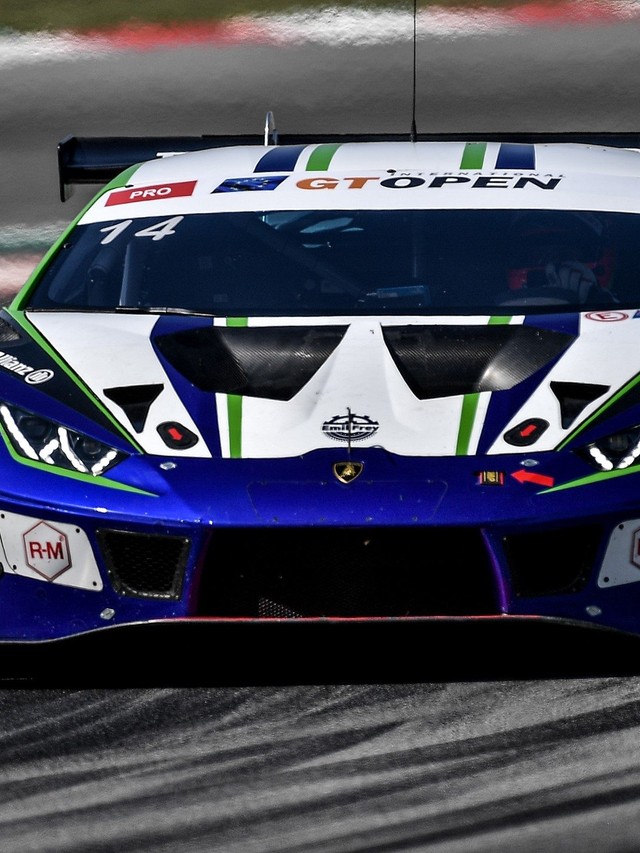
The “Evo” designation signals something specific in Squadra Corse’s vocabulary. Rather than a clean-sheet redesign, it represents iterative aerodynamic and mechanical refinement built on years of real-world data from customer teams around the globe. Each update addresses what the previous season’s racing exposed, from airflow management around the diffuser to suspension geometry tuning. The car visible in official imagery from Barcelona shows the aggressive front splitter, large-format air intakes, and carbon-fiber rear wing that define the current aero package.
For context, the Huracán GT3 Evo won the GTD class at both the 2019 24 Hours of Daytona and the 12 Hours of Sebring earlier this year, according to one report. That same source credits the platform with a clean sweep of GT World Challenge Europe titles (Sprint, Endurance, and overall) during the 2019 season. Barcelona fits a pattern: this car wins across different circuits, different weather, and different race formats.

The number 14 Lamborghini Huracán GT3 EVO races intensely on the track during the International GT Open championship.
Emil Frey Racing and the Customer Team Model That Powers Lamborghini’s Trophies
Lamborghini does not field a factory team in the International GT Open. Every result on the timing sheet belongs to a customer squad, and Emil Frey Racing’s dominance in Barcelona illustrates why that model works rather than merely exists.
Squadra Corse, Lamborghini’s motorsport division, operates a support infrastructure that includes engineering assistance, parts logistics, and driver development through its GT3 Junior Program. The manufacturer supplies the car and the expertise; the customer team supplies the operational budget, crew, and race-weekend execution. When that relationship clicks, as it clearly does with Emil Frey, the results speak for themselves.
Ferrari and Porsche run similar customer-racing ecosystems, and both brands field enormous GT3 grids worldwide. What distinguishes Lamborghini’s approach is scale relative to ambition. Lamborghini fields fewer total chassis than Porsche’s sprawling 911 GT3 R customer base, yet consistently punches above its weight in championship results. In 2022, Oregon Team delivered Lamborghini’s fifth overall International GT Open title with the Huracán GT3 Evo, building on a history that includes Vincenzo Sospiri Racing’s multiple wins in 2021.
For prospective customer racers, the practical question is cost. One source places the Huracán GT3 Evo at roughly $430,000 for the car itself, though full-season budgets covering spares, tires, crew, travel, and entry fees multiply that figure considerably. Lamborghini does not publish those operational numbers, and they vary by series and team. What Barcelona demonstrates is that the investment can yield championship-contending performance, not just arrive-and-drive participation.
Championship Stakes: What Monza Means for Lamborghini
Eleven points sounds comfortable, but anyone who follows GT racing knows how quickly a mechanical failure, a penalty, or a first-lap incident can erase a margin. The Monza finale on October 12-13 offers two races and a full complement of points.
Altoe and Costa control their own destiny. A pair of solid finishes, even without victories, should be enough to clinch the title. Monza, as Lamborghini’s home circuit in all but postal address, carries symbolic weight that extends beyond the points table. Winning the International GT Open championship at the Autodromo di Monza would be a storybook conclusion for a car and a team that rebounded from an 11th-place Saturday to lock out the front of the grid on Sunday.
Lamborghini already claimed its fifth overall GT Open title in 2022. A sixth would reinforce the Huracán GT3 platform’s status as one of the most successful customer GT3 cars of its generation, arriving in what may be one of the platform’s final full seasons before the Temerario GT3 program takes over. Car and Driver reports that the Temerario GT3 will replace the Huracán GT3 Evo 2 as Lamborghini’s factory-backed GT3 effort, lending this championship run the character of a farewell tour for the naturally aspirated V10 in top-tier GT competition.
Why GT3 Results Matter to Every Lamborghini Buyer
GT3 racing exists, in part, as a marketing exercise. Every manufacturer in the class understands that weekend warriors watching timing screens translate into showroom traffic on Monday. But the connection between the Huracán GT3 Evo’s track record and the road-going Huracán is more direct than most brands can claim.
The engine architecture is shared. The mid-engine layout is shared. The fundamental chassis philosophy carries over. When Squadra Corse discovers that a revised camshaft profile improves reliability under sustained high-rpm loads, that data feeds back into the road car development cycle. Lamborghini’s engineering teams in Sant’Agata Bolognese treat the race program as a rolling laboratory, and the Huracán’s decade-long evolution from road car to GT3 to Super Trofeo to Evo to Evo2 reflects that loop. Car and Driver tested the Super Trofeo Evo2 variant at Virginia International Raceway and recorded a 2:30.6 lap, noting a base price of $360,000 for that one-make series car.
For Lamborghini enthusiasts who will never race a GT3 car, the takeaway is straightforward: the engineering credibility behind the road car is not hypothetical. It gets validated, weekend after weekend, against Ferraris, Porsches, and Mercedes-AMGs on circuits around the world. Barcelona was the latest proof. Monza could be the exclamation point.
The broader picture for the brand is a smooth handover. One source tallies 96 titles and 187 race wins across all Huracán GT3 iterations, and Lamborghini will need the Temerario GT3 to sustain that momentum with a turbocharged V8 replacing the naturally aspirated V10. Whether that transition preserves the throttle response and driver confidence that made the Huracán so effective in customer hands remains the open question. For now, the V10 still has at least one more weekend of work to do.


