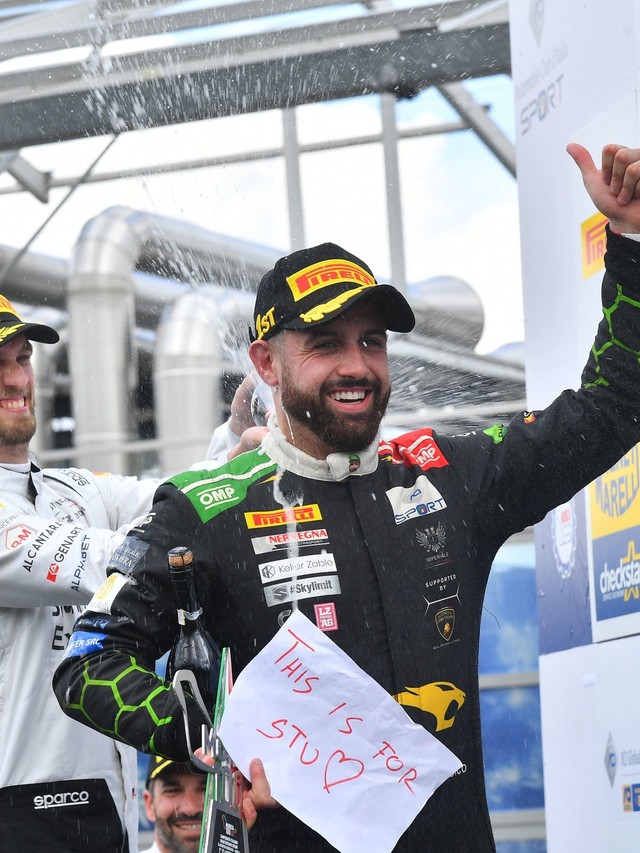
A Solo Driver, a Handwritten Sign, and a Win Nobody Expected
Alberto di Folco stood on the Monza podium holding a scrap of paper that read “THIS IS FOR STU” with a hand-drawn heart. Hours earlier, his Imperiale Racing teammate Stuart Middleton had been clipped by another car entering the pit lane during Race 1 of the Italian GT Championship Sprint Cup opener, suffering injuries to his arm and leg serious enough to require a hospital transfer. Di Folco was left to drive the #6 Huracán GT3 EVO alone for the rest of the weekend.
Lamborghini says di Folco absorbed a one-minute time penalty in Race 1 for running solo, erasing what would have been a second-place finish on the road. For Race 2, he faced a further five-second handicap penalty before the green flag even dropped. He started second on the grid, courtesy of Middleton’s qualifying effort from the day before, and still managed to emerge from the mandatory pit-stop phase in the lead. A late safety car bunched the field, but di Folco pulled away on the restart and crossed the line just over a second clear.
In a category where driver changes are mandatory and the regulations penalize solo entries precisely because they represent an unfair endurance advantage, winning under those conditions is genuinely rare. Di Folco did it at Monza, on a weekend that swung between wet and dry conditions, against a field that included BMWs he openly acknowledged were faster on the straights. The result was not just a personal triumph; it was a testament to how deeply the Huracán GT3 EVO rewards a driver who trusts it.

Victorious drivers celebrate on the podium with champagne, holding a heartfelt message for a friend.
The Huracán GT3 EVO: A Decade of Refinement Against Constant Renewal
A decade had passed since Lamborghini first put the V10 Huracán GT3 on a grid. In that time, as Road & Track observed, eleven manufacturers released entirely new GT3 cars while Lamborghini kept refining the same basic platform. Porsche alone cycled through three complete designs in the same period. The Huracán just kept showing up.
Di Folco’s own post-race comments illuminate why. He noted the BMW was faster on the straights but praised the Huracán’s balance across both wet and dry conditions, crediting the Imperiale Racing team‘s setup work. That adaptability across changing surfaces is one of the qualities customer teams have consistently valued in the platform. GT3 racing rewards predictability and mechanical confidence over outright peak performance, and the Huracán has delivered both for a remarkably long time.
For teams that have built entire programs around the car’s characteristics, this longevity matters commercially. Learning a GT3 car deeply, understanding its tire degradation curves and brake behavior at specific circuits, is an investment measured in seasons. The Huracán has rewarded that investment more consistently than most rivals, which is precisely why a solo driver could climb into one at Monza and still find the confidence to attack.

A grid of high-performance race cars, led by a Lamborghini Huracán GT3 Evo, prepares for the start of a thrilling race.
Emil Frey Racing Opens Its ADAC GT Masters Campaign on the Podium
Monza was not the only circuit where the Huracán proved its depth that weekend. At Oschersleben, Emil Frey Racing made its ADAC GT Masters debut with immediate results. Lamborghini Factory Driver Franck Perera put the car on pole position, two tenths clear of the field in a session where traffic played a significant role. He controlled the opening stint before handing over to Lamborghini GT3 Junior driver Arthur Rougier for the second half of the race.
Rougier’s debut was not flawless. He lost the lead at the first corner after running across the gravel under pressure from an Audi, but he recovered composure and brought the #19 car home in second place. Mick Wishofer and Konsta Lappalainen added a Junior trophy class podium in the #14 Huracán, while the #63 entry of Jack Aitken and Lamborghini Factory Driver Albert Costa Balboa finished fifth in Race 2.
The breadth of these results matters. Imperiale Racing, Emil Frey, and the various Junior program entries represent a network of private teams choosing to invest in the Huracán platform across different championships and different countries. That buy-in from customer squads is arguably more meaningful than factory results alone, because it reflects real confidence from people spending real money to race these cars. It also underscores the same quality di Folco demonstrated at Monza: the Huracán gives its drivers a car they can trust, whether they are seasoned factory pilots or juniors finding their feet.

A blue Lamborghini Huracán GT3 Evo race car with number 19 speeds through a turn on a bright track day.
The Temerario Waits, but the Huracán Is Not Done Yet
All of this accumulated trust is what makes the coming platform transition so consequential. The Temerario GT3 is slated to replace the Huracán GT3 Evo 2 as Lamborghini’s factory-backed GT3 contender, and it represents a genuine milestone: the first race car fully designed and developed in-house at Sant’Agata Bolognese. In adherence to GT3 regulations, the Temerario GT3 will utilize a modified version of the road car’s twin-turbocharged engine, notably without its hybrid components. The shift from naturally aspirated V10 to forced-induction V8 will reshape how Lamborghini’s customer racing cars deliver their power.
For the teams currently running Huracáns, that transition means adapting to an entirely different powerband, altered weight distribution, and the complexities of turbo management in wheel-to-wheel racing. Weekends like Monza and Oschersleben serve as a reminder of how much institutional knowledge exists around the current car. The Temerario GT3 will need to build that depth from scratch.
Yet the Huracán’s competitive record gives Lamborghini credibility as it asks customer teams to make that leap. Winning at Monza with a solo driver absorbing penalties is not a technical specification, but it is the kind of result that keeps team principals loyal through a platform transition. The next Italian GT Championship round heads to Enna Pergusa on May 14-15, followed by the ADAC GT Masters at the Red Bull Ring a week later. Both circuits will offer further evidence of whether the old warhorse can keep delivering while its replacement waits in the wings.
Gallery


