Alexa Arrives in the Huracán EVO at CES 2020
When Lamborghini rolled a Huracán EVO onto the floor of the Consumer Electronics Show in Las Vegas in January 2020, the point was not the car itself but what lived inside its touchscreen. Integrated directly into the HMI system was Amazon Alexa, and Lamborghini claimed a genuine first: no other automaker offered full in-car control of core vehicle functions through Amazon’s voice assistant. That claim framed a broader question the company was only beginning to answer, namely how far a supercar maker rooted in analog sensation should lean into cloud-connected digital convenience.
The practical pitch was straightforward enough. Voice commands let drivers adjust climate control, interior lighting, and seat heating without lifting a hand from the wheel. Standard Alexa capabilities like placing calls, getting directions, playing music, and checking news and weather came along for the ride. On the all-wheel-drive EVO, Alexa also plugged into the Lamborghini Dinamica Veicolo Integrata (LDVI) dynamic setup, granting voice access to driving dynamics screens and the ability to switch between drive modes like Strada and Corsa.
The system connected to smart home devices too. Owners could open entry gates, adjust thermostats, or toggle lights at home, all from the cockpit. Whether that qualifies as genuinely useful or a solution looking for a problem probably depends on how many connected devices populate your life outside the car.
Inside the HMI: What the Integration Actually Looks Like
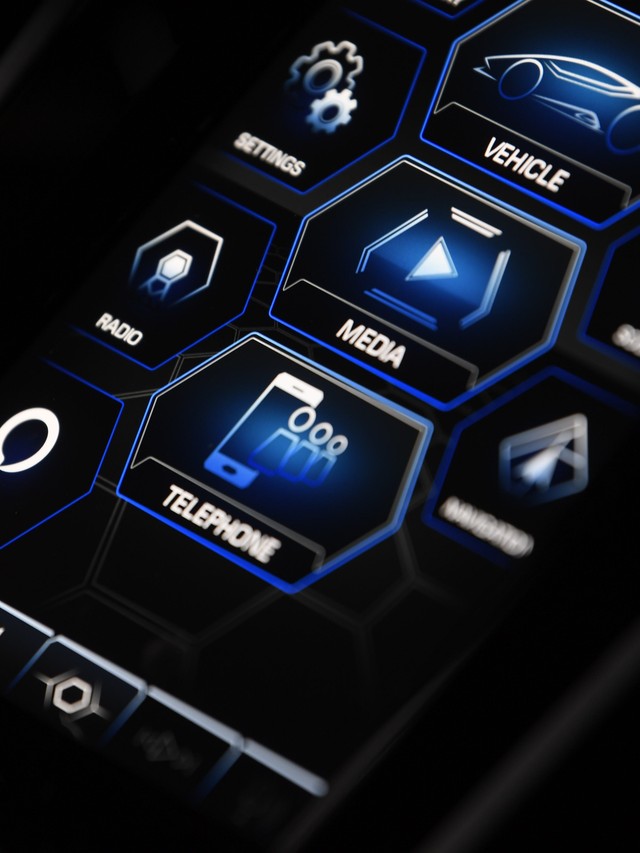
On the Huracán EVO’s touchscreen, Alexa appears as one of several hexagonal menu icons alongside Media, Telephone, and Vehicle controls. The layout stays consistent with the rest of the cockpit: angular, minimal, backlit in blue. Carbon fiber trim and the red engine start button frame the screen, reinforcing the hierarchy that this is still a supercar cockpit first and a smart device second.
Lamborghini designed its enhanced HMI system for continuous over-the-air updates to Alexa’s functionality, which in theory means the feature set could expand after delivery. The Alexa option was scheduled to roll out across the entire Huracán EVO family, including the rear-wheel-drive variant announced that same month, throughout 2020.
The ambition was clear. Execution, at least in the early days, proved less seamless than the CES demo suggested. Forum discussion among Huracán EVO owners paints a mixed picture of the infotainment system’s reliability more broadly, with multiple owners describing touchscreen bugs, connectivity glitches, and inconsistent responsiveness. Because the Alexa layer sits on top of that foundation, its real-world polish depends heavily on how well the underlying system behaves. That dependency is the first hint that Lamborghini’s digital ambitions were running ahead of its software maturity.

The Lamborghini Huracán EVO's HMI touchscreen interface features hexagonal menu icons for various vehicle functions and integrated Alexa voice control.
The Amazon Partnership and What Lamborghini Was Really Building
Lamborghini positioned this integration as the opening move in a strategic collaboration with Amazon, not a one-off feature addition. According to Stefano Domenicali, then Chairman and CEO of Automobili Lamborghini, connectivity enables customers to focus on driving while enhancing the ownership experience. Ned Curic, Vice President of Alexa Auto at Amazon, framed the partnership as setting a new standard for in-car voice experiences.
More revealing than the executive language was the mention of future integration with Amazon Web Services (AWS). The two companies were collaborating on broader connectivity innovations, hinting at cloud-based vehicle data, diagnostics, or personalization features down the road. For a manufacturer with a relatively small engineering budget compared to volume producers, partnering with Amazon’s infrastructure rather than building a proprietary ecosystem from scratch was a pragmatic choice, and one that spoke directly to how Sant’Agata Bolognese intended to compete digitally without overextending its resources.
Unlike other automakers who integrated Alexa primarily for cloud-based services like music and weather, Lamborghini’s approach extended the voice assistant into actual vehicle system control. That distinction mattered at the time, even if the practical gap between controlling your seat heater by voice versus by button is, candidly, not enormous.
How Competitors Approached the Same Problem Differently
Lamborghini’s willingness to adopt a third-party voice assistant rather than develop something proprietary stands in contrast to how some rivals handle in-car technology. Ferrari tends toward bespoke infotainment solutions that keep the digital ecosystem tightly controlled and brand-specific. McLaren similarly builds its own interfaces, prioritizing minimalism and driver focus over broad connectivity ecosystems.
The trade-off is real. A proprietary system gives a manufacturer complete control over the user experience but requires constant development investment. Adopting Alexa gives Lamborghini access to Amazon’s vast skill library and continuous cloud improvements, yet it also means the in-car experience partially depends on a third party’s development priorities. For a buyer who already uses Alexa at home, the Huracán EVO’s integration creates a seamless loop between house and car. It who does not, it is a feature that sits quietly unused.
This openness to external digital partnerships, rather than insisting on a walled garden, may prove to be the more consequential strategic signal from CES 2020. Whether it translated into a meaningful ownership advantage depended entirely on execution.
The Purist Question: Does a Supercar Need a Voice Assistant?
Enthusiast forums remain split on this one, and reasonably so. The Huracán EVO’s core appeal rests on its 5.2-liter naturally aspirated V10 producing 640 hp at 8,000 rpm, a 2.9-second sprint to 100 km/h, and a top speed exceeding 325 km/h. Weighing 1,422 kg dry, the car achieves a power-to-weight ratio of 2.22 kg/hp. Asking Alexa to warm your seat changes none of that.
The tension is philosophical rather than mechanical. Lamborghini built its reputation on visceral, unfiltered driving experiences. Adding a cloud-connected AI assistant to the cockpit does not diminish the V10’s wail or the chassis dynamics, but it shifts the character of the cabin from pure instrument panel toward something closer to a connected living space. Some owners appreciate the convenience. Others would rather the cockpit remain a place where the only voice that matters is the engine’s.
For prospective buyers of used Huracán EVOs, a practical note: the Alexa feature’s usefulness depends heavily on the underlying infotainment system’s condition. If the touchscreen is responsive and updated, Alexa can be a pleasant convenience. If the system is glitchy, as some owners report, it becomes one more thing to troubleshoot.
From the Huracán EVO to the Temerario: Where Lamborghini’s Digital Strategy Goes Next
Viewed from a few years’ distance, the Huracán EVO’s Alexa experiment looks like a learning exercise, a first attempt at answering the question of how much digital connectivity belongs in a supercar cockpit. One report describes the Temerario’s digital ecosystem as the most technologically sophisticated multimedia system in Lamborghini’s history, featuring a triple-display HMI architecture with a 12.3-inch instrument panel, an 8.4-inch central screen, and a 9.1-inch passenger display, all governed by a single processing unit. That represents a generational leap from the Huracán EVO’s single center touchscreen.
Lamborghini has not confirmed whether the Temerario will carry Alexa integration or pivot to a different connectivity partner. What the Huracán EVO chapter established is that Sant’Agata Bolognese is willing to collaborate with major tech companies rather than go it alone on digital features. The AWS relationship, if it matured beyond the initial announcement, could underpin everything from over-the-air updates to predictive maintenance in Lamborghini’s hybrid era.
The CES 2020 reveal was a small story about a voice assistant in a supercar. The larger story, still unfolding, is how Lamborghini balances its analog soul with digital ambition as every model in the lineup goes hybrid. The Huracán EVO was the first car to pose that question out loud. The Temerario will need to answer it.
Gallery


