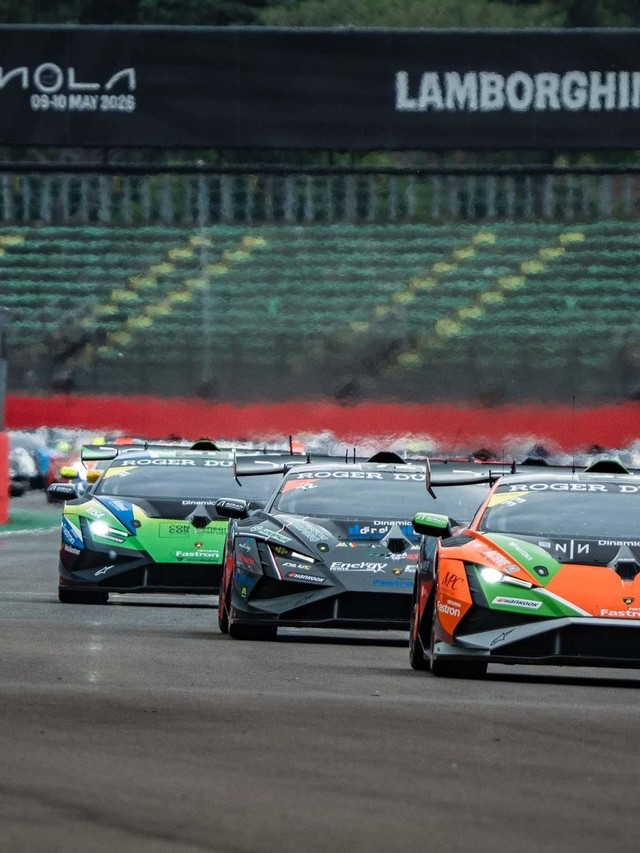
Two Top-10 Finishes in a GTD Field That Punished Everyone
Paul Miller Racing’s No. 48 Lamborghini Huracán GT3 crossed the line seventh in the GT Daytona class at the 2017 Rolex 24 At Daytona. Italian outfit EBIMOTORS brought its No. 46 entry home ninth. Neither car stood on the podium, but the context matters: this was a rain-soaked, strategy-scrambled race on Daytona International Speedway’s 3.56-mile layout, with cold temperatures and repeated caution periods punishing every team in the ultra-competitive GTD class. For a manufacturer only one full season into the WeatherTech Championship, putting both entries inside the top 10 through those conditions represented tangible progress, and it planted the seeds of a Daytona record that would eventually include outright class victories.
Lamborghini confirmed that the Paul Miller Racing car was piloted by Bryan Sellers, Madison Snow, Bryce Miller, Dion von Moltke, and Andrea Caldarelli. EBIMOTORS fielded Emanuele Busnelli, Fabio Babini, Emmanuel Collard, and Francois Perrodo. Both lineups blended gentleman drivers with experienced professionals, a hallmark of the GT3 customer racing model that Lamborghini was still establishing in IMSA competition at the time.
The race started dry but cold on Saturday afternoon. Rain moved in during the evening hours and persisted through Sunday morning, forcing teams into difficult tire and strategy calls across the 12-turn circuit. Survival came first; pace mattered only afterward.
GRT Grasser’s Heartbreak and the Rest of the Lamborghini Contingent
The most compelling Lamborghini storyline of the weekend belonged to GRT Grasser Racing Team, a Blancpain GT Series powerhouse making its Rolex 24 debut. The No. 11 car, driven by Christian Engelhart, Rolf Ineichen, Ezequiel Perez Companc, and Mirko Bortolotti, ran as high as second place in GTD during the night hours after qualifying fifth on the grid. A technical issue forced an extended pit stop and dropped the car to 15th, a result that Lamborghini’s own account described as “deceiving.” The team’s second entry, the No. 61, finished 17th. Despite the mechanical heartbreak, GRT Grasser’s debut previewed a team that would become a significant force in global GT3 competition with Lamborghini machinery.
DAC Motorsports salvaged 13th with the No. 18 car after an incident in the final practice session forced the crew to change the entire chassis. Lamborghini says the team completed the work and reported to the grid roughly 20 minutes before the green flag, a feat of mechanical urgency that deserves recognition regardless of where the car finished. Brandon Gdovic, Anthony Massari, Emmanuel Anassis, and Zach Claman shared driving duties.
Further down the order, Dream Racing’s No. 27 entry was credited with 19th after overnight contact forced retirement. Konrad Motorsport withdrew due to a technical issue and was classified 20th. Change Racing’s No. 16 Huracán managed only 79 laps before early contact ended their race, resulting in a 25th-place classification. The attrition underlined a reality of 24-hour racing at Daytona that would define the Huracán GT3’s long arc at this circuit: the car had to prove it could survive before it could prove it could win.
Why This Race Mattered More Than the Results Suggest
Seventh and ninth in a single endurance race do not, on their own, rewrite a manufacturer’s racing reputation. But this was January 2017, and Lamborghini Squadra Corse was still proving that it belonged in the same conversation as Porsche, Ferrari, Mercedes-AMG, and BMW in North American GT3 competition. The Huracán GT3 debuted in the WeatherTech Championship only in 2016, earning its first victory at VIRginia International Raceway in August of that year with Paul Miller Racing. The 2017 Daytona result confirmed that the 2016 breakthrough was no fluke and that the team infrastructure around the car could handle the most demanding race on the IMSA calendar.
The Huracán GT3 was the first GT3 car fully engineered, developed, and assembled internally by Automobili Lamborghini, a distinction the company emphasized at the time. Previous Lamborghini racing efforts relied more heavily on external partners. Squadra Corse’s decision to bring the entire program in-house signaled a level of factory commitment that would pay dividends in subsequent seasons, and the 2017 Rolex 24 was the first major endurance test of that commitment on American soil after the car’s inaugural IMSA campaign.
Paul Miller Racing’s seventh-place finish also reinforced the team’s role as Lamborghini’s anchor squad in IMSA. Sellers, Snow, and Caldarelli would become recurring names in the Huracán’s Daytona story over the following years, building the kind of driver-team-manufacturer continuity that wins championships.
The Huracán GT3: Built for Customer Racing, Proven Through Endurance
Lamborghini described the V10-powered Huracán GT3 as born from a desire to offer factory-built and supported cars to customers worldwide. That phrasing is worth unpacking. The GT3 category exists specifically to allow manufacturers to sell race-ready cars to privateer teams and gentleman drivers, creating a competitive ecosystem that does not require a full factory effort at every event. Lamborghini’s investment in the Huracán GT3 program was, at its core, a commercial strategy: build a car that customers can race competitively with factory backing, and the brand’s motorsport credibility grows organically through sheer volume of entries.
One source reports that the original 2015 Huracán GT3 was developed in collaboration with Dallara, retaining the road car’s aluminum and carbon fiber hybrid construction while adding an increased body width and extensive aerodynamic modifications. The same source lists key specifications including a 5,204 cc naturally aspirated V10 producing 576 hp at 8,000 rpm and 428.1 lb-ft of torque at 6,500 rpm, with a weight of 2,712 lbs. Those figures positioned the car competitively in a GTD field that included turbocharged entries from rival manufacturers. The naturally aspirated V10’s throttle response and linear power delivery gave drivers a distinct character advantage in wet and mixed conditions like those encountered at the 2017 Daytona race, reinforcing the connection between the car’s engineering philosophy and its ability to survive the kind of grueling event that builds long-term credibility.
The construction philosophy mirrored what Lamborghini was doing on the road car side: use advanced materials to keep weight down, then let the engine do the talking. In a 24-hour race where mechanical sympathy and driver confidence matter as much as raw pace, that approach proved sound.
What Came After: From Top-10 Finishes to Daytona Class Wins
Viewed in isolation, the 2017 Rolex 24 was a solid but unspectacular outing for Lamborghini. Viewed in the context of what followed, it was foundational. One source reports that Paul Miller Racing earned a third-place GTD finish at the 2018 Rolex 24, then returned in 2020 to win the GTD class outright with the No. 48 Huracán GT3 Evo, driven by Caldarelli, Corey Lewis, Sellers, and Snow. That 2020 victory reportedly marked Lamborghini’s third consecutive class win at the 24-hour race, a streak that cemented the Huracán GT3 platform as one of the most successful GT3 cars in IMSA history.
The continuity of personnel is striking. Caldarelli, Sellers, and Snow appeared in the 2017 Paul Miller Racing lineup that finished seventh. They were still driving together when the team won the race three years later. In GT3 customer racing, where driver lineups often shuffle annually, that kind of stability is rare and speaks to the strength of the relationship between Paul Miller Racing and Lamborghini Squadra Corse. It also traces a direct line from the modest 2017 result to the dominant seasons that followed.
Lamborghini also reportedly captured back-to-back manufacturer championships in the GTD class in 2018 and 2019, building on the infrastructure and experience accumulated during the 2016 and 2017 campaigns. The Huracán GT3 platform evolved through the EVO and EVO2 specifications, with each iteration refining aerodynamics and mechanical performance while retaining the naturally aspirated V10 that defined the car’s character.
The Bigger Picture: From Huracán to Temerario GT3
The Huracán GT3’s decade-long competitive life is now drawing to a close. According to Road & Track, the Temerario GT3, unveiled at the 2025 Goodwood Festival of Speed, will replace the Huracán as Lamborghini’s factory-backed GT3 effort. The transition represents a generational shift: the Temerario GT3 moves to a twin-turbocharged V8 architecture, dropping the hybrid system found in the road car to comply with GT3 regulations. Car and Driver reports that the Temerario GT3 is the first race car entirely designed and developed at Lamborghini’s Sant’Agata Bolognese facility, building on the in-house engineering philosophy that began with the original Huracán GT3.
For teams and drivers who built their programs around the Huracán’s naturally aspirated V10 characteristics, the transition to a turbocharged powerplant means adapting to an entirely different powerband, altered weight distribution, and the complexities of turbo management in wheel-to-wheel racing. The Huracán’s throttle response and linear torque delivery were defining advantages, particularly in mixed conditions. Whether the Temerario GT3 can replicate that driver confidence while adding the outright performance gains that turbocharging enables is the central question for Lamborghini’s next chapter in customer racing.
Lamborghini stuck with updated versions of the same basic Huracán GT3 for a full decade, while competitors like Porsche cycled through multiple entirely new GT3 platforms. That longevity is both a testament to the original car’s fundamental soundness and a reminder that the Temerario arrives with significant expectations. The Huracán GT3’s record at Daytona alone, from those modest top-10 finishes in 2017 to outright class victories, gives the successor a benchmark that few GT3 platforms can match.
What This Means for Lamborghini Enthusiasts
The 2017 Rolex 24 at Daytona sits in a part of Lamborghini’s racing timeline that is easy to overlook. No trophies were hoisted. No champagne was sprayed. But the race demonstrated that Lamborghini’s factory-backed GT3 program could field multiple cars at the most grueling North American endurance event and bring them home inside the top 10 in only its second season of IMSA competition.
For buyers considering the road-going Huracán or its Temerario successor, the GT3 program matters because it validates the engineering underneath. Customer racing programs exist to sell cars, both race cars to teams and road cars to enthusiasts who want to own something connected to a proven competition platform. Every weekend the Huracán GT3 spent racing at Daytona, Sebring, and Petit Le Mans reinforced the engineering credibility of the road car it was derived from.
Lamborghini confirmed that the next WeatherTech Championship round after Daytona was the 12 Hours of Sebring on March 16-18, 2017, continuing a season that would further establish the Huracán GT3’s endurance credentials. The broader takeaway is straightforward: Lamborghini’s motorsport credibility was not built overnight. It was assembled through races exactly like this one, through difficult conditions, imperfect results, and the kind of incremental progress that eventually produces class victories and manufacturer championships. The 2017 Rolex 24 was one brick in that wall, and every Daytona success that followed rests partly on the foundation laid that cold, rainy January weekend in Florida.
Gallery


