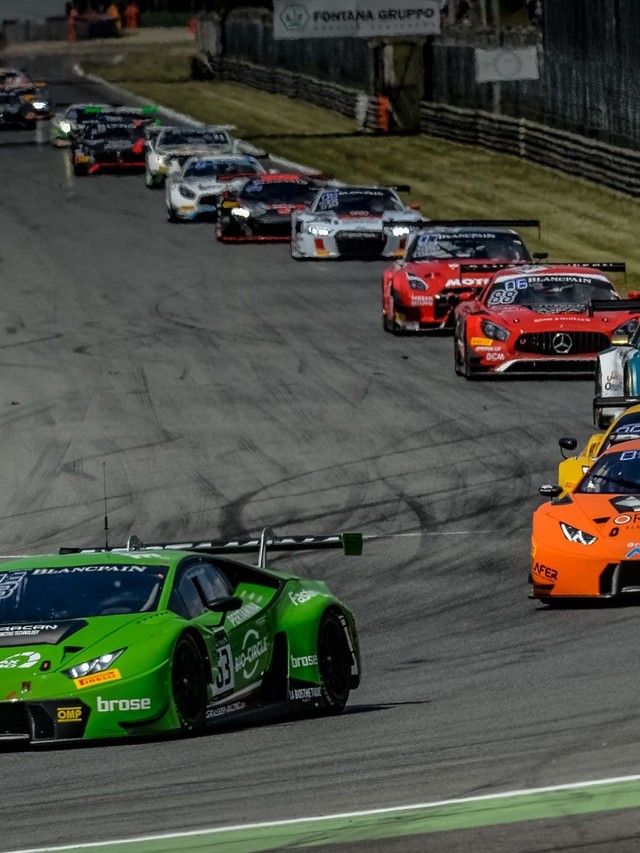
Grasser Racing’s Huracán GT3 Dominates Monza’s Blancpain GT Opener
Two years after the Huracán GT3 scored its inaugural victory at the same circuit, Lamborghini returned to the Autodromo Nazionale Monza and proved the 2015 result was no fluke. Grasser Racing Team’s #63 entry, crewed by Lamborghini Squadra Corse factory drivers Mirko Bortolotti, Andrea Caldarelli, and Christian Engelhart, won the opening round of the 2017 Blancpain GT Series Endurance Cup, crossing the line ahead of AF Corse’s Ferrari 488 GT3 and HTP Motorsport’s Mercedes AMG-GT3.
The three-hour endurance race drew a fifty-car grid, ten of them Huracán GT3s. Combined with a first-place finish at the Nürburgring during the final round of the 2016 season, the Monza victory traced a clear arc: the Huracán GT3 program had arrived as a credible contender and, by the spring of 2017, was operating as a genuine frontrunner capable of beating the most established names in GT racing on one of Europe’s fastest circuits. That trajectory, from promising newcomer to dominant winner, is the real story of this race.
A Chaotic Start and a Clinical Recovery
Nothing about the opening lap suggested a comfortable Lamborghini victory. A multi-car collision triggered by the #7 Bentley Continental GT3 engulfed ten cars, including Grasser Racing’s sister #19 entry, which had qualified on the front row with Perez Companc, Giammaria, and Siedler aboard. That car’s race was effectively over before it began.
The #63, starting from fifth, survived the carnage. Bortolotti drove the opening stint and picked his way through a disrupted field with enough pace to take the lead outright. Caldarelli climbed aboard for the second stint and stretched the advantage to roughly 20 seconds, a gap large enough to give Engelhart breathing room for the final hour. Engelhart managed the closing stint cleanly, bringing the car home under the checkered flag with a comfortable margin.
Endurance racing rewards consistency as much as outright speed. Building a 20-second cushion during the middle stint of a three-hour race means the Huracán GT3 was not merely quick in qualifying trim or over a handful of laps. It maintained competitive pace across a full fuel load, through tire degradation windows, and under the pressure of knowing the sister car was already out. That kind of sustained performance speaks to the maturity of the platform and the quality of the driver lineup, and it is precisely what separated the Huracán GT3 from the rest of the fifty-car field.
Beating Ferrari and Mercedes-AMG: What It Signals
The names behind the Huracán GT3 on the results sheet matter as much as the margin. AF Corse is Ferrari’s most decorated GT customer team, and HTP Motorsport ran a factory-supported Mercedes-AMG program. These are not privateer efforts scraping for points; they represent the best operational infrastructure that Lamborghini’s two most prominent rivals can field in GT3 competition.
GT3 racing operates under Balance of Performance regulations designed to equalize the cars, which means raw pace advantages tend to be small. Winning consistently in that environment comes down to operational excellence, driver quality, and the fundamental rightness of a chassis platform. When the Huracán GT3 beats a Ferrari 488 GT3 over three hours at Monza, the implication is that Lamborghini’s engineering and team infrastructure can match or exceed its rivals under conditions where power advantages are neutralized.
For Lamborghini, the significance is strategic. The Huracán GT3 succeeded the Gallardo FL2 as the brand’s primary GT3 contender, and the early years of that transition involved proving that Sant’Agata Bolognese could compete at the sharp end of a category long shaped by Porsche, Ferrari, and Mercedes-AMG. Winning at Monza, one of the most high-profile rounds on the calendar, against exactly those rivals, reinforced the message that Lamborghini’s customer racing program belonged at the front of the grid rather than in the midfield.
Factory Drivers as a Competitive Weapon
Lamborghini’s decision to embed three factory drivers in the Grasser Racing entry deserves attention. Bortolotti and Engelhart carried over from 2016, while Caldarelli joined the crew for the new season. All three are Lamborghini Squadra Corse factory drivers, meaning they develop the car, know its behavior intimately, and bring a level of consistency that gentleman drivers or hired guns typically cannot replicate.
This approach mirrors what Ferrari and Mercedes-AMG do with their own factory-supported entries, but for Lamborghini it represents a relatively recent escalation. The Austrian-based Grasser Racing Team, founded in 2011, grew into one of Lamborghini’s most important customer racing partners. Pairing that team with a full factory driver lineup signals that Squadra Corse was treating the Blancpain Endurance Cup as a priority championship, not a secondary effort.
The payoff at Monza was tangible. Each driver delivered a stint without errors, without unnecessary risk, and with enough pace to build and maintain a gap. In endurance racing, the weakest link in a three-driver crew often determines the result. The Grasser and Lamborghini combination had no weak link, and the 20-second advantage Caldarelli built during the middle stint illustrated how factory-caliber consistency compounds over the length of a race. The teams that win championships tend to be the ones where factory support and driver quality align perfectly with a mature, reliable car. The Monza result suggested the Huracán GT3 program had reached exactly that alignment.
GT3 Success and the Road Car Connection
The relationship between GT3 racing and road car credibility is sometimes overstated, but in Lamborghini’s case the connection is more direct than most. The Huracán GT3 is an evolution of the road-going Huracán platform, sharing its fundamental architecture, and Squadra Corse’s racing division operates out of Sant’Agata Bolognese alongside the production line. Lessons learned in competition, particularly around aerodynamic efficiency, cooling, and structural rigidity, feed back into the development cycle for road variants like the Performante and later the STO.
For prospective Huracán buyers, a result like Monza serves as a form of engineering validation that no amount of marketing copy can replicate. When a car survives a chaotic start, runs at the front for three hours, and beats factory-backed Ferraris and Mercedes-AMGs, it tells you something concrete about the underlying platform’s strength. Balance of Performance rules limit power, but they do not dictate chassis stiffness, cooling reliability, or how a car behaves when pushed to its limits lap after lap. The Huracán’s racing pedigree is not a brochure talking point. It is a documented competitive record against the exact rivals that Huracán owners encounter in the supercar market, and that record grew meaningfully stronger after Monza.
The Supporting Cast and What Comes Next
Beyond the headline victory, the race also marked the Blancpain GT debut of Orange 1 Team Lazarus, the 2016 International GT Open champion. Their #27 Huracán GT3, driven by Squadra Corse GT3 Junior Drivers Fabrizio Crestani, Gustavo Yacaman, and Nicholas Pohler, ran inside the top ten during the opening stint before a tire issue dropped them to 21st. The result was disappointing, but the team’s presence expanded Lamborghini’s footprint on the grid and gave its junior driver program competitive mileage in a top-tier championship.
With the victory, Lamborghini took the lead in the Blancpain GT Series Endurance Cup standings heading into the second round at Silverstone from May 12 to 14. That early points advantage, combined with the operational momentum of a dominant win, positioned the Huracán GT3 program to fight for the overall championship across the remaining rounds. The Monza result made one thing clear: the Huracán GT3 entered the 2017 season as a fully mature racing car, capable of winning the biggest races against the strongest opposition. For a platform that replaced the Gallardo FL2 just a few years earlier, that maturation curve was remarkably steep.
Gallery


