First Manufacturer to Repeat: Lamborghini’s Unprecedented GTD Victory at Daytona
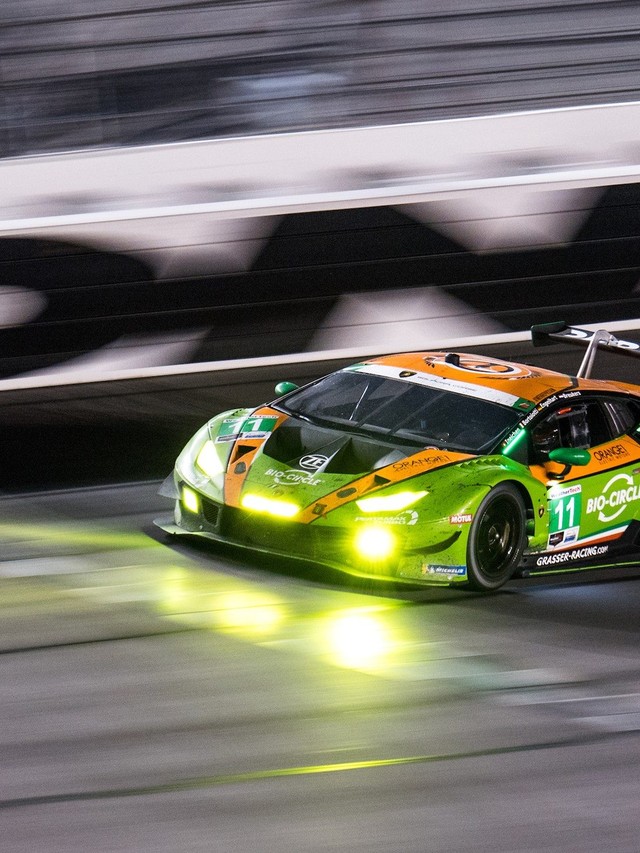
GRT Grasser Racing’s #11 Lamborghini Huracán GT3 Evo crossed the line first in the GTD class at the 2019 Rolex 24 Hours of Daytona, giving Lamborghini its second consecutive class victory and making it the first manufacturer to accomplish that since the GTD class was introduced. Mirko Bortolotti, Rolf Ineichen, Rick Breukers, and Christian Engelhart shared driving duties across a race defined by penalties, punctures, red flags, and a final stoppage that froze the order before the full 24 hours elapsed.
A single endurance result can be attributed to favorable conditions, a well-timed caution, or a rival’s misfortune. Consecutive wins suggest something more durable: a car and a team operation capable of performing under wildly different circumstances from one year to the next. For a manufacturer that only entered organized GT3 competition a few years earlier, this kind of consistency sent a pointed message to Ferrari, Porsche, and Mercedes, all of whom field extensive factory-supported programs at Daytona. The 2019 result was not a fluke confirming a fluke. It was proof that Lamborghini’s motorsport operation had arrived at a level its rivals could no longer dismiss.
From 11th to First: The Race That Nearly Slipped Away
Calling the 2019 Rolex 24 chaotic would be generous. The #11 Huracán GT3 Evo qualified fifth, and Ineichen jumped to third on the opening lap after passing the sister #46 Ebimotors entry. The car soon led the GTD class outright, which is precisely when the trouble started.
Race officials handed the #11 a three-minute and 40-second stop-and-hold penalty for disobeying the full-course caution wave-by procedure. Breukers dropped to 16th in class. The recovery was methodical: Breukers clawed back positions, Bortolotti consolidated fourth, and by the ninth hour the team was running near the front again. Then the weather intervened.
Heavy rain forced two red-flag stoppages through the night and into the morning. Before the first stoppage, the #46 Ebimotors Huracán retired after a collision with a Porsche, and the #48 Paul Miller Racing entry was sidelined by an oil leak sustained after contact. Two of the five Lamborghini entries were gone.
When racing resumed, Bortolotti held third. At the first corner of the restart, contact between two GTLM class leaders caused a puncture on the #11. With Engelhart now at the wheel, the car fell as low as 11th in GTD. What followed was a relentless charge back through the field, and when race control permanently stopped the event short of the 22nd hour due to conditions, Engelhart’s Huracán sat at the top of the GTD order. The race completed 561 laps.
That the car won despite a penalty, a puncture, two red flags, and an early stoppage only reinforces the broader point about the Huracán GT3 Evo platform. Pace alone does not survive that kind of adversity. Reliability, driver depth, and team composure do. The other Lamborghini entries had rougher days: the #7 Magnus Racing Huracán GT3 Evo finished 11th in class, while the #47 Precision Performance Motorsport car ended 20th after a clutch failure.

The Lamborghini Huracán GT3 EVO, number 11, races under the night lights, showcasing its vibrant livery and powerful headlights.
Engineering for Endurance: Why the Evo Upgrade Mattered
Daytona 2019 marked the competitive debut of the Huracán GT3 Evo, an updated evolution of the original Huracán GT3 featuring aerodynamic and technical refinements developed by Squadra Corse. Winning an endurance classic on the car’s first outing is the kind of validation that engineering departments dream about and marketing departments could never buy.
The original Huracán GT3 had already proved the platform’s durability by winning the 2018 Daytona race. The Evo package, however, needed to demonstrate that its updates improved the car without compromising the reliability that made the original so effective over 24-hour distances. Daytona’s unique demands, including high-speed banking, heavy braking zones, and the infield’s tight sections, stress every component in ways that shorter sprint races simply do not. That the Evo survived a penalty stint, a puncture, and hours of wet running on its very first competitive weekend speaks directly to the depth of Squadra Corse’s development process.
For prospective customer racing buyers, the practical takeaway is straightforward: the Huracán GT3 Evo proved its reliability and pace at the highest level in its very first competitive outing. A customer team considering a GT3 purchase could point to this result as evidence that the platform delivers out of the box, which matters when a season’s budget and a team’s reputation ride on the decision.
A Decade in the Making: Squadra Corse’s Path to Daytona Dominance
Lamborghini’s motorsport story looks very different depending on when you start telling it. For most of the company’s history, racing was an afterthought, something Ferruccio Lamborghini famously resisted. The modern chapter began in earnest when Squadra Corse formally entered organized motorsport in 2013, building on the Lamborghini Super Trofeo one-make series that started in Europe in 2009 and expanded to Asia and North America.
According to one report, the Huracán GT3, unveiled in late 2014, represented Lamborghini’s first entirely in-house developed GT3 program. The car won on its competitive debut at Monza in 2015. Three years later, it won the Daytona 24. One year after that, the Evo version repeated the feat. That trajectory, from a company with essentially zero modern racing pedigree to back-to-back wins at one of the world’s most demanding endurance events, compressed what took other manufacturers decades into roughly half a dozen years.
One source reports that the Squadra Corse GT3 program accumulated over 200 race victories and 99 championship titles across various series. Even accounting for the breadth of GT3 competition worldwide, those numbers reflect a program that scaled rapidly and effectively. Ferrari and Porsche, by contrast, brought generations of factory racing infrastructure to the GT3 category. Porsche’s 911 GT3 R benefits from decades of rear-engine endurance racing development. Ferrari’s GT program draws on a motorsport heritage that predates road car production entirely. Lamborghini arrived at the same table with a fraction of the institutional memory and, at Daytona at least, kept winning. The consecutive victories were not an isolated spike but the sharpest point of a much broader competitive arc.
Domenicali’s Verdict and What Consecutive Wins Signal for the Brand
Lamborghini CEO Stefano Domenicali described the result as a success that recognized the effort behind the company’s motorsport commitment.
“This is a historic victory for Lamborghini… Last year’s success was incredible, but this year will remain in the motorsport history books.”
Domenicali, who would later move on to lead Formula One, was positioning Lamborghini’s racing program as a core brand pillar rather than a peripheral activity. For a company whose identity was built almost entirely on road cars, that represented a genuine strategic shift.
Consecutive Daytona wins carry weight beyond the trophy case. They influence how dealers position the brand to buyers who cross-shop against Porsche and Ferrari, both of which lean heavily on racing heritage in their showroom narratives. A Lamborghini dealer can now point to Daytona and say the racing credibility is earned, not borrowed. For collectors, the Huracán platform’s racing success adds a layer of provenance that typically enhances long-term desirability, particularly for special editions and track-focused variants that reference the GT3 program. The back-to-back wins transformed Lamborghini’s motorsport narrative from a promising experiment into a legitimate competitive identity.
After Daytona: Lamborghini’s GT3 Future and the Temerario Question
Every dominant racing platform eventually faces a transition, and the Huracán GT3 Evo’s success inevitably raises the question of what comes next. Lamborghini confirmed the Temerario as the Huracán’s road-car successor, and the GT3 racing program will eventually need to follow.
The shift from the Huracán’s naturally aspirated V10 to the Temerario’s twin-turbocharged V8 hybrid architecture represents a fundamental change in character. For teams and drivers who built their programs around the V10’s linear power delivery and distinctive sound, adapting to an entirely new powerband, different weight distribution, and the complexities of hybrid energy management in wheel-to-wheel racing will require significant recalibration. Lamborghini has not detailed the Temerario GT3‘s specifications or timeline.
What the Daytona results confirm is that Squadra Corse now possesses the institutional knowledge and operational infrastructure to develop and support a competitive GT3 car at the highest level. The Huracán GT3 won at Monza on debut, won at Daytona twice in succession, and accumulated victories across nearly every major GT3 championship in the world. That record sets an extraordinarily high bar for its successor. Whatever the Temerario GT3 becomes, it will be measured against a car that turned Lamborghini from a motorsport newcomer into a manufacturer that Porsche and Ferrari could no longer ignore at the starting grid.


