A 25-Second Margin and a Championship Sealed Early
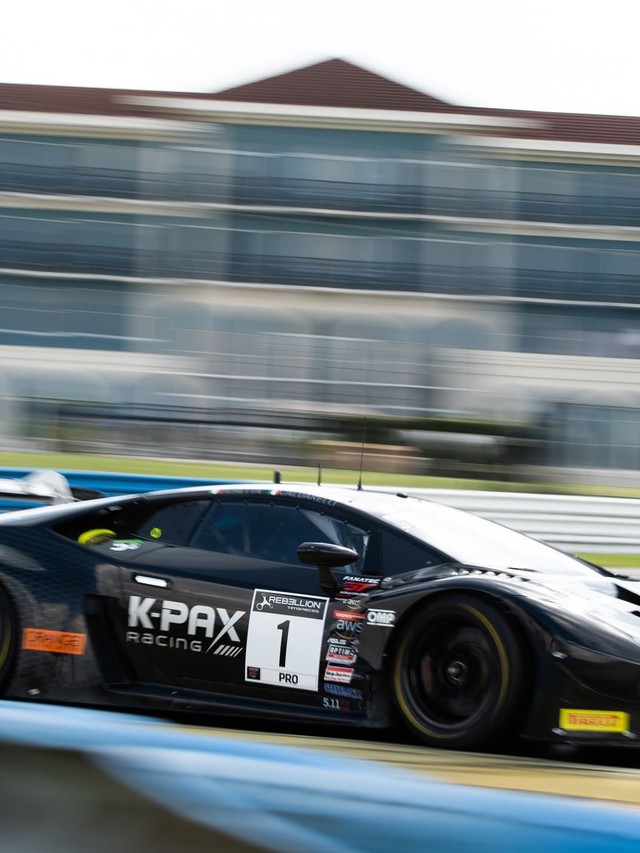
Andrea Caldarelli and Michele Beretta drove their K-Pax Racing Huracán GT3 EVO to two commanding victories at Sebring, wrapping up the Fanatec GT World Challenge America drivers’ and teams’ championships with a full round still remaining on the calendar. The margin in Race 1 tells the story: 25 seconds at the chequered flag, after Beretta put the #1 car on pole by more than five tenths in qualifying. Race 2 required a bolder approach. Caldarelli started third, fought side by side with K-Pax teammate Jordan Pepper through the opening laps, and pulled off a decisive pass around the outside of turn one before handing the car to Beretta for the run home.
Caldarelli entered Sebring with a 47-point cushion in the standings and leaves with exactly 50, a buffer large enough to guarantee the title on wins alone even in a hypothetical tie. K-Pax Racing also locked up its fifth teams’ championship, while Lamborghini earned a second consecutive manufacturer’s title. The sister #3 car of Pepper and Misha Goikhberg contributed a pair of podium finishes across the weekend, reinforcing that this was a team result as much as an individual one. Taken together, the numbers point to something larger than a single strong weekend: they confirm the Huracán GT3 EVO as one of the most successful GT3 platforms of its generation.

The K-PAX Racing Lamborghini Huracán GT3 EVO, number 1, speeds around the track during a race event.
The Huracán GT3 EVO’s Quietly Remarkable Run
The platform delivering this championship deserves as much attention as the result itself. Developed by Lamborghini Squadra Corse in conjunction with Dallara, the Huracán GT3 EVO retains a naturally aspirated 5.2-liter V10 in a GT3 field increasingly populated by turbocharged machinery. Where forced-induction cars rely on Balance of Performance adjustments to manage boost and power delivery, the Huracán’s atmospheric engine offers a more linear, predictable response, a quality that experienced customer teams consistently exploit over a race stint.
K-Pax Racing went unbeaten through 10 regular season rounds spanning a 10-month period. That kind of consistency across different circuits, weather conditions, and BoP windows speaks to a mature platform that Squadra Corse and its partner teams understand deeply. Caldarelli’s 17th victory for K-Pax in the series underscores how thoroughly this driver-car-team combination has been optimized.
The Huracán GT3 EVO’s trophy case extends well beyond North America. Lamborghini says the platform secured IMSA WeatherTech titles, a British GT championship, class wins at the 24 Hours of Spa, and multiple GT World Challenge victories across global series. Few GT3 homologation cars can claim that breadth of success across so many different sanctioning bodies and regulations, and it is precisely this accumulated record that transforms a strong Sebring weekend into a capstone moment.

The K-PAX Racing Lamborghini Huracán GT3 EVO, number 1, navigates a turn on the race circuit.
Caldarelli and Beretta: Factory Talent in a Customer Program
A detail that often gets lost in championship recaps is the role of factory drivers embedded within customer teams. Caldarelli and Beretta are Lamborghini factory drivers, not independent professionals hired by K-Pax on the open market. Their presence reflects Squadra Corse’s deliberate strategy of placing its best talent where it can deliver results, develop the car, and feed data back to Sant’Agata Bolognese.
Caldarelli acknowledged the reciprocal nature of this relationship after Sebring. “I am really happy for the team and all the guys from the workshop in Sant’Agata,” he said. “Another great championship to put in the books, it’s a lot of hard work.” The mention of Sant’Agata’s workshop staff is telling. Factory driver programs function as a two-way engineering pipeline between the race team and the manufacturer, and the consistency of the Huracán GT3 EVO’s results over successive seasons is partly a product of that feedback loop.
For prospective customers considering a Lamborghini GT3 program, this matters. One historical report from 2018 placed the Huracán GT3 EVO’s price at around $430,000, though current costs for a competitive season (spares, engineering support, entry fees, logistics) are substantially higher. What the K-Pax results demonstrate is that the Squadra Corse support structure can genuinely deliver at the championship level, not just provide a turn-key car and a phone number.
Why GT3 Success Matters Beyond the Podium
Lamborghini’s investment in GT3 racing serves a purpose that extends past trophies. Customer racing is the most direct way a manufacturer proves the durability, performance envelope, and engineering integrity of its platform under conditions no road car will ever face. Every weekend that a Huracán GT3 EVO survives multi-hour races in Florida heat, endurance events at Spa, and sprint battles at COTA feeds credibility back into the road car showroom.
What separates Lamborghini’s approach from its competitors is the concentration of results: fewer cars on the grid, but a disproportionate share of championships. That efficiency matters to potential customer teams evaluating where to invest their racing budgets, and it reinforces the broader argument that the Huracán GT3 EVO has punched well above its grid presence throughout its competitive life.

The K-PAX Racing Lamborghini Huracán GT3 EVO, number 1, accelerates down the track.
The Handover Question: From Huracán to Temerario
Every dominant racing platform eventually reaches the end of its competitive lifecycle. Lamborghini’s next GT3 contender will be based on the Temerario, marking a fundamental shift from the naturally aspirated V10 to a twin-turbocharged V8 hybrid architecture. For teams and drivers who built their programs around the Huracán’s linear power delivery and distinctive exhaust note, this transition means adapting to an entirely different powerband, altered weight distribution, and the complexities of managing turbo response in wheel-to-wheel racing.
Lamborghini has not publicly detailed the Temerario GT3‘s development timeline or technical specifications. What the Sebring championship does confirm is that the Huracán platform will exit competitive service with an extraordinary record, one that becomes the benchmark its successor must meet. Squadra Corse carries a deep reservoir of data, team relationships, and operational knowledge into that next chapter. For customer teams weighing their next purchase, the question is straightforward: can the successor replicate this consistency? The Huracán’s final chapters will make that answer easier to judge.
Gallery


