A Clean Sweep at Misano: Huracán GT3 Takes Both Races
Two customer teams, four junior drivers, and a pair of victories that put the Lamborghini Huracán GT3 at the top of the Italian GT Championship standings. That is the short version of what happened at the Misano World Circuit during the second round of the season. The longer version reveals something more interesting: a manufacturer talent pipeline delivering results through independent privateer operations, not a single factory superteam.
Antonelli Motorsport won Race 1 on Saturday through Riccardo Agostini and Daniel Zampieri, who started fourth on the grid and worked their way past the BMW M6 GT3 of Comandini and Cerqui. A second Antonelli Huracán GT3, piloted by Lamborghini Young Drivers Alain Valente and Lorenzo Veglia, completed the podium. On Sunday, Ombra Racing’s Alex Frassineti put his car on pole in Saturday morning qualifying, led from the start through the pit window, and handed the car to Michele Beretta, who managed the gap to the checkered flag ahead of the Scuderia Baldini Ferrari 488 GT3 and the Agostini/Zampieri entry. All four winning drivers belong to the Lamborghini Squadra Corse GT3 Junior Program.
Lamborghini says this represents the Huracán GT3’s first victory of the season in the Italian GT Championship. After strong results earlier in the year across the Blancpain GT Series Sprint and Endurance Cup, the British GT Championship, and the German ADAC GT Masters, the Italian domestic series was the one gap in the car’s 2017 résumé. Misano closed it with a one-two.
Squadra Corse’s Talent Pipeline: What the GT3 Junior Program Actually Does
Most manufacturer junior programs earn a press mention when a young driver wins and then disappear from the conversation. Lamborghini’s GT3 Junior Program deserves closer attention because of what happened at Misano: every driver on the top step across both races came through the same development framework, yet competed for different teams with different strategies.
The program sits within Lamborghini Squadra Corse, the company’s motorsport division. Its purpose is straightforward: identify promising drivers competing in GT3 machinery, embed them with customer teams across multiple championships, and develop them toward potential factory driver status. The selection process uses a coefficient ranking drawn from early-season results across various continental series rather than relying purely on age. Chief instructors from the Scuola Federale ACI Sport assess candidates, with Lamborghini factory drivers serving as regional advisors.
Critically, the program does not concentrate its talent in a single entry. It distributes drivers across customer operations, which means those teams benefit from Squadra Corse’s coaching infrastructure while the drivers gain experience adapting to different engineering cultures and race-day approaches. Agostini and Zampieri competed with Antonelli Motorsport. Frassineti and Beretta raced for Ombra Racing. Different garages, different pit walls, same development backbone.
For context, Daniel Zampieri is noted as a 2014 GT Open champion, which suggests the program draws drivers who already carry meaningful racing credentials rather than simply grooming karting graduates. The blend of proven ability and structured mentorship explains why four Junior Program members locked out the top positions at Misano, and why the results reflect more than individual talent. They reflect a system working as designed.
The Huracán GT3’s Competitive Edge Against Ferrari and BMW
Results tell one story. The cars those results were scored against tell another.
At Misano, the Huracán GT3 beat the BMW M6 GT3 in Race 1 and the Ferrari 488 GT3 in Race 2. Both are serious machinery backed by deep factory resources. Beating both in a single weekend with customer teams rather than a works operation says something about the Huracán GT3’s underlying competitiveness and the quality of support Squadra Corse provides to its privateers.
The Huracán GT3 succeeded the Gallardo FL2 as Lamborghini’s primary GT race car, and it brought a level of professionalism to the brand’s customer racing operation that the Gallardo era never quite achieved. Designed from the outset as a purpose-built GT3 platform with stripped interior, advanced aerodynamics, and an engineering package that privateer teams can run reliably across a full season, the car rewards good preparation without demanding perfection. That reliability factor is easy to overlook in race reports, but it matters enormously to the teams writing the checks.
Customer teams live and die by parts availability, technical support response times, and how forgiving a car is when setup decisions go slightly wrong. Two different Lamborghini customer operations winning on the same weekend, against factory-supported rivals from BMW and Ferrari, validates the platform rather than any single team’s brilliance.

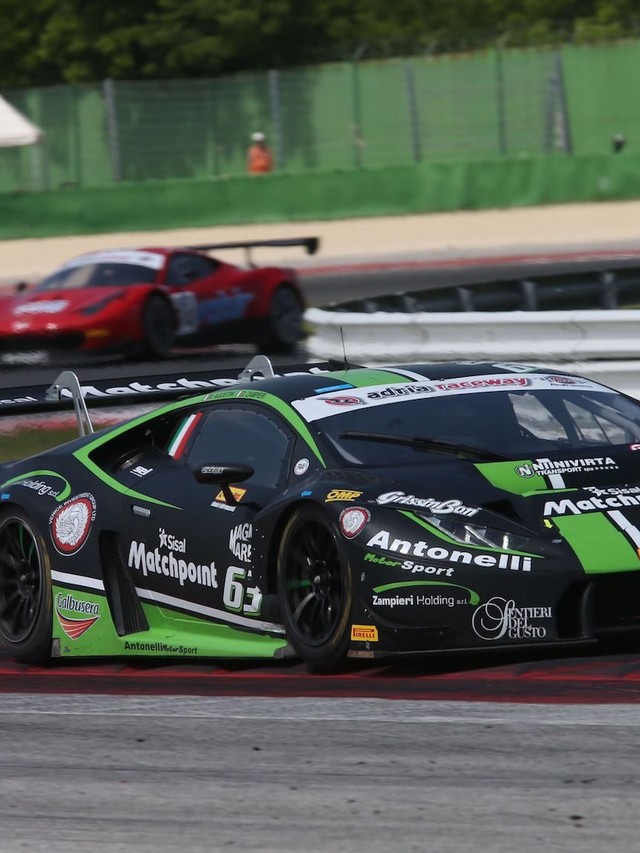
The black and green Lamborghini Huracán GT3 race car takes a corner on the track, with a competitor in the distance.
Antonelli Motorsport and Ombra Racing: The Customer Teams Behind the Wins
Lamborghini’s motorsport strategy depends on customer teams performing at a high level, and Misano showcased two operations that embody different strengths while proving the same point about the Junior Program’s distributed model.
Antonelli Motorsport, founded in 1993, built its reputation through years of Italian and European GT competition. One source notes the team achieved victories in the International GT Sprint Series at Spa and Mugello in 2011, well before its current Lamborghini partnership. Running two Huracán GT3 entries at Misano, with both cars finishing on the podium in Race 1, reflects an operation with genuine depth, one that can prepare and support multiple competitive entries simultaneously.
Ombra Racing’s approach looked different but proved equally effective. Frassineti’s pole position gave the team clean air from the start, and the pit stop strategy executed the driver change without surrendering the lead. Beretta’s stint managing the gap to the finish was clinical rather than dramatic, which is exactly what a well-run customer team wants: wins that look controlled, not desperate.
The broader significance ties back to the Junior Program’s philosophy. Distributing competitive machinery and developing talent across multiple independent operations creates a wider base of success. When both Antonelli and Ombra win on the same weekend with program drivers, it confirms that the system produces results regardless of which team runs the car.
Championship Implications: Who Leads and What Comes Next
Frassineti and Beretta of Ombra Racing now lead the Super GT3 class standings with 54 points. Agostini and Zampieri of Antonelli Motorsport sit second with 47 points. Both pairings are Lamborghini Junior Program drivers, which means Squadra Corse’s development framework controls the top two positions in the championship.
The next round at Monza on June 16 to 18 carries significant weight. Monza’s high-speed character rewards a different set of aerodynamic and powertrain characteristics than Misano’s tighter layout, and it will test whether the Huracán GT3’s advantage translates across circuit types. A strong result there would move the conversation from “good weekend” to “championship favorite.”
The practical takeaway for anyone following the Italian GT series is that the Huracán GT3 is not just winning races. It is winning with the next generation of drivers the brand is actively developing, using customer teams as the delivery mechanism. That combination of competitive hardware, structured talent development, and empowered privateer operations is what separates a manufacturer with a racing program from a manufacturer with a racing strategy.
What Misano Means for Lamborghini’s GT Racing Future
The Huracán GT3’s success at Misano gains additional significance when viewed against the car’s broader arc. According to Road & Track, the Huracán GT3 served as Lamborghini’s primary GT3 platform for a full decade, during which eleven other manufacturers introduced entirely new GT3 cars. Lamborghini updated the Huracán through successive EVO iterations rather than starting from scratch, and results like Misano demonstrate that the fundamental engineering held up against newer designs from rival brands.
The eventual successor, the Temerario GT3, represents a clean-sheet approach. Car and Driver reports it will be the first race car entirely designed and developed at Lamborghini’s Sant’Agata Bolognese facility, using a modified version of the Temerario’s twin-turbocharged V8 without the road car’s hybrid system. That transition from naturally aspirated V10 to twin-turbo V8 will reshape how Lamborghini customer teams approach setup, driver coaching, and race strategy.
The talent pipeline built through weekends like Misano will matter just as much as the new hardware. Drivers who learned their craft in the Huracán GT3, developed through the Junior Program, and won championships with customer teams are the same drivers who will validate the Temerario GT3 in its critical early seasons. Lamborghini’s investment in people, not just cars, is what makes results like Misano more than a race report. The foundation being laid at circuits like this is the one the Temerario GT3 program will inherit.
Gallery


