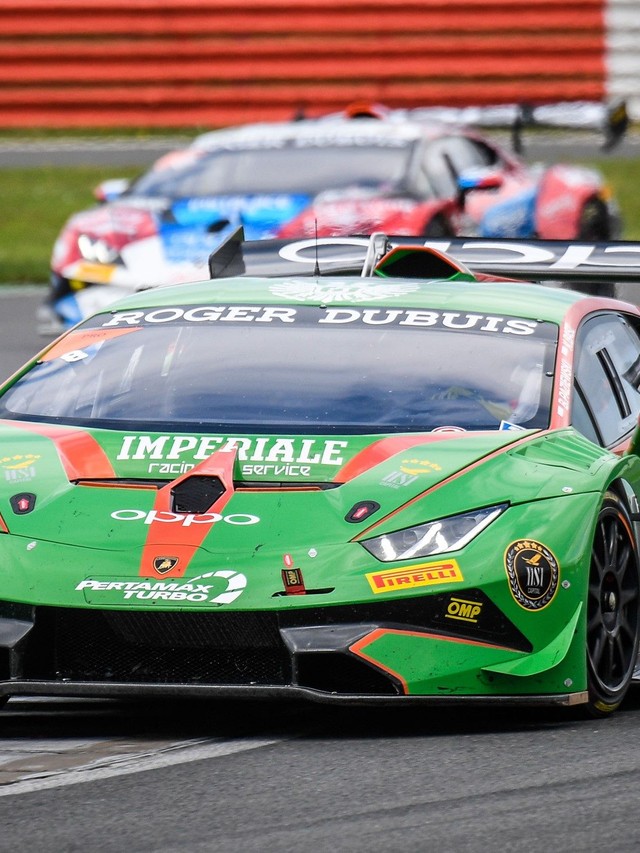
Imperiale Racing Locks Out the Silverstone Podium
Karol Basz and Bartosz Paziewski secured victory in the second Lamborghini Super Trofeo Europe race at Silverstone on May 12, 2019, leading an Imperiale Racing one-two that doubled as a redemption story. The Polish pairing lost a near-certain win in Race 1 to final-lap contact, so the commanding performance in Race 2 felt less like routine dominance and more like a team proving a point.
Basz launched from pole and built a comfortable margin in the opening stint. After the mandatory driver swap, Paziewski took over with more than ten seconds in hand over teammate Vito Postiglione in the #44 car. Postiglione, though, mounted a remarkable late charge, carving that gap down to just 1.5 seconds entering the final tour. He ran out of tarmac rather than pace, settling for second. The #32 Bonaldi Motorsport Huracán of Stuart Middleton and Jack Bartholomew, winners of Race 1, completed the podium in third.
The drama extended well beyond the Pro class. Alberto di Folco ran a strong second in the opening stint for Target Racing SRL, but his co-driver Davide Venditti spun at Chapel on his first out-lap after the pit stop and tumbled to sixth. The pair still recovered enough to claim Pro-Am class honors with a fifth-place overall finish. Nicolas Gomar prevailed in the Am class after a multi-car scrap involving five cars battling for position through the middle of the field. Belgian siblings Benoit and François Semoulin repeated their Race 1 form to win the Lamborghini Cup class, leading home triple LC champion Gerhard van der Horst.
What a One-Make Victory Actually Tells You
Single-make race results can look deceptively simple on paper. Every car runs the same naturally aspirated 5.2-liter V10 producing 620 horsepower. Every car sits on the same Hankook rubber. Every car weighs 1,270 kg dry. When the machinery is equalized this aggressively, a one-two finish reveals something specific about team preparation, pit-stop execution, and driver quality rather than about who brought the biggest checkbook.
Imperiale Racing’s Silverstone sweep illustrates this precisely. Postiglione’s closing charge, recovering over eight seconds in the second stint, points to superior tire management and a driver willing to push through the entire stint rather than protect a position. Venditti’s spin at Chapel, by contrast, shows how thin the margins become when a cold set of tires meets a driver still adjusting to a car mid-race. The mandatory driver-change format, with its 50-minute race window and minimum pit-stop times, rewards teams that prepare both drivers equally rather than loading all their talent into one seat.
For Lamborghini, the competitive depth of the grid validates the format. When a Pro-Am crew can run inside the top five overall and an Am class battle involves five cars fighting for a single position, the series is doing what customer racing programs are supposed to do: keep the racing close enough that every class feels consequential. That closeness, in turn, is what makes the Huracán Super Trofeo more than a spec-racing curiosity. It is the proving ground where Lamborghini’s performance identity gets tested by the people who actually buy the cars.

A green Lamborghini Huracán GT3 race car with orange accents speeds around a track, leading another competitor in the background.
The Huracán Super Trofeo as a Racing Instrument
The car itself deserves scrutiny, because it represents a philosophy Lamborghini committed to for over a decade. Derived from the road-going LP610-4, the Huracán Super Trofeo undergoes an extensive conversion. According to one source, the race car sheds 335 pounds compared to its street-legal counterpart, arriving at that 1,270 kg dry weight through a combination of stripped interior, polycarbonate windows, and purpose-built bodywork. The resulting weight-to-power ratio lands at 2.05 kg per horsepower, a figure that keeps the car competitive against other single-make series machines without requiring exotic engine modifications.
One detail that separates the Super Trofeo from the road car is the rear-wheel-drive configuration. While the street Huracán sends power to all four wheels, the race car channels all 620 horsepower exclusively to the rear axle through a 6-speed sequential gearbox electrically actuated by Marelli. Squadra Corse made this choice deliberately. Rear-wheel drive demands more from the driver in terms of throttle modulation, corner-exit discipline, and wet-weather adaptability. For gentlemen drivers working their way up through the Am and Lamborghini Cup classes, it provides a crash course (sometimes literally) in car control that directly translates to higher-level GT racing.
The electronics package reflects this educational mission. Racing ABS with 12 adjustable positions, 9-position traction control, and adjustable brake bias all run through a MOTEC M182 engine management system. Drivers can progressively reduce the electronic safety net as their confidence grows, which is exactly the kind of graduated learning environment that keeps paying customers coming back season after season. Postiglione’s ability to extract those final tenths at Silverstone, closing an eight-second gap while managing tire degradation, is the product of a car designed to reward skill rather than mask its absence.
Super Trofeo’s Place in the Customer Racing Landscape
Lamborghini launched the Super Trofeo series in 2009, and the European championship alone saw over 700 drivers compete across 22 different circuits in its first decade. The series now spans three continental championships covering Europe, North America, and Asia, with a World Finals event that brings regional champions together for a global showdown.
This scale matters. Ferrari and Porsche both operate single-make series with similar structures, but the competitive dynamics differ. Lamborghini serves as the exclusive constructor for every car on the Super Trofeo grid, meaning Squadra Corse controls the engineering, the parts supply, and the technical support infrastructure. For teams like Imperiale Racing and Bonaldi Motorsport, this creates a direct relationship with the factory that extends beyond race weekends.
The four-class structure (Pro, ProAm, Am, and LB Cup) accommodates everyone from aspiring professional racers to enthusiast owners who want competitive wheel-to-wheel action without being thrown in against full-time professionals. Each 50-minute race includes a mandatory pit-stop window, and minimum stop times (63 seconds for single-driver entries, 60 for two-driver cars) ensure that strategy stays relevant without turning races into pit-lane chess matches.
For prospective participants, the unanswered question is always cost. Lamborghini does not publish a comprehensive budget figure for a full Super Trofeo season, and the total outlay depends heavily on the team, the number of rounds entered, travel logistics, and crash damage. What the series structure does confirm is that Lamborghini provides the car, the tires through its Hankook partnership, and a significant technical support framework, reducing some of the variables that make other customer racing programs unpredictable in cost.
From Track to Showroom: What Racing Proves for Road Cars
The connection between Super Trofeo racing and Lamborghini’s road car lineup is more tangible than the usual marketing claim of “race-bred technology.” The Huracán STO, one of the most celebrated driver’s cars Lamborghini produced, borrowed directly from the Super Trofeo and GT3 programs in its aerodynamic development, cooling architecture, and rear-wheel-drive calibration. When Lamborghini engineers needed to validate a new brake duct design or refine the behavior of the rear differential under sustained high-load cornering, the Super Trofeo grid provided hundreds of hours of real-world data across dozens of circuits and climate conditions.
This pipeline works in both directions. Road car development informs the race car’s baseline architecture, and race car feedback shapes the calibration of performance-oriented road models. The hybrid carbon-aluminum frame construction used in the Super Trofeo, for instance, reflects the same structural philosophy that underpins the road car’s chassis, refined through the specific demands of sustained racing loads.
The practical takeaway for buyers considering a Huracán STO or its successors: the car’s behavior at the limit was shaped by thousands of competitive laps driven by hundreds of customers, not just by factory test drivers on a closed proving ground. That breadth of real-world validation is something few manufacturers can match at this scale, and it is the reason a result like Imperiale Racing’s Silverstone sweep carries meaning beyond the trophy cabinet. Every lap Postiglione used to close that gap fed data back into a development loop that ultimately touches the cars in Lamborghini showrooms.
The Temerario Transition and the Huracán’s Final Chapter
Lamborghini’s all-new Temerario Super Trofeo will replace the Huracán in the series starting in 2027, with approximately 100 new race cars being built for the simultaneous introduction across all three continental championships. The transition marks the end of the naturally aspirated V10’s reign in Lamborghini’s customer racing program, a shift that will redefine the sensory character of the series as fundamentally as the move from the Gallardo to the Huracán did years ago.
According to Autoblog, the Temerario GT3 debuted at the 2025 Goodwood Festival of Speed as Lamborghini’s first competition car to be fully designed, developed, and built entirely in-house. That distinction matters. Previous Lamborghini GT3 cars were developed in partnership with external racing specialists, and bringing the entire process under the Squadra Corse roof signals a deeper commitment to controlling the engineering narrative from concept through competition.
For current Super Trofeo participants and Huracán owners, the 2027 timeline creates an interesting window. The Huracán Super Trofeo Evo2, now in its fifth season of competition according to one report, will complete its competitive life as one of the last naturally aspirated single-make race cars in production. Autoblog noted that a low-mileage Huracán Super Trofeo EVO appeared on Bring a Trailer, highlighting the growing collector interest in these cars as the V10 era closes. Forum discussion among Lamborghini enthusiasts reflects similar sentiment: the Super Trofeo Stradale variants and race-spec cars are increasingly viewed as tangible artifacts of a naturally aspirated era that will not return.
The Silverstone result from 2019 captures a moment in that arc. Imperiale Racing’s performance, Postiglione’s relentless charge, and the multi-class battles across the field demonstrate what the Huracán Super Trofeo program was built to deliver. Whether the Temerario can replicate that raw, screaming V10 character with a twin-turbo V8 remains the open question that will define the next chapter of Lamborghini’s customer racing story. What Silverstone proved, and what the broader Super Trofeo program continues to prove, is that Lamborghini’s commitment to putting paying customers into competitive, well-supported race cars generates both brand loyalty and genuine on-track spectacle.


