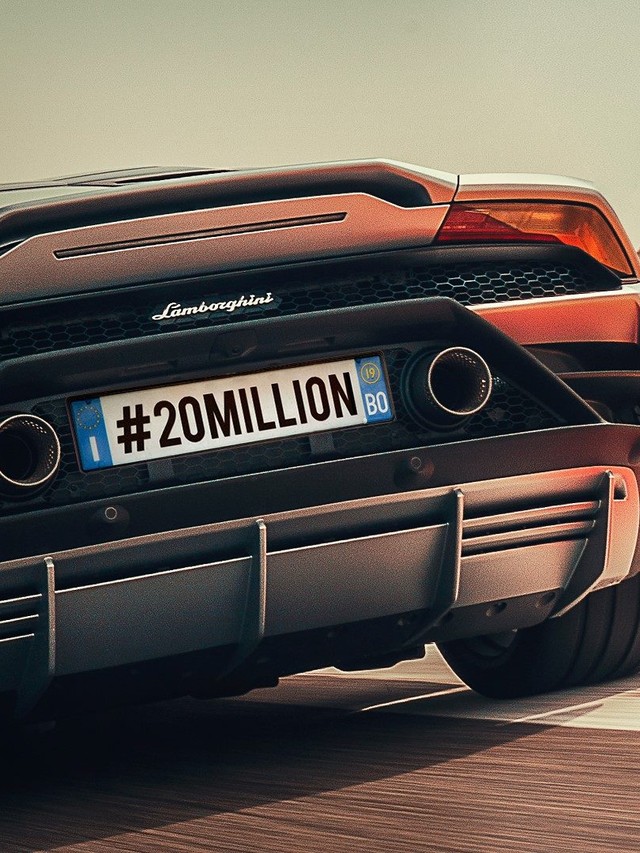
Twenty Million Followers and a Huracán With a Very Special Plate
On June 10, 2019, Lamborghini celebrated 20 million Instagram followers the way only Sant’Agata Bolognese could: by putting a Huracán EVO on display with a custom license plate reading #20MILLION. Chairman and CEO Stefano Domenicali recorded a personal greeting posted to LinkedIn and Twitter, photographed alongside both the Aventador SVJ and the Huracán EVO. The real party, though, played out on Instagram itself.
The brand created a dedicated post for enthusiasts featuring that license-plated Huracán, then followed it with interactive Instagram Stories. Followers could receive a hashtag-free version of the car’s rear image, type their own name onto the plate, and share the result across their personal channels. The mechanic was simple, but the psychology was sharp: Lamborghini gave 20 million people the chance to briefly own a piece of the brand, even if only in pixel form.
The account had launched in May 2012. Reaching 20 million in under seven years meant Lamborghini averaged over three million new followers per year, a growth rate few automakers of any segment could match at the time. For a company that builds roughly 10,000 cars annually, the ratio of followers to actual customers is staggering. That imbalance, far from being a problem, is precisely the point, and it reveals a deliberate strategy that turned a follower count into something far more valuable than a vanity metric.
Selling the Dream, Not the Car
Most luxury brands face a fundamental tension on social media: the product is exclusive, the audience is not. A company that builds cars costing several hundred thousand dollars each cannot realistically convert 20 million followers into buyers. Lamborghini understood this early and leaned into it rather than fighting the math.
The brand’s Instagram feed functions less as a showroom and more as a visual magazine, blending race footage, factory glimpses, design close-ups, and lifestyle imagery into a stream that rewards scrolling without demanding a purchase. Lamborghini says the account conveys the brand’s DNA, which is corporate language for a real insight: the company treats Instagram as a place to build emotional equity rather than generate leads. The license plate stunt reinforces this perfectly. Letting followers personalize a Huracán image costs nothing to produce, but it turns passive viewers into active participants who then broadcast Lamborghini’s identity on their own feeds.
For actual owners and prospective buyers, this digital community serves a different purpose. Enthusiast forums, including Lamborghini-Talk, show that owners frequently reference social media as part of the ownership experience, whether sharing their own cars on Instagram or following official content for first looks at new models and liveries. The 20 million milestone reflects a layered audience: a small core of owners and serious buyers surrounded by a vast ring of aspirational followers whose attention keeps the brand culturally relevant in ways that traditional advertising cannot replicate. Every layer reinforces the next, and the whole structure rests on a single conviction: that desirability, not sales conversion, is the currency that matters most on social media.
Why the CEO Showed Up Personally
Stefano Domenicali’s direct involvement in the celebration deserves a closer look. In 2019, it was still uncommon for a CEO of a major automotive brand to personally front a social media milestone. Domenicali posed with the cars, recorded a greeting, and distributed it across his own professional channels. The gesture signaled that Lamborghini’s digital strategy carried executive-level weight, not just marketing department enthusiasm.
That willingness to treat a follower count as worthy of the chairman’s time foreshadowed a broader shift in how luxury automakers communicate. Within a few years, CEO-led digital moments became standard practice across the industry, from product reveals streamed on social platforms to executives engaging directly with fan communities. Lamborghini was early to a tactic that competitors adopted later, and the 20 million celebration served as a quiet proof of concept.
The choice of cars flanking Domenicali also told a story about the brand’s range. The Aventador SVJ represented the pinnacle of Lamborghini’s naturally aspirated V12 lineage, while the Huracán EVO showcased the more accessible (relatively speaking) V10 supercar with updated connectivity and driving dynamics. Together, they framed the full breadth of engineering that the Instagram audience was following, a visual shorthand that reinforced the same thesis: Lamborghini’s digital presence existed to project the totality of the brand, not to spotlight a single product.
Lamborghini vs. the Supercar Grid on Social Media
Context matters when evaluating a number like 20 million. In mid-2019, Lamborghini’s Instagram following placed it among the most-followed automotive brands on the platform, competing with manufacturers that produce far more vehicles annually.
Ferrari, the perennial rival, maintained a strong Instagram presence of its own, but the two brands deployed noticeably different strategies. Ferrari’s feed leaned heavily on motorsport heritage and Formula 1 content, drawing from a racing pedigree that predates the road car business. Lamborghini, lacking a comparable F1 history, built its feed around the cars themselves, their design language, and the lifestyle they represent. McLaren’s social content skewed technical, emphasizing carbon fiber construction and aerodynamic detail to appeal to a more engineering-focused audience. Porsche, with a far broader model range, split its attention across everything from the 911 to the Cayenne, diluting the aspirational concentration that Lamborghini maintained by focusing almost exclusively on supercars and the occasional Urus.
Lamborghini’s advantage in this landscape was clarity of message. Every post reinforced the same identity: angular, aggressive, loud, unapologetic. Followers knew exactly what they were getting, and that consistency translated into engagement rates that outperformed what a simple follower count would suggest. A Lamborghini post looked like a Lamborghini post, whether it featured a factory walkthrough or a sunset canyon drive. The brand never needed to explain itself or pivot between product categories, and that discipline is what separated a large following from a genuinely powerful one.
One source reports that Lamborghini’s following now exceeds 36.5 million, nearly doubling the 2019 figure. The trajectory suggests that the strategy established during the Domenicali era, and the habits built around milestones like this one, created a compounding effect that continued well beyond the original celebration.
What Digital Reach Actually Means for Owners and Buyers
The practical question for LamboCars readers is whether any of this digital noise translates into something tangible for the people who actually buy these cars. Lamborghini has not publicly quantified a direct link between Instagram followers and showroom traffic. What the company’s record sales years throughout the late 2010s and early 2020s do confirm is that brand heat and commercial performance moved in the same direction during this period.
For current owners, the massive follower base creates a secondary benefit: residual value support. A brand that stays culturally visible tends to hold its desirability in the used market. When millions of people engage with Lamborghini content daily, the cars remain objects of desire rather than fading into the background noise of the luxury segment. Collectors and speculators pay attention to cultural relevance, not just production numbers.
For prospective buyers, the digital community functions as an informal research tool. Instagram comments, Stories interactions, and the broader social ecosystem around the brand provide a window into ownership culture before anyone signs a purchase agreement. Enthusiast discussion on platforms like Lamborghini-Talk and Reddit reflects a community that actively debates whether social media exposure enhances or cheapens the ownership experience. Some owners embrace the visibility, using their cars as content platforms. Others prefer discretion. The split itself reveals something healthy: Lamborghini’s audience is large enough to contain genuinely different philosophies about what it means to own one of these cars.
Viewed from a few years’ distance, the 20 million milestone marked the moment when Lamborghini’s digital audience became too large to dismiss as a vanity metric. It represented a strategic asset: a global community of brand advocates who amplify every launch, every livery, and every limited edition without Lamborghini spending a cent on traditional advertising to reach them. The interactive license plate gimmick was a small, clever gesture. The infrastructure behind it, seven years of consistent visual storytelling from Sant’Agata Bolognese, was the real achievement.
Gallery


