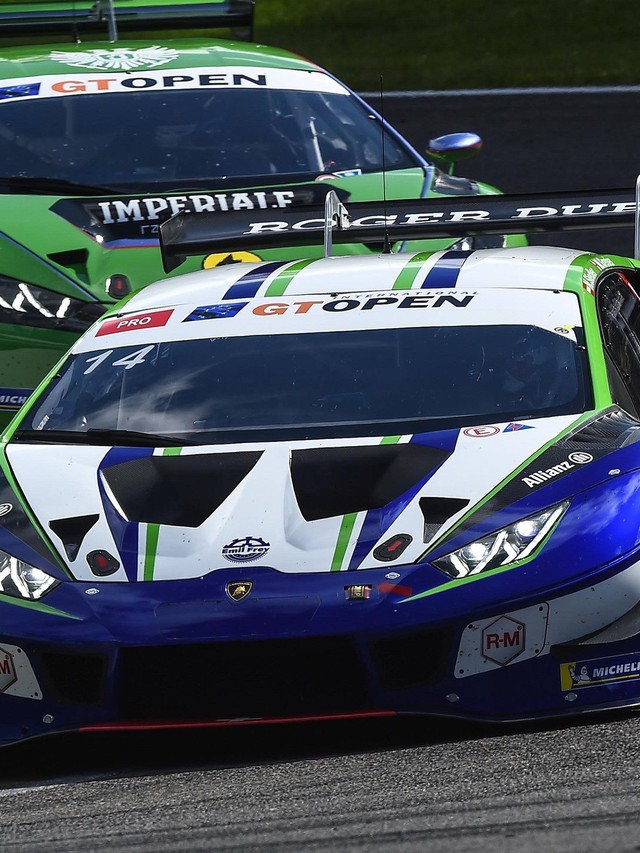
Fifth After the Pit Stop, First at the Checkered Flag
Norbert Siedler climbed out of the #14 Emil Frey Racing Lamborghini Huracán GT3 EVO at Spa-Francorchamps carrying a 15-second success penalty, a soaking wet visor, and a victory that should not have been mathematically possible. Siedler rejoined the race in fifth place after the mandatory driver swap from Mikael Grenier, the penalty swallowing the advantage Grenier had built by climbing from third on the grid to second before pitting. What followed over the next 30-odd minutes was one of the most clinical comeback drives the International GT Open produced in 2019.
Siedler was lapping significantly faster than the cars ahead, closing gaps that the 15-second handicap was designed to make permanent. He moved to third, then to second with just 16 minutes left on the clock. Ahead of him, the Imperiale Racing Lamborghini #34 of Adrian Amstutz and the Mercedes of Miguel Ramos were contesting the lead. Siedler dispatched Amstutz on the approach to Pouhon, then watched Ramos run deep at La Source, a mistake that handed the Austrian the lead. He opened a three-second gap almost immediately, stretching it past 11 seconds before the Ardennes weather intervened one final time.
Heavy rain returned at Stavelot with four minutes remaining. Siedler held the car together, brought it home, and delivered Emil Frey Racing and Lamborghini their third GT Open victory of the season. Amstutz, meanwhile, brought the #34 Imperiale Racing Huracán GT3 EVO across the line to claim the ProAm class win, giving Lamborghini a double result that the success penalties were explicitly designed to prevent.
Why the Penalty Existed, and Why It Failed
GT Open’s success penalty system works like a handicap in golf: win too much, and the series adds weight to your pit stop to keep the field competitive. Both Emil Frey Racing Lamborghinis, the #14 of Grenier and Siedler and the #63 of Giacomo Altoé, carried a 15-second pit-stop penalty into Spa as a consequence of their dominant performance at Hockenheim. Fifteen seconds is brutal. In GT3 racing, where the entire field can be covered by a handful of seconds per lap, that penalty is often enough to bury a car in the midfield for the rest of the afternoon.
That Siedler erased it through raw pace tells you something important about the Huracán GT3 EVO‘s underlying competitiveness at Spa. The circuit rewards mechanical grip through high-speed corners like Pouhon and Blanchimont, punishes cars with poor traction out of slow hairpins like La Source, and exposes any aerodynamic weakness on the long Kemmel Straight. Siedler could lap full seconds faster than the cars ahead, according to Lamborghini’s account, suggesting the car was operating in a performance window that the success penalty alone could not neutralize.
One report following the Spa weekend indicated that Grenier and Siedler moved into second place in the championship standings, just one point behind the leaders, while Emil Frey Racing maintained its lead in the team championship. The penalty system was supposed to slow them down. Instead, it produced a better story.
The Engineering That Makes the Comeback Possible
A comeback like Siedler’s does not happen because a driver simply tries harder. It happens because the car underneath allows a driver to exploit tire life, braking stability, and traction in conditions where rivals are managing degradation.
According to one source, the Huracán GT3 is built on a hybrid aluminum and carbon-fiber chassis, with carbon reinforcement concentrated in areas of greatest torsional stress. It shares a carbon-fiber firewall with the road-going Huracán models, a structural element that contributes to overall rigidity without adding weight. The same source reports a near-ideal 48/52 front-to-rear weight distribution derived from the LP580-2 road car on which the GT3 is based.
The 5.2-liter naturally aspirated V10 in GT3 specification runs through a 38mm air restrictor that reportedly limits output to around 530 hp, well below the road car’s 580 hp. That deliberate power reduction was a strategic choice. Lamborghini’s then-R&D director, Maurizio Reggiani, explained that the engine was homologated with lower output than the road car to cover the possibility of ballast additions and a smaller air restrictor should the FIA’s Balance of Performance index shift against Lamborghini. The engine was designed for durability under sustained racing loads, with strengthened crankshaft bearings and solid engine mounts replacing the road car’s rubber items. Under racing conditions, the engine is reported to manage approximately 10,000 km between rebuilds, a figure that matters enormously to customer teams managing budgets across a full season.
A Bosch MS6.4 ECU handles traction control, shift logic, TFT display management, and data logging, while a configurable Cosworth Powerbox manages the custom-built electrical system. For customer teams like Emil Frey Racing, this integrated electronics package is the difference between a car that only a factory squad can exploit and one that a well-funded privateer can also extract performance from. The Huracán GT3 EVO was designed to be a weapon that did not require a factory pit wall to win.
Lamborghini vs. Mercedes at La Source: A Competitive Snapshot
The race’s decisive moment came when Miguel Ramos, leading in his Mercedes, ran too deep into La Source and handed the position to Siedler. That mistake was not random. La Source is a tight right-hander at the end of Spa’s pit straight, and under mixed conditions with rain arriving in waves, the braking zone becomes a judgment call that changes lap by lap. Siedler, already carrying more momentum through the middle sector, was close enough to capitalize instantly.
This matters in the broader GT3 landscape because the Mercedes-AMG GT3 was one of the Huracán’s primary rivals across every major series during this period. Both cars competed under Balance of Performance regulations designed to equalize their very different engineering philosophies: Mercedes with its front-engine, twin-turbo V8 layout, Lamborghini with a mid-engine, naturally aspirated V10. BoP can equalize straight-line speed and approximate lap times, but it cannot equalize a car’s behavior on the limit in changing conditions. That is where chassis balance, driver confidence, and tire management separate the field.
The Huracán GT3 EVO’s mid-engine layout gives it a natural advantage in rear traction out of slow corners, precisely the kind of grip that matters most when a wet track is drying unevenly. Siedler’s ability to close gaps so rapidly in the second stint, while the Mercedes ahead struggled to maintain its advantage, illustrated a car working with its driver rather than against him.
What Spa 2019 Tells Us About Lamborghini’s Racing DNA
By mid-2019, the Huracán GT3 platform was already four years old, and Lamborghini was winning with an evolution of a car that competitors had been studying since 2015. That longevity is a statement in itself. Porsche cycled through multiple GT3 platforms in a similar timeframe, and Ferrari updated its 488 GT3 aggressively to stay competitive. Lamborghini’s approach with the Huracán was different: build a fundamentally sound car, evolve it carefully, and let customer teams develop the operational knowledge to extract everything from it.
Emil Frey Racing’s Spa victory was a product of that philosophy. The team knew the car’s limits intimately, trusted its durability under penalty conditions, and had a driver pairing in Grenier and Siedler who could split the race’s demands perfectly. Grenier qualified well and gained a position before pitting. Siedler attacked from behind. The car allowed both approaches.
For anyone following Lamborghini’s current motorsport trajectory, the Huracán GT3’s decade of competitive service provides important context. Car and Driver reported that the Temerario GT3, revealed at the 2025 Goodwood Festival of Speed, is the first race car entirely designed and developed at Lamborghini’s Sant’Agata Bolognese facility. Road & Track noted that while Lamborghini stuck with updated versions of the same basic Huracán platform for a full decade, Porsche alone released three entirely new GT3 cars in the same period. The Temerario GT3 replaces the naturally aspirated V10 with a twin-turbo V8 and drops the hybrid system from the road car, a significant philosophical shift that will test whether Lamborghini’s customer racing success can transfer to an entirely new powertrain architecture.
The practical takeaway for anyone invested in Lamborghini’s customer racing program: the Huracán GT3 EVO proved that a well-conceived platform can remain competitive for years beyond its expected shelf life. The Temerario GT3 now carries the burden of matching that record while adapting to turbocharged power delivery, a characteristic that fundamentally changes how drivers manage throttle application in low-grip conditions, exactly the kind of conditions that defined Spa in June 2019.
A Race Worth Remembering
Spa-Francorchamps rewards cars and drivers that can adapt in real time. The safety car start, the shifting rain, the success penalty, and the decisive error by a rival at La Source all compressed into a single hour of racing that demonstrated why the Huracán GT3 EVO earned its reputation as one of the most dependable GT3 platforms of its generation.
Lamborghini confirmed a second-race result of ninth place for Grenier and Siedler, adding more championship points to a campaign building toward a title challenge. The sister #63 car of Altoé, also carrying a 15-second penalty, faced its own struggles across the weekend. But the headline result, a penalty-defying outright victory plus a ProAm class win for the Imperiale Racing Huracán, gave Lamborghini a weekend at Spa that few manufacturers could match under similar handicaps.
For the teams and drivers who built their careers around the Huracán GT3 platform, races like this one are the reason the car earned such fierce loyalty. The V10 screaming through Eau Rouge, the carbon-fiber tub absorbing curb strikes lap after lap, the Bosch ECU managing traction on a surface that changed character every few minutes. The Huracán GT3 EVO was not the newest car on the grid at Spa in 2019. It was simply the one that worked best when nothing else did.
Gallery


