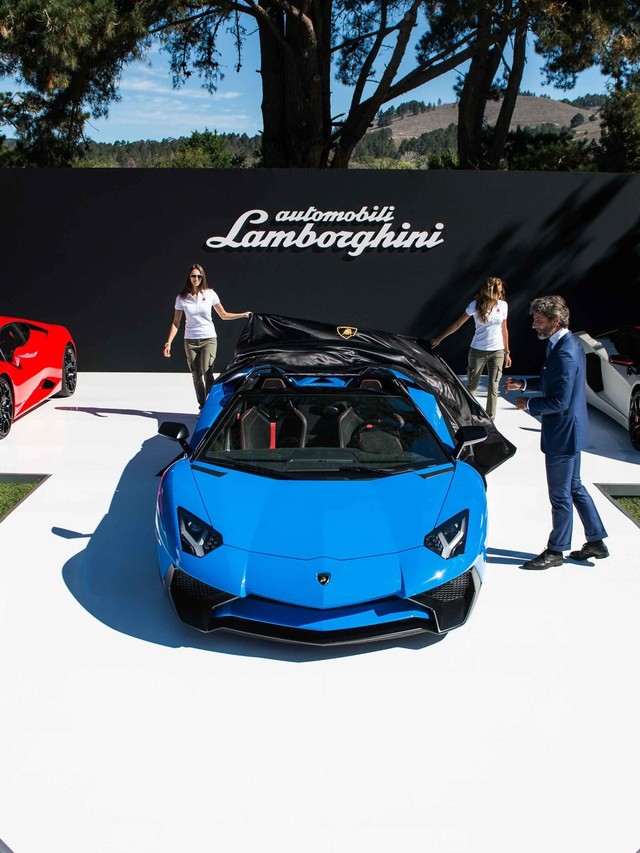
Forty Cars, All Spoken For Before the Covers Came Off
Lamborghini unveiled the Centenario at the 2016 Geneva Motor Show as a centenary tribute to founder Ferruccio Lamborghini, born April 28, 1916, in Renazzo di Cento. All 40 units, split evenly between 20 coupes and 20 roadsters, were already sold before the car was officially revealed. At an original price of 1.75 million euros (roughly $1.9 million at the time), the Centenario arrived pre-collected and instantly positioned at the very top of Lamborghini’s modern hierarchy.
Its purpose was deliberately dual. On one hand, it celebrated the man who decided a tractor magnate could build a better grand tourer than Enzo Ferrari. On the other, it served as a rolling laboratory for technologies Lamborghini intended to push into future production models. That second purpose is what elevates the Centenario beyond a commemorative exercise. In hindsight, it was a declaration of engineering intent that reshaped the Aventador line and informed the architecture of the Revuelto.
Ferruccio’s Centenary: Why This Tribute Carried Weight
Lamborghini’s limited-edition strategy differs meaningfully from Ferrari’s more frequent special-series cadence. Where Maranello produces multiple limited variants across overlapping product cycles, Sant’Agata reserves its ultra-exclusive runs for moments of genuine brand significance. The Veneno marked the company’s 50th anniversary. The Sián FKP 37 honored Ferdinand Karl Piëch. The Centenario honored the founder himself, and that distinction gave its engineering team unusual latitude.
Stephan Winkelmann, then Lamborghini’s CEO, described the project as an opportunity for designers and engineers to work beyond the constraints of series production. The framing sounds like standard executive language, but the results suggest it was more than rhetoric. The Centenario introduced features genuinely new to the Lamborghini V12 lineage, and several of them migrated to the Aventador S within a year of the Centenario’s debut. Ferruccio’s centenary gave Sant’Agata both the emotional justification and the commercial cover to experiment aggressively, turning a birthday tribute into a proving ground for the next generation of V12 supercars.
Rear-Wheel Steering: The Innovation That Rewrote the V12 Playbook
Every competitor’s coverage of the Centenario mentions rear-wheel steering. Few explain why it mattered so much for a car built on the Aventador’s platform. The Aventador, for all its drama, was a large, long-wheelbase machine that could feel ponderous in tight corners. Rear-wheel steering addressed that limitation directly.
At low speeds, the rear wheels turn opposite to the fronts, virtually shortening the wheelbase and tightening the turning circle. At higher speeds, they steer in the same direction as the fronts, effectively lengthening the wheelbase for greater stability. One source indicates the system could virtually alter the wheelbase by as much as 1,200 mm depending on speed, a substantial figure for a car of this footprint. It worked in concert with Lamborghini Dynamic Steering and magneto-rheological dampers, adjusting its behavior across the Strada, Sport, and Corsa driving modes.
No Lamborghini V12 had offered rear-wheel steering before. Within roughly a year, the Aventador S arrived with the same core technology adapted for series production. The Revuelto, Lamborghini’s current hybrid V12 flagship, carries a more advanced iteration of the same principle. The Centenario did not just preview the feature; it validated it in a real chassis, at real speeds, for real owners. That validation pipeline, from limited-edition testbed to series-production rollout, is the strategic engine behind Lamborghini’s one-off program and the thread that ties the Centenario to every V12 that has followed.
770 Horsepower and a Carbon Fiber Obsession
Built on the Aventador’s platform, the Centenario extracted 770 hp from its naturally aspirated 6.5-liter V12, making it one of the most powerful engines Lamborghini had produced at that point. The coupe reaches 100 km/h (62 mph) from rest in 2.8 seconds (2.9 seconds for the roadster) and exceeds 350 km/h (217 mph) flat out. A zero-to-300 km/h sprint of 23.5 seconds contextualizes the car’s mid-range pull as much as its outright top speed, while braking from 100 km/h to a standstill requires just 30 meters.
Lamborghini quotes a weight-to-power ratio of 1.97 kg/hp. That figure comes from a full carbon fiber monocoque and body holding dry weight to 1,520 kg (3,351 lbs) for the coupe, rising to 1,570 kg (3,461 lbs) for the roadster. Wet curb weights land at 1,675 kg and 1,725 kg respectively. The aerodynamic package includes an extending rear wing that deploys for additional downforce at high speeds, a feature that would become more sophisticated in later models. One source notes the Centenario also debuted triple exhausts, another first for the brand.
These are not cosmetic details. They represent a design team given permission to explore ideas that would have been filtered out of a normal production cycle. The 7-speed ISR automated manual transmission paired with a mid-engine, all-wheel-drive layout kept the Centenario mechanically recognizable as an Aventador derivative, and signature scissor doors ensured its silhouette was unmistakably Lamborghini even as its surfaces broke new ground. Yet the innovations born here found their way into cars that thousands of buyers, not just 40, would eventually own.
From Centenario to Revuelto: Tracing the Technology Forward
The Centenario’s real contribution to Lamborghini’s story becomes clearest when you follow its innovations through the product timeline. Rear-wheel steering appeared on the Aventador S in 2017, then evolved further for the Revuelto. The aggressive carbon fiber construction philosophy informed the Sián FKP 37 and, eventually, the Revuelto’s carbon fiber front structure. Extending aero elements pioneered on the Centenario found more refined expression in subsequent limited editions.
This pattern is not accidental. The Veneno, the Centenario, the Sián, and now the Fenomeno each introduced specific technologies or design directions that later appeared in series production. Car and Driver describes the Fenomeno as the newest entry in Lamborghini’s “few off” series, following the 2021 Countach LPI 800-4, and built on the Revuelto’s platform with an increased focus on performance. Each limited car tests something, and the lessons filter down.
The Centenario also arrived with a touchscreen infotainment system featuring internet browsing and Apple CarPlay, which sounds unremarkable today but was forward-looking for a Lamborghini V12 in 2016. The Aventador’s interior had long been criticized for lagging behind its performance capabilities, and the Centenario’s connected cabin signaled that Sant’Agata recognized the gap. Current models, from the Revuelto to the Temerario, treat connected infotainment as a baseline expectation, a shift the Centenario quietly helped initiate. In every case, the same logic applies: what debuted in a 40-unit run became standard equipment for the broader lineup.
Collector Reality: What the Centenario Means on the Market Today
Collectors who secured Centenario allocations in 2016 made a sound investment by almost any measure. One source estimates the current market value at approximately $5 million, a significant appreciation from its original 1.75-million-euro price. That trajectory mirrors the broader pattern for Lamborghini’s ultra-limited V12 specials: the Veneno, the Sián, and the Centenario all trade well above their original stickers, rewarding buyers who had the relationship and the capital to secure an allocation.
For prospective collectors watching Lamborghini’s current lineup, the Centenario’s trajectory offers a useful data point. The company continues to produce limited-edition V12 models on the Revuelto platform, and the pattern of pre-sold allocations, technology previews, and strong secondary-market appreciation shows no sign of breaking. Whether Revuelto-based specials will appreciate at the same rate depends on factors no one can predict with certainty, including production volumes, the broader collector market, and the eventual fate of naturally aspirated and hybrid V12 powertrains in a tightening regulatory environment.
What is clear is that Lamborghini’s limited-edition strategy creates a self-reinforcing cycle. Each sold-out run strengthens the brand’s exclusivity narrative, which in turn makes the next allocation more desirable. The Centenario did not invent this playbook, but it executed it with particular precision at a moment when the brand needed to demonstrate that its V12 lineage still commanded the highest tier of collector attention. And because the car also seeded real technology into the production pipeline, its value rests on substance as much as scarcity.
The Centenario’s Lasting Argument
Most automakers build commemorative editions as marketing exercises. Lamborghini built the Centenario as a working prototype disguised in collector’s clothing. The rear-wheel steering that made the Aventador S a more capable car started here. The carbon fiber philosophy that defines the Revuelto’s structure was pushed further here. The connected cabin that current Lamborghini buyers take for granted was first fitted here.
Ferruccio Lamborghini built his company on the conviction that a better car was always possible, that engineering ambition should never defer to convention. The Centenario honored that conviction not with a bronze plaque or a heritage livery, but by doing exactly what Ferruccio would have demanded: making the next car better than the last one. Forty owners received a 770-hp V12 supercar that looked like nothing else on the road. Every Lamborghini buyer since received the technology those 40 cars validated.


