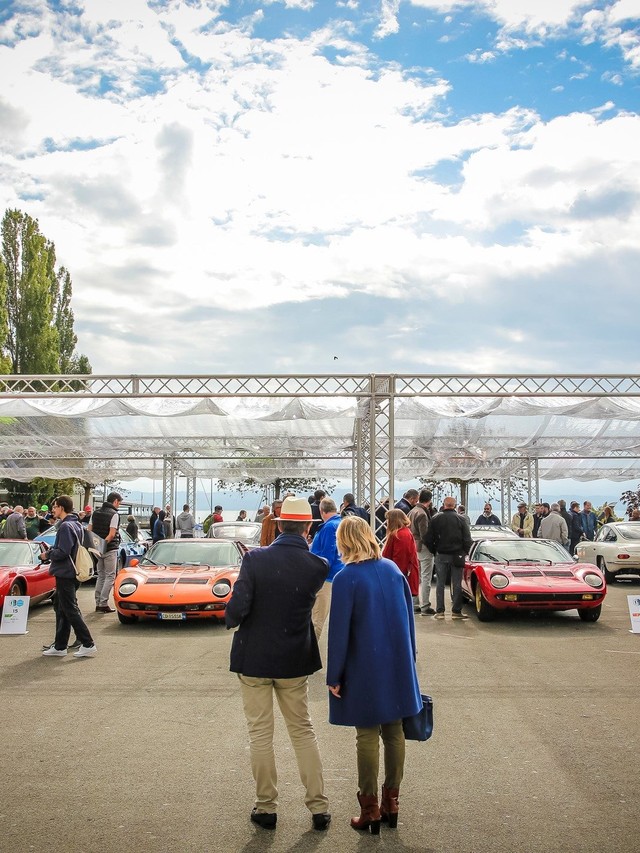
A Strategic Debut on the Shores of Lake Neuchâtel
Fifty Lamborghinis gathered at the Place du Port in Neuchâtel, Switzerland, on September 17, 2017, for the first “Lamborghini & Design” Concours d’Élégance. Organized by the factory’s heritage arm, Polo Storico, the event paid tribute to Charles-Édouard Jeanneret-Gris, the architect and designer better known as Le Corbusier, who was born in nearby La Chaux-de-Fonds. Miuras, Countachs, Espadas, an LM 002, the singular Marzal prototype, and even a Veneno Roadster lined the lakeside promenade while an international jury of design specialists judged entries across eleven categories.
A charming weekend, certainly. But the more interesting question is why Lamborghini chose this particular moment to enter the concours business at all. Fifty-four years into its existence, the company had never staged a branded concours of its own. The timing was not accidental. It involved Ferrari’s long head start in heritage curation, a Swiss watchmaking town steeped in design culture, and a Super SUV still months from its official debut. Each thread ran through Neuchâtel that weekend, and together they reveal the concours as the opening move in a broader campaign to redefine how the world thinks about Lamborghini’s past and future.
The Ferrari Question: Playing Catch-Up or Rewriting the Rules?
Ferrari’s relationship with concours culture stretches back decades. The Classiche program certifies and restores historic Ferraris, and Maranello maintains a commanding presence at events like Pebble Beach, Villa d’Este, and Goodwood. Ferrari leverages that heritage infrastructure to reinforce collector confidence, protect residual values, and keep wealthy owners emotionally tethered to the brand. By any measure, it is a mature and effective strategy.
Lamborghini’s Neuchâtel event marked Polo Storico’s first attempt to create that kind of curated, factory-endorsed heritage showcase. Rather than imitating Ferrari’s approach directly, though, Lamborghini leaned into something different: design as an intellectual discipline, not just a competitive trophy exercise. Choosing Le Corbusier as the event’s spiritual patron and routing participants through his early architectural works framed the weekend as a cultural pilgrimage rather than a parking-lot beauty contest. Whether that distinction resonated with every owner who shipped a car across continents is debatable, but it gave Lamborghini a narrative lane that Ferrari’s heritage events do not occupy.
The strategic implication for collectors and prospective buyers is straightforward. When a manufacturer invests in authenticating, celebrating, and contextualizing its back catalog, it signals long-term commitment to supporting those cars. That commitment tends to stabilize or elevate values over time. Lamborghini entering this arena, even modestly, benefits every owner in the room.
Le Corbusier and the Design Thread
The Le Corbusier connection was more than decorative branding. On Saturday, participants drove their registered cars to La Chaux-de-Fonds for the non-competitive “Tour du Charme et du Design,” visiting two of the architect’s earliest works, Villa Turque and Maison Blanche, along with the Musée International d’Horlogerie. According to Autoweek, Le Corbusier was a lifelong car enthusiast who designed his own vehicle, the “Voiture Minimum,” which was displayed at the concours.
The pairing of a modernist architect with a supercar brand sounds like marketing-department whimsy until you consider how much of Lamborghini’s visual identity rests on architectural principles. Marcello Gandini‘s work on the Miura, Countach, and Marzal treated sheet metal the way Le Corbusier treated concrete: as a medium for geometric purity pushed to its functional limits. The Marzal’s hexagonal glass doors and the Countach’s folded-paper geometry owe more to architectural drafting than to conventional automotive styling of their respective eras. Staging the concours in Le Corbusier’s home region was Lamborghini’s way of claiming that intellectual lineage explicitly, rather than letting it remain the province of design-school lectures. It also sharpened the distinction from Ferrari’s heritage playbook: where Maranello’s events celebrate racing provenance, Neuchâtel celebrated the act of drawing a line that had never been drawn before.
Polo Storico’s Expanding Mandate
Lamborghini Polo Storico, headquartered at Sant’Agata Bolognese, focuses on restoration and certification of authenticity for Lamborghini vehicles out of production for at least ten years, covering everything from the 350 GT through the Diablo. The department also preserves factory archives and supplies original spare parts for classic models.
Organizing a branded concours represented a meaningful expansion of that mandate. Polo Storico moved from being a back-office restoration and parts operation to becoming the public face of Lamborghini’s heritage strategy. Certification programs only matter if collectors trust the institution behind them, and staging an international event with a distinguished jury, presided over by Stefano Pasini and including members such as Alain De Cadenet and Corrado Lo Presto, builds exactly that kind of institutional credibility.
The department’s involvement also served a practical purpose for owners considering restoration work. Seeing factory-authenticated cars judged and awarded by recognized specialists reinforces the value proposition of going through Polo Storico rather than an independent shop. Lamborghini would later continue this concours tradition with subsequent events, suggesting the Neuchâtel debut was not a one-off experiment but the beginning of an ongoing program tied directly to the brand’s larger ambition of standing alongside Ferrari in the heritage arena.
From Miura SV to Marzal: The Cars That Told the Story
The “Best of Show” prize went to a 1971 Miura SV in verde senape, serial number 4838, belonging to a Japanese collector. A Miura SV winning at a design-themed concours is about as surprising as water flowing downhill, but the choice of this particular car underscored the event’s emphasis on originality and condition over sheer rarity.
The more provocative award was “Best of the Best,” reserved by the jury and factory management for the Marzal prototype. Designed by Gandini in 1967, the Marzal famously inaugurated the Monaco Grand Prix that year with Prince Rainier and Princess Grace aboard. As a four-seat, glass-doored concept built on a transverse inline-six layout, it represents a road Lamborghini chose not to take in production, which makes its survival and celebration all the more compelling. The Marzal is the kind of car that reminds enthusiasts how wildly ambitious Sant’Agata’s design ambitions were in the 1960s, and honoring it at a concours themed around architectural vision made the design thesis tangible in a way no speech could.
A separate “Long Distance Driving” award honored a British collector who drove a red 1987 Countach QV some 2,500 kilometers to attend. That detail alone says something about the character of Lamborghini owners: these cars are not all hermetically sealed in climate-controlled garages. Some people still drive them, hard, across international borders, to park them on a Swiss lakefront and let strangers gawk.
Pre-Framing the Urus Within a Heritage Narrative
Stefano Domenicali, then Chairman and CEO of Automobili Lamborghini, used the occasion to connect past and future in terms that were anything but subtle. Lamborghini says Domenicali described the concours as reflecting a brand that looks ahead while appreciating its legendary past, and he specifically cited the upcoming Urus, calling it the realization of the LM 002’s original concept for high-performance SUVs.
This was September 2017. The Urus would not debut until December of that year. Introducing the idea of a Super SUV at a heritage concours, surrounded by Miuras and Countachs, was a deliberate act of narrative construction. Lamborghini wanted collectors and purists to see the Urus not as a departure from the brand’s identity but as a continuation of it, with the LM 002 serving as the historical bridge. The LM 002 was present at Neuchâtel, parked among the mid-engined icons, doing exactly the legitimizing work Lamborghini intended.
Whether that framing convinced skeptics at the time is another matter. The Urus went on to become Lamborghini’s best-selling model by a wide margin, transforming the company’s financial position. Looking back, the Neuchâtel concours reads as an early chapter in that commercial transformation: a moment when Lamborghini began telling a broader story about what the brand could be, using the authority of what it had already built. The concours was never just about polished paint on a Swiss lakefront. It was the opening salvo in a heritage strategy designed to give Lamborghini the same kind of narrative depth that Ferrari had cultivated for decades, timed precisely to prepare the ground for the most consequential product launch in Sant’Agata’s history.
Gallery


