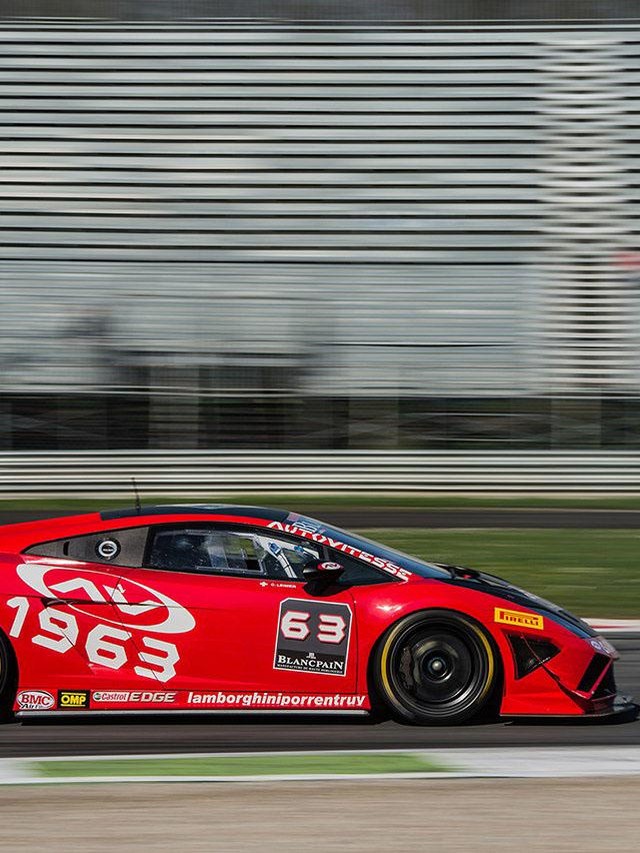
A Three-Point Swing Changes Everything at the Nürburgring
Mikaël Grenier and Loris Spinelli walked into the Nürburgring as contenders and walked out as PRO championship leaders. Their double victory at the fifth and penultimate round of the Lamborghini Super Trofeo Europe, both races won under the Antonelli Motorsport banner, produced the kind of standings upheaval that turns a season finale into appointment viewing.
The swing hinged on a pit-stop infringement. Jonathan Cecotto and Vito Postiglione of Imperiale Racing arrived in Germany atop the PRO standings, but a drive-through penalty for violating the mandatory minimum pit-stop time in Race 2 dropped them to fifth. That single procedural lapse cost the pair the championship lead. Lamborghini says Cecotto and Postiglione now sit three points behind Grenier and Spinelli, with Rik Breukers and Axcil Jefferies of GDL Racing a further four points back in third after their own Race 2 podium.
Race 2 conditions made the results all the more telling. A wet track that gradually dried through the session forced every crew to gamble on tire strategy and driver confidence. Grenier, who noted he had never raced at the Nürburgring before, acknowledged the difficulty:
“Everything was more difficult, also because of the wet/dry asphalt conditions. But eventually, everything went smoothly, my co-driver was perfect as usual and now we have to concentrate on the Imola round, where we will fight for the title.”
With Raphael Abbate and Yuki Nemoto of VS Racing still mathematically alive but trailing by 12 points, the PRO title fight is effectively a two-horse race heading into Imola.
AM Title Sealed, PRO-AM Down to a Single Point
While the PRO class was thrown into chaos, the Nürburgring delivered the season’s first confirmed champion. Andrej Lewandowski and Teodor Myszkowski of VS Racing clinched the AM category title with two races still remaining, a reward for one of the most consistent campaigns in any class this year. Their third-place AM finish in Race 2 was enough to make the math irreversible, especially after Raffaele Giannoni, their closest rival, withdrew from Race 2 following a class victory in Race 1 the day before. The Dörr Motorsport pairing celebrated a home-circuit win in the AM class, while Nicolas Gomar of AGS Event took second.
The PRO-AM picture could hardly be tighter. Kikko Galbiati, reunited with returning co-driver Gianluca Giraudi at Antonelli Motorsport, won the PRO-AM class in Race 2 and trimmed the gap to leaders Christopher Dreyspring and Liang Jiatong (VS Racing) to a single point. Galbiati, who called the car “perfect as usual,” now carries real momentum into the finale. Dreyspring and Liang had won Race 1 and still hold the slimmest of advantages, but Imola will decide everything.
In the Lamborghini Cup, Colombian driver Juan Perez extended a remarkable streak: five consecutive victories, all under the Antonelli Motorsport umbrella. Perez is closing on standings leader Gerard Van der Horst, though Van der Horst and teammate William Van Deyzen (Van der Horst Motorsport) still control the class championship. Perez’s own assessment of his Race 2 performance was characteristically measured:
“It was the first time I’d driven on wet asphalt with dry tires. I was very careful and tried to make no mistakes.”
The Huracán Super Trofeo as a Driver Development Tool
Results like these carry extra weight because of the car that produces them. The Huracán Super Trofeo uses a rear-wheel-drive configuration, a deliberate departure from the all-wheel-drive layout of the road-going Huracán LP610-4 on which it is based. That choice serves a specific purpose: developing the car control and throttle management skills that translate directly into GT3 competition. A driver who can manage oversteer in a 620-horsepower, rear-drive V10 at the Nürburgring in mixed conditions is learning something transferable.
One report indicates the race car sheds roughly 335 pounds compared to its street-legal counterpart, bringing dry weight down to approximately 1,270 kg. The hybrid carbon and aluminum frame, Motec engine management system, and stripped interior all point to a machine calibrated for competitive racing rather than weekend track days. The naturally aspirated 5.2-liter V10, producing 620 horsepower according to available reporting, remains one of the most visceral powerplants in any one-make series.
For Lamborghini, the Super Trofeo functions as a talent pipeline. Drivers who prove themselves here often graduate to GT3 programs, and the engineering lessons feed back into Squadra Corse’s broader competition efforts. The series bridges the gap between enthusiasts who want real wheel-to-wheel racing and the professional ranks, which is exactly the kind of ecosystem that keeps a customer racing program healthy over the long term. Grenier and Spinelli’s Nürburgring performance is a case study: adapting to an unfamiliar circuit in deteriorating conditions, managing a co-driver handoff under pressure, and extracting maximum points when a rival stumbles.
Where Super Trofeo Fits in Lamborghini’s Racing Architecture
The series runs regional championships in Europe, Asia, and North America before converging at an annual World Final, giving the brand a global racing footprint with relatively contained costs for each participating team. That structure also creates a natural marketing cycle: race weekends generate content, build community among owners and aspiring owners, and keep the Huracán name relevant in competition circles even as the road car lineup evolves.
Looking forward, the transition from the Huracán platform to the Temerario generation will eventually reshape this series. According to Autoblog, the Temerario GT3 represents Lamborghini’s first competition car fully designed, developed, and built in-house, a significant shift from the previous arrangement where Dallara handled much of the GT3 engineering. How and when the one-make Super Trofeo series transitions to a Temerario-based car remains unconfirmed, but the direction is clear. The Huracán Super Trofeo is the final chapter of a naturally aspirated, rear-drive racing formula that defined Lamborghini’s customer motorsport identity for nearly a decade.
For teams currently invested in Huracán-based programs, that looming platform change adds an extra layer of strategic calculation. Winning a championship now, with this car, carries a particular significance that future seasons may not replicate. The urgency visible in every class at the Nürburgring reflects that reality.
Imola Will Settle Everything
The final round of the Lamborghini Super Trofeo Europe takes place November 16 and 17 at Imola, and the same weekend hosts the fifth edition of the World Final, where the European, Asian, and North American series converge. That combination turns Imola into the most consequential weekend on Lamborghini’s customer racing calendar.
The PRO championship math is straightforward but unforgiving. Grenier and Spinelli hold a three-point lead over Cecotto and Postiglione, with Breukers and Jefferies lurking close behind. A single bad qualifying session, a penalty, or a mechanical failure could flip the standings again. The PRO-AM gap of one point between Dreyspring/Liang and Galbiati/Giraudi guarantees drama. Only the AM title, already secured by Lewandowski and Myszkowski, is settled.
Perez’s five-race winning streak makes him the form driver in the Lamborghini Cup, but Van der Horst’s points cushion means consistency, not heroics, will likely decide that class.
Imola rewards precision. The circuit’s mix of high-speed sweeps and heavy braking zones will test every team’s setup choices and every driver pairing’s ability to manage tire degradation across a stint. The wet-dry chaos of the Nürburgring rewarded adaptability; Imola, if conditions stay dry, will reward preparation. Three of four class titles remain undecided, the World Final adds global stakes, and the Huracán platform’s days as the series backbone are numbered. Everything that matters converges in November.
Gallery


