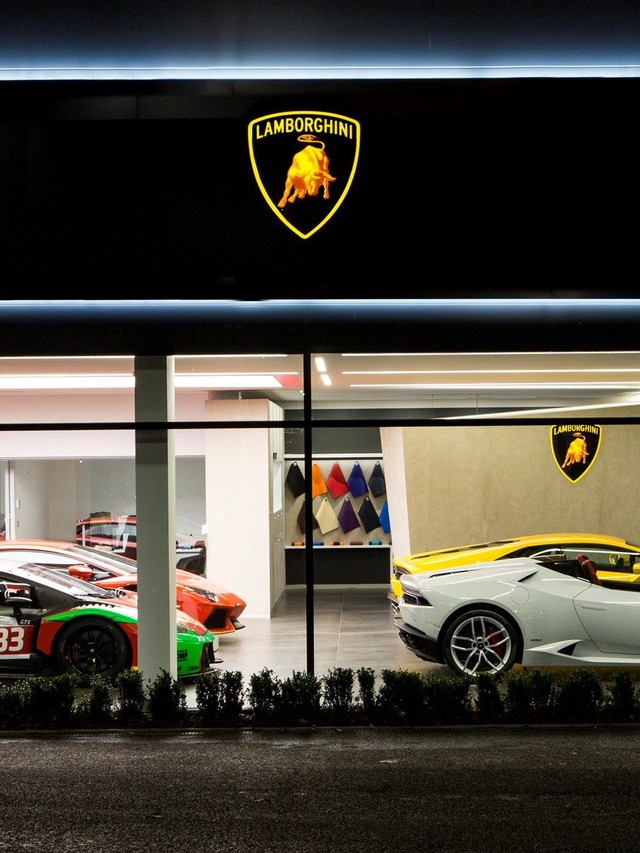
Bristol, September 2016: Lamborghini Rewrites Its Retail Playbook
When Lamborghini opened its eighth UK dealership in Bristol on 22 September 2016, the building itself was not the story. What mattered was what it represented: the first physical expression of a completely new global corporate identity, conceived to accommodate a brand that planned to double its annual sales within two years.
The catalyst was already visible. Lamborghini confirmed the new showroom environment reflected a need for increased space as the company expanded its model lineup and prepared for the launch of its SUV by 2018. At the time, roughly 3,500 cars left Sant’Agata each year, built around two model lines: the Aventador and the Huracan. Adding a third pillar, and an SUV at that, would bring an entirely different customer through the door. Those customers would need a different kind of welcome.
Automobili Lamborghini CEO Stefano Domenicali framed the investment plainly: “Lamborghini and our dealer partners are investing in a bright future.” The new dealership environment, he said, embodied the brand’s philosophies of “Pure, Visionary and Cutting Edge.” Beneath the corporate polish, the logic was sharp. Lamborghini was not simply renovating showrooms. It was building retail infrastructure for a company that intended to become twice as large, and it started the rollout before the SUV even existed as a production vehicle.
Designing for the Urus Buyer Who Didn’t Exist Yet
Consider the problem Lamborghini faced in 2016. The typical Aventador or Huracan buyer already knew what a Lamborghini dealership looked like. The Urus, however, would attract a fundamentally different demographic: younger buyers, more women, families with active lifestyles, and customers crossing over from brands like Porsche, Bentley, and Range Rover. Many of these people had never set foot in a Lamborghini showroom. The space needed to feel unmistakably Lamborghini without feeling alienating.
Bristol introduced several design elements that would propagate globally. Exteriors featured an illuminated Lamborghini shield against a black background, visible at night, alongside a black totem displaying the bull logo. Inside, the design language leaned into polygonal geometry and sharp angles, raw surfaces paired with controlled lighting. Vehicles sat on a white center stage, uplit by LED lights tuned to complement each car’s exterior color. The effect was theatrical without being garish.
More practically, the layout incorporated dedicated Ad Personam areas where clients could physically handle material samples: leathers, stitching patterns, carbon fiber weaves, paint swatches. A digital car configuration system occupied the client lounge. For a brand whose personalization program generates significant margin on every order, giving buyers a tactile, unhurried space to explore options was as much a revenue strategy as a hospitality gesture. Enthusiast forums consistently cite the Ad Personam experience as one of the more memorable parts of the buying process, and Bristol was where Lamborghini first gave that experience a permanent, purpose-built home within the new identity.
The Bet Paid Off: Urus Sales and the Doubling That Actually Happened
Lamborghini said it would double sales by 2018, and the numbers bore that out with force. One source tracking Urus sales figures reports that in 2018, the SUV’s partial launch year, Lamborghini delivered 1,761 units of the Urus alone. By 2019, its first full calendar year, that number climbed to 4,962 units, with the Urus accounting for over 60 percent of total brand deliveries. Even in 2020, amid global disruption, Lamborghini moved 4,391 Urus models.
Those figures validated the Bristol blueprint. A dealership network built around two low-volume supercars could not have absorbed that kind of throughput. The expanded showroom footprints, the customer lounges designed for longer configuration sessions, the service bays sized for a vehicle considerably larger than a Huracan: all of it needed to be in place before the first Urus rolled off the line in Sant’Agata. Lamborghini announced the new corporate design would roll out globally to all new and existing showrooms in the years following the Bristol debut, and the Urus timeline made that rollout urgent rather than aspirational.
What the original announcement did not predict was how far beyond “doubling” the brand would eventually go. By 2025, Lamborghini was posting record deliveries and record revenue, according to Road & Track, with multiple new models planned for 2026. The dealership network that started with Bristol’s redesign now supports a lineup that includes the Revuelto, the Urus SE, and the forthcoming Temerario. The infrastructure Domenicali described in 2016 as preparation for one SUV turned out to be preparation for an entirely different scale of company.
How Lamborghini’s Retail Strategy Compares to Ferrari and Porsche
Lamborghini was not the only luxury brand rethinking its physical retail presence in the mid-2010s, but the timing and motivation were distinct. Ferrari developed its Atelier personalization concept around a similar period, embedding bespoke specification studios within select dealerships. The philosophy overlaps with Ad Personam, though Ferrari’s approach tends toward even more exclusivity, with Atelier access sometimes reserved for clients ordering higher-tier models. Porsche, meanwhile, invested heavily in standalone Experience Centers, purpose-built facilities combining tracks, simulators, and hospitality, a strategy aimed at deepening brand loyalty rather than redesigning the traditional sales environment.
Lamborghini’s approach split the difference. The new corporate identity was designed to scale across every dealership worldwide, not just flagship locations. That mattered because the Urus would be sold in markets where Lamborghini previously maintained minimal presence. A consistent, recognizable environment, from Bristol to Dubai to Dallas, gave the brand visual coherence at a moment when its customer base was about to diversify rapidly.
The inclusion of Accessori Originali displays and Collezione Automobili Lamborghini merchandise near the entrance served a quieter commercial purpose. These touchpoints extended the brand relationship beyond the vehicle purchase itself, a tactic Porsche has executed effectively for decades through its Driver’s Selection program. For Lamborghini, integrating lifestyle merchandise and accessories into the showroom architecture signaled a shift toward thinking about the dealership as a brand environment rather than a transactional space.
What Bristol Tells Us About Lamborghini’s Next Retail Chapter
The 2016 corporate identity was built for a two-supercar-plus-SUV lineup. Lamborghini now sells a V12 hybrid flagship, a twin-turbo V8 mid-engine sports car, and a plug-in hybrid SUV, with limited editions and special series appearing at an accelerating pace. Whether the Bristol-era design language still serves that expanded portfolio is a fair question, and one Lamborghini has not publicly addressed in detail.
Forum discussions on Lamborghini-Talk suggest the dealership experience remains a genuine differentiator for the brand, though quality varies significantly by location. Some owners describe exceptional treatment, including test drives, gifts, and invitations to unveiling events. Others report frustrating service interactions. The consistency that the 2016 redesign aimed to establish across the global network remains a work in progress, as it does for virtually every luxury marque.
The practical takeaway for prospective buyers is straightforward. The showroom you walk into today, with its configuration tools, material samples, and theatrical lighting, traces directly back to a strategic decision made nearly a decade ago, when Lamborghini looked at its future and realized the buildings needed to change before the cars did. That kind of infrastructure planning rarely makes headlines, but it shaped the buying experience that current Revuelto and Urus SE customers encounter. If Lamborghini’s next chapter involves even broader electrification or a potential fourth model line, expect the retail environment to evolve again, likely before the cars themselves arrive.
Gallery


